Classical
Horace
65 BC – 8 BC
Roman lyric poet (65 BC – 8 BC)
- Ancient Rome
- Classical Antiquity
- Literary Theory
About
Quintus Horatius Flaccus, commonly known in the English-speaking world as Horace, was the leading Roman lyric poet during the time of Augustus. The rhetorician Quintilian regarded his Odes as the only Latin lyrics worth reading: "He can be lofty sometimes, yet he is also full of charm and grace, versatile in his figures, and felicitously daring in his choice of words."
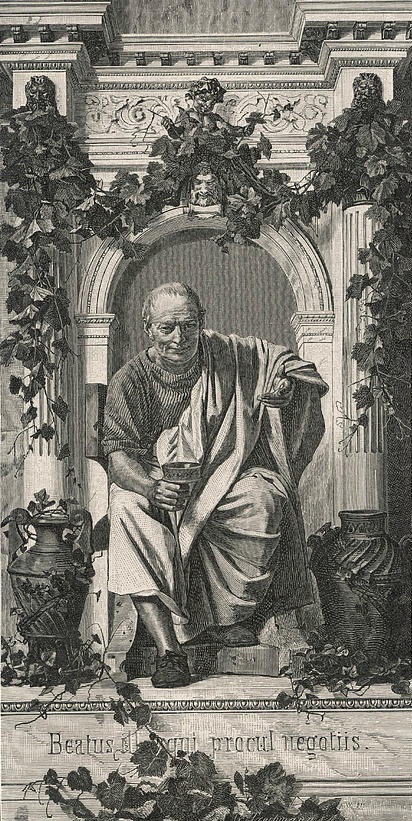
Source: Wikipedia (CC BY-SA). Portrait by Anton von Werner (Public domain) via Wikimedia Commons.
Life on the Timeline
Major Works
Exam Dossier
Most-asked topics
- Horace's life and Augustan patronage (Maecenas)
- Odes: themes of carpe diem, aurea mediocritas (golden mean), Epicurean philosophy
- Ars Poetica and its influence on neoclassical criticism
- Horatian satire vs Juvenalian satire (tone and technique)
- Horace's concept of decorum and 'ut pictura poesis'
- The 'utile et dulce' (instruct and delight) doctrine
- Horace's influence on English poets (Jonson, Pope, Milton)
- Horatian ode form and its adaptation in English poetry
Previous-year themes
- Horace as a classical authority in Renaissance and Neoclassical literary criticism
- The 'instruct and delight' (utile et dulce) principle in Ars Poetica
- Horace's influence on Ben Jonson and the 'Sons of Ben'
- Carpe diem theme traced from Horace's Odes to English lyric poetry
- Horatian satire as a model distinct from Juvenalian satire
- Classical unities and decorum as discussed via Horace
- Horace's reception in Augustan Age English poetry (Pope, Dryden)
Common confusions
- Confusing Horatian satire (gentle, urbane) with Juvenalian satire (bitter, indignant) — these represent the two classical satiric modes.
- Confusing Ars Poetica with Aristotle's Poetics — both are foundational works of literary criticism but from different eras and traditions (Roman vs Greek).
- Mixing up the dates of Odes Books 1-3 (23 BC) with Book 4 (13 BC), published separately years later.
- Confusing Horace's patron Maecenas with Augustus himself — Maecenas was the literary patron; Augustus was the emperor Horace also wrote for (e.g., Carmen Saeculare).
- Attributing 'carpe diem' to the Ars Poetica instead of the Odes.
- Confusing 'ut pictura poesis' (a comparison of poetry to painting) with a call for poetry to be literally pictorial or descriptive only.
Memory tricks
CARPE = Cherish A Rare Present, Enjoy — for 'seize the day' from the Odes.
AUREA MEDIOCRITAS: 'Golden' + 'Mediocre' sounds odd but means the balanced, moderate middle path — think 'gold standard of moderation.'
UTILE ET DULCE: 'Utile' = useful (instruct), 'Dulce' = sweet (delight) — remember 'Useful and Delicious.'
ARS POETICA = 'The Art of Poetry' — Horace's letter to the Pisos, think 'A Recipe for Sound Poetry.'
Horace vs Juvenal: Horace = 'Ha-ha' gentle mockery; Juvenal = 'Judge, harsh and furious.'
MAECENAS = 'My Aid, Encouragement, Cash, Endorsement, Nurturing Arts Support' — patron of Horace, Virgil.