Victorian
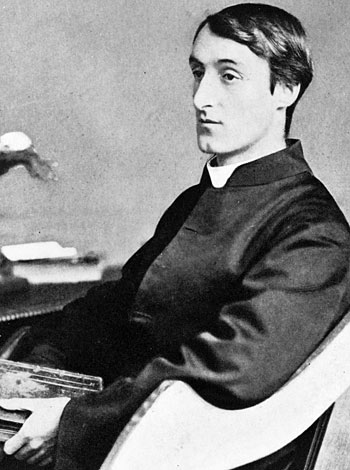
Gerard Manley Hopkins
1844 – 1889
English poet (1844–1889)
- United Kingdom of Great Britain and Ireland · United Kingdom
- British
About
Gerard Manley Hopkins was an English poet and Jesuit priest, whose posthumous fame places him among the leading English poets. His prosody – notably his concept of sprung rhythm – established him as an innovator, as did his praise of God through vivid use of imagery and nature.
Source: Wikipedia (CC BY-SA). Portrait by Unknown authorUnknown author (Public domain) via Wikimedia Commons.
Life on the Timeline
Major Works
Exam Dossier
Most-asked topics
- Sprung rhythm and its distinction from free verse/syllabic metre
- The concepts of inscape and instress
- The Wreck of the Deutschland: context and themes
- God's Grandeur, The Windhover, Pied Beauty: nature and divine praise
- The 'terrible sonnets' of spiritual desolation (1885)
- Hopkins's conversion to Catholicism and Jesuit vocation
- Posthumous publication history via Robert Bridges (1918)
- Hopkins as precursor to Modernist poetry
Previous-year themes
- Hopkins's technical innovations in prosody (sprung rhythm, counterpoint rhythm)
- Hopkins's coinages 'inscape' and 'instress' and their philosophical roots in Duns Scotus
- Religious and devotional character of Hopkins's poetry
- Circumstances and significance of posthumous publication (1918, ed. Bridges)
- Hopkins's place between Victorian poetry and Modernism
- Identification of famous opening lines and their source poems
- Biographical facts: Jesuit vocation, conversion, Dublin professorship
Common confusions
- Confusing 'inscape' (the individual essence or design of a thing) with 'instress' (the energy that conveys and sustains that essence to the perceiver).
- Assuming Hopkins published his poems during his lifetime — almost all appeared posthumously in the 1918 edition prepared by Robert Bridges.
- Treating Hopkins as a twentieth-century Modernist because of his technical influence, when he actually wrote in the 1870s-80s and was only widely read after 1918.
- Mixing up 'sprung rhythm' (Hopkins's stress-counting metrical system) with unmetered 'free verse' — sprung rhythm is still a regulated metre.
- Misattributing Hopkins's conversion to Catholicism to Cardinal Manning rather than to John Henry Newman, who actually received him into the Church in 1866.
- Confusing the dark 'terrible sonnets' of spiritual desolation (e.g. 'No worst, there is none') with his earlier exuberant nature sonnets of praise (e.g. 'Pied Beauty', 'The Windhover').
Memory tricks
SPRUNG = Stresses Per line, Rest Unmeasured, Number of syllables Not Governed — recalls that sprung rhythm counts stresses, not syllables.
'Bridges Built the Bridge to 1918' — Robert Bridges published Hopkins's poems in 1918, long after his death.
'IN-scape stays IN the thing; IN-stress pushes IN on you' — inscape is the design within the object, instress is the force that strikes the perceiver.
'Newman Nudged him to Rome' — John Henry Newman received Hopkins into the Catholic Church in 1866.
'Deutschland Drowned Nuns' — The Wreck of the Deutschland mourns Franciscan nuns lost at sea in 1875.
'Dappled Things, Grandeur Sings' — Pied Beauty celebrates varied, dappled things while God's Grandeur proclaims divine glory in nature.