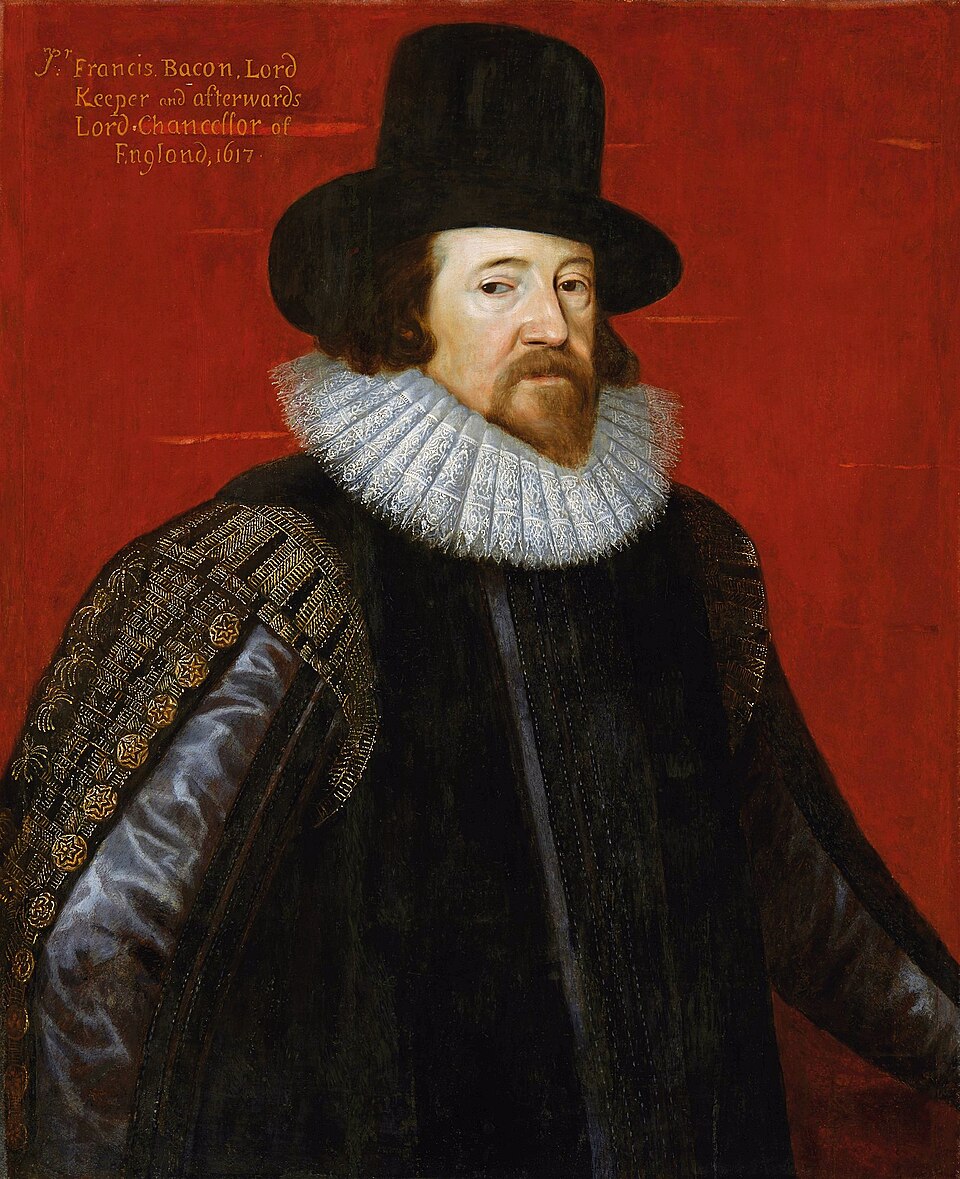
Renaissance
Francis Bacon
1561 – 1626
English philosopher and statesman (1561–1626)
- Kingdom of England
- British
- empiricism
About
Francis Bacon, 1st Viscount St Alban was an English philosopher and statesman who served as Attorney General and Lord Chancellor of England under King James I. Bacon argued for the importance of natural philosophy, guided by the scientific method, and his works remained influential throughout the Scientific Revolution.
Source: Wikipedia (CC BY-SA). Portrait by Paul van Somer I / Formerly attributed to Frans Pourbus the Younger (Public domain) via Wikimedia Commons.
Life on the Timeline
Major Works
Exam Dossier
Most-asked topics
- Bacon as the father of the English essay
- The three editions of Essays (1597, 1612, 1625) and their aphoristic prose style
- Novum Organum and the inductive method
- The Idols of the Mind (Tribe, Cave, Marketplace, Theatre)
- New Atlantis as utopian/scientific fiction and Salomon's House
- Bacon's role in the Scientific Revolution and empiricism
- The Advancement of Learning and classification of knowledge
- Bacon's prose style: aphorism, compression, and utilitarian purpose
Previous-year themes
- Bacon's contribution to the development of the English essay form
- Empiricism and the inductive method as opposed to Aristotelian deduction
- The concept of the Idols of the Mind in Novum Organum
- Utopian and scientific vision in New Atlantis
- Bacon's aphoristic prose style and its influence on English prose
- Bacon's place in Renaissance humanism and the Scientific Revolution
Common confusions
- Confusing Francis Bacon (essayist-philosopher, 1561-1626) with Roger Bacon (medieval friar-scientist, 13th century) — both associated with empirical method but centuries apart.
- Assuming Bacon's Essays are personal/familiar in the manner of Charles Lamb; Bacon's style is aphoristic, impersonal, and utilitarian, not confessional.
- Mixing up the three editions of the Essays (1597 with 10 essays; 1612 enlarged; 1625 final version with 58 essays) and their exact essay counts.
- Believing New Atlantis is a complete, polished novel; it is in fact an unfinished fragment published after Bacon's death.
- Attributing 'Knowledge is power' to Novum Organum when it is more properly traced to Bacon's Meditationes Sacrae (1597).
- Confusing Bacon's Idols (Idols of the Tribe, Cave, Marketplace, Theatre) with Plato's Theory of Forms — both use 'idols/forms' but refer to entirely different concepts (obstacles to knowledge vs. ideal metaphysical archetypes).
Memory tricks
'BACON fried the syllogism' — remember Bacon rejected Aristotelian deduction in favour of induction.
Essays years: 1597 to 1625 — think '97 to '25; the collection grew from 10 essays to 58, nearly six-fold.
'New Atlantis, New Beginning' — published posthumously (1627), a year AFTER his death (1626), symbolising his unfinished scientific vision.
Four Idols mnemonic: T-C-M-T = Tribe, Cave, Marketplace, Theatre — 'Tribes Cook Meat Together' (idols that mislead the mind).
'Of Studies' = 'Studies for Life' — remember it as Bacon's essay praising reading, discussion, and writing.
Bacon = Statesman + Scientist + Stylist — three S's cover his career as Lord Chancellor, empiricist philosopher, and essayist.