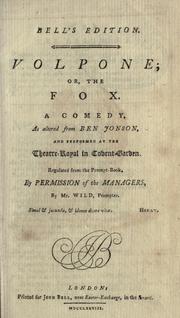
Summary
Volpone is a comedy play by English playwright Ben Jonson first produced in 1605–1606, drawing on elements of city comedy and beast fable. A merciless satire of greed and lust, it remains Jonson's most-performed play, and it is ranked among the finest Jacobean-era comedies.
Source: Wikipedia (CC BY-SA).
Historical Background
Volpone, or The Fox is a comedy by Ben Jonson, first performed by the King's Men in 1605-1606 and printed in 1607. Set in Venice, it belongs to the tradition of city comedy while drawing heavily on beast-fable and animal-trickster motifs, with characters named for predatory and scavenging animals (Volpone the fox, Mosca the fly, Voltore the vulture, Corbaccio the crow, Corvino the raven). The play satirizes greed, legacy-hunting, and moral corruption among Venice's merchant and legal classes. Jonson dedicated the play to the two universities, defending comedy's moral seriousness and his own craftsmanship against charges of licentiousness and slander. Structurally rigorous and classically influenced (observing something close to the unities of time, place, and action), it is widely regarded as Jonson's finest achievement and one of the great Jacobean comedies, admired for its dense, ingenious plotting, its savage wit, and its uncompromising moral vision, which culminates in the harsh punishment of nearly every schemer.
The Story
The wealthy Venetian Volpone, aided by his cunning parasite Mosca, feigns mortal illness to extract gifts from legacy-hunters hoping to be named his heir. Voltore (a lawyer), Corbaccio (a decrepit old man), and Corvino (a jealous merchant) each bring costly presents, competing to outdo one another, unaware Volpone has no intention of dying or naming any of them heir. Mosca manipulates each victim further: he persuades Corbaccio to disinherit his own son Bonario in Volpone's favor, and convinces Corvino to offer his virtuous wife Celia to the supposedly dying Volpone. When Volpone, in disguise, attempts to assault Celia, Bonario (hidden by Mosca to witness Corbaccio's betrayal) bursts in and rescues her. The case goes before the Venetian court, where the schemers' perjury and Voltore's legal cunning nearly convict the innocent Celia and Bonario instead. To savor his triumph further, Volpone fakes his own death and names Mosca his heir, delighting in watching the legacy-hunters' fury from hiding. But Mosca, now legally in control of the estate, turns on his master and refuses to relinquish the fortune, forcing Volpone to reveal the whole fraud in open court to save himself from Mosca's blackmail. The exposure backfires on everyone: the magistrates sentence Volpone, Mosca, Voltore, Corbaccio, and Corvino to severe, fitting punishments, restoring Celia and Bonario's honor and enacting the play's uncompromising comic justice.
Themes
- Greed and avarice as corrupting forces
- Legacy-hunting and the commodification of relationships
- Deception, disguise, and role-playing
- Justice and its corruption by wealth and rhetoric
- The predator-prey logic of a mercantile society
- Appearance versus reality
- Moral corruption of the legal and clerical professions
- Punishment and comic justice
Literary Devices
- Beast fable naming - characters bear animal names (fox, fly, vulture, crow, raven) that encode their moral natures
- Dramatic irony - the audience shares Volpone and Mosca's scheme, heightening suspense as victims are duped
- Satire - exaggerated portraits of avarice and hypocrisy expose social vice
- Disguise and role-play - Volpone's feigned illness and mountebank disguise drive the plot
- Aside and soliloquy - direct address reveals characters' true, often venal, motives
- Classical unity of time and place - action largely confined to a single day in Venice
- Reversal (peripeteia) - Mosca's betrayal of Volpone inverts the trickster-tricked pattern
- Ekphrastic opening speech - Volpone's opening apostrophe to gold parodies religious devotion
Symbolism
- Gold - the object of worship that replaces true religious and moral values
- Volpone (the fox) - cunning, predatory opportunism
- Mosca (the fly) - the parasite who feeds on and ultimately exploits his host
- The animal names generally - a bestiary mapping human vice onto predator and scavenger types
- Celia's virtue - an emblem of incorruptible integrity amid universal venality
Critical Interpretation
Volpone has long been read as Jonson's most fully realized comical satire, praised for its architectural plotting and its refusal of easy comic reconciliation. Critics have noted its debt to classical comic and satiric traditions and to beast-fable tradition, and its place within the vogue for city comedy alongside contemporaries like Middleton. T. S. Eliot's influential essays on Jonson helped rehabilitate his reputation in the twentieth century, arguing for the coherence and force of Jonson's comic vision against charges that his characters are mere caricatures. Scholars have debated the play's genre boundaries, since its final act, with its harsh judicial punishments, pushes against comedy's usual movement toward reconciliation and marriage, giving the play a darker, almost tragicomic edge. The play is also frequently discussed for its treatment of the mountebank scene and its self-conscious theatricality, with Volpone himself functioning as both master schemer and internal dramatist of his own plot.
Quotations
Good morning to the day; and next, my gold: Open the shrine, that I may see my saint.
Volpone's opening apostrophe to his gold, parodying religious worship and announcing the play's central satire on avarice.
I glory More in the cunning purchase of my wealth, Than in the glad possession.
Volpone confesses that the pleasure of the scheme itself, not mere possession, is his true vice.
Influence
Volpone is regarded as one of the masterpieces of Jacobean city comedy and Jonson's most enduring stage success, remaining in repertory and frequently revived across the centuries when much of his other work fell out of favor. Its rigorous plotting and moral seriousness influenced later comic satire and the broader tradition of English "comedy of humours" and city comedy, shaping how playwrights combined classical form with contemporary social satire. The play's beast-fable naming convention and its unflinching depiction of greed have made it a touchstone for later satirists of commercial and legal corruption. It is a staple of academic study and repertory theatre, frequently cited alongside The Alchemist as evidence of Jonson's stature as second only to Shakespeare among Renaissance English dramatists.
Related Works
- The Alchemist by Ben Jonson
- Every Man in His Humour by Ben Jonson
- Bartholomew Fair by Ben Jonson
- A Chaste Maid in Cheapside by Thomas Middleton
- The Duchess of Malfi by John Webster
Curator's Notes
- 1The full title is Volpone, or The Fox, and every principal character's name derives from an animal in Italian (volpone/fox, mosca/fly, voltore/vulture, corbaccio/crow, corvino/raven).
- 2Jonson prefaced the printed play with a dedicatory epistle to the two universities defending the moral purpose of comedy.
- 3The play is set in Venice, a common choice for English Renaissance drama to depict exotic vice and legal intrigue at a safe geographical remove.
- 4Unlike much romantic comedy of the period, Volpone ends not in marriage but in judicial sentencing, underscoring its satiric severity.
For the Exam
UGC NET frequently tests Volpone as a key text of Jacobean city comedy and "comedy of humours," asking students to identify its genre, date, characters' animal-derived names and their symbolic function, and its relation to Jonson's classical, satiric dramaturgy. Expect questions on the beast-fable structure, the theme of greed/legacy-hunting, comparison with The Alchemist, and Jonson's place relative to Shakespeare in the periodization of English drama. Familiarity with the plot mechanics (feigned death, Mosca's betrayal, the trial scene) and stock character names is commonly tested.