Summary
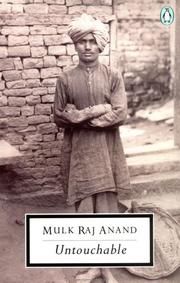
Untouchable is a novel by Indian writer Mulk Raj Anand published in 1935. The novel established Anand as one of India's leading English authors. The book was inspired by his aunt's experience of being ostracized for sharing a meal with a Muslim woman. The plot of this book, Anand's first, revolves around the argument for eradicating the caste system. It depicts a day in the life of Bakha, a young "sweeper", who is "untouchable" due to his work of cleaning latrines.
Source: Wikipedia (CC BY-SA).
Historical Background
Mulk Raj Anand (1905-2004) wrote Untouchable in the early 1930s while living in England and moving in Bloomsbury circles; the manuscript was reportedly reworked several times before its 1935 publication, which carried a preface by E. M. Forster. Anand was closely associated with India's Progressive Writers' Movement, which championed socially engaged, realist literature addressing poverty, caste, and colonial injustice. The novel's germ, as Anand recounted, lay in a family memory: his aunt was ostracised by relatives for having shared a meal with a Muslim woman, an incident that crystallised his anger at caste-based exclusion. The book was also shaped by Anand's engagement with Gandhian thought on the abolition of untouchability alongside his own leftist, humanist politics. Written in English but attempting to render the rhythms of Punjabi speech and the textures of Indian working-class life, the novel was among the first major works of Indian fiction in English to place a "sweeper," an "untouchable" latrine-cleaner, at its centre. It appeared as a founding text of a generation of Indian novelists writing in English about contemporary Indian social conditions rather than purely nationalist or exoticised themes, establishing Anand as one of the pioneers of the Indo-Anglian novel.
The Story
Untouchable compresses its action into a single day in the life of Bakha, a young sweeper and latrine-cleaner in the fictional cantonment town of Bulashah. The narrative opens with Bakha performing his hereditary, degrading labour and follows him through a series of humiliations: he is publicly struck and abused by a high-caste man whom he accidentally touches in the street, is refused entry to temples and denied access to the public well because his touch is considered polluting, and witnesses further indignities visited on his family, including the harassment his sister Sohini faces from a priest. Interspersed with these episodes are glimpses of Bakha's inner life, his fascination with the clothes, games, and manners of the British soldiers and sahibs, and his inarticulate yearning for a dignity that caste society denies him. As the day proceeds, Bakha encounters several possible answers to his degradation: he hears a Christian missionary preach conversion, he listens to Mahatma Gandhi address a public meeting on the evil of untouchability and the need for sweepers to be treated with respect, and finally he overhears a poet, Iqbal Nath Sarshar, argue that the flush toilet and machine sanitation, rather than religious conversion or charity, will ultimately abolish the sweeper's degrading role. The novel ends inconclusively, with Bakha walking home turning these competing possibilities over in his mind, his fate and India's caste future left open rather than resolved.
Themes
- The dehumanisation and social exclusion of caste-based untouchability
- Colonial hierarchy and Indian society under British rule
- The search for individual dignity within a rigid social order
- Religion, hypocrisy, and institutional complicity in oppression
- Gandhian reform versus radical/structural change
- Poverty and the exploitation of labour
- Silence, voicelessness, and the difficulty of self-expression
- The body as a site of pollution and social control
Literary Devices
- Single-day narrative structure — compresses the novel into roughly twelve hours to intensify focus on one representative life
- Free indirect discourse — renders Bakha's inarticulate thoughts and feelings in a style closer to the narrator's English idiom
- Social realism — detailed, unsentimental depiction of sanitation labour and slum conditions
- Symbolic set-piece episodes — the temple, the well, and the hockey match each stage a distinct facet of caste humiliation
- Juxtaposition of competing ideologies — missionary Christianity, Gandhism, and modern technology are staged as rival solutions and left unresolved
- Anglicised rendering of vernacular speech — dialogue attempts to carry Punjabi/Hindustani cadences into English prose
Symbolism
- The latrines and excrement Bakha cleans — the stigma and pollution imposed on sweeper labour by caste ideology
- The public well — the denial of a basic communal resource to those deemed untouchable
- Bakha's desire for British-style dress and military uniform (overcoat, breeches, puttees) — his aspiration toward a different, freer identity modelled on the British soldiers he admires
- The flush toilet described by the poet Iqbal Nath Sarshar — technological/modern change as a potential escape from hereditary degradation
Critical Interpretation
Untouchable has been read primarily as a foundational text of socially committed Indian writing in English, valued for giving early literary voice to a Dalit protagonist within a realist frame. Critics associated with the Progressive Writers' Movement praised its unflinching depiction of caste oppression and its humanist, reformist sympathies. Postcolonial critics have examined the novel's ambivalent position: written in English for a largely non-Dalit, often Western readership, with a preface by E. M. Forster, it has been discussed as an instance of a privileged, upper-caste author speaking on behalf of a Dalit subject, raising questions later central to Dalit literary criticism about authenticity, representation, and who has the authority to narrate untouchable experience. The novel's open ending, in which Bakha is left weighing missionary conversion, Gandhian reform, and modern sanitation technology without a clear resolution, has been read both as a realistic refusal of easy answers and as a structural weakness. Anand's use of English to convey vernacular speech patterns has also drawn sustained critical attention within debates on language and Indian writing in English.
Quotations
Untouchable! Untouchable! Untouchable! That's the word! Untouchable! I am an untouchable!
Bakha's anguished, repeated recognition of his caste identity, voiced amid his humiliations during the day.
Influence
Untouchable helped establish caste oppression and the lives of the marginalised as legitimate, central subjects for the Indian novel in English, opening a path later followed by writers addressing poverty, labour, and social injustice in Indian fiction. Alongside contemporaries such as R. K. Narayan and Raja Rao, Anand is regarded as one of the founding figures of the modern Indian English novel. The book is frequently cited as an important precursor to later Dalit literature and to broader postcolonial debates about representation, voice, and who is entitled to narrate the experience of the oppressed.
Related Works
- Coolie by Mulk Raj Anand
- The Guide by R. K. Narayan
- Kanthapura by Raja Rao
- A Passage to India by E. M. Forster
- Joothan by Omprakash Valmiki
Curator's Notes
- 1The novel is set entirely within a single day, an unusual structural choice for a socially expansive novel.
- 2Anand's manuscript was reportedly revised numerous times before publication, and its 1935 edition carried a preface by E. M. Forster.
- 3Mahatma Gandhi appears as a character in the novel, delivering a speech on untouchability that Bakha witnesses.
- 4Anand was part of the Bloomsbury literary milieu in London while composing the novel, alongside his involvement in the Progressive Writers' Movement.
For the Exam
UGC NET frequently tests Untouchable as a landmark text of the Indian English novel and of the Progressive Writers' Movement: expect questions on its author and publication year (1935), its single-day structure, its protagonist Bakha and his caste occupation, the novel's treatment of Gandhian ideas on untouchability, and its status as an early socially realist, reformist novel. Candidates should also know E. M. Forster's association with the book and be able to distinguish Anand's realist mode from later Dalit self-narration.