Summary
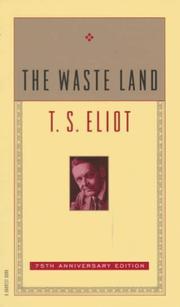
The Waste Land is a poem by T. S. Eliot, widely regarded as one of the most important English-language poems of the 20th century and a central work of modernist poetry. Published in 1922, the 434-line poem first appeared in the United Kingdom in the October issue of Eliot's magazine The Criterion and in the United States in the November issue of The Dial. Among its famous phrases are "April is the cruellest month", "I will show you fear in a handful of dust", and "These fragments I have shored against my ruins".
Source: Wikipedia (CC BY-SA).
Historical Background
T. S. Eliot composed The Waste Land in the aftermath of the First World War, during a period of personal crisis: his marriage to Vivienne Eliot was deeply troubled, and he suffered a nervous breakdown, undergoing a rest cure in Lausanne, Switzerland, in late 1921, where much of the poem was drafted. Eliot brought a lengthy manuscript to Ezra Pound, whose extensive editorial cuts shaped the poem into its final, fragmented form; Eliot dedicated the poem to Pound as "il miglior fabbro" ("the better craftsman"), a phrase borrowed from Dante's tribute to the troubadour poet Arnaut Daniel. The poem was first published in 1922, appearing in Britain in The Criterion and in America in The Dial, and later in book form with Eliot's own explanatory endnotes. It draws on an immense range of sources—Dante, Shakespeare, the Bible, Buddhist scripture, Wagnerian opera, Jessie Weston's study of the Grail legend (From Ritual to Romance), and Sir James Frazer's The Golden Bough—reflecting Eliot's erudition and his sense of a civilization's spiritual and cultural exhaustion after the war. Its fragmented, allusive, multivocal method became a defining monument of literary modernism.
The Story
The Waste Land does not follow a linear narrative but proceeds as a montage of voices, scenes, and literary allusions organized into five sections. "The Burial of the Dead" opens with images of a sterile spring and moves through fragmented memories, a tarot reading by Madame Sosostris, and a vision of crowds flowing over London Bridge, evoking spiritual death-in-life. "A Game of Chess" juxtaposes a wealthy woman's sterile boudoir with a working-class pub conversation about an unwanted pregnancy, contrasting decayed opulence with ordinary desperation. "The Fire Sermon" presents scenes of sexual emptiness, including the mechanical seduction of a typist by a "young man carbuncular," observed by the blind seer Tiresias, who unites the poem's many figures into a single consciousness. "Death by Water" is a brief, elegiac section on the drowned Phoenician sailor Phlebas, a meditation on mortality. "What the Thunder Said" moves through a parched, apocalyptic landscape toward a symbolic thunderstorm, drawing on Hindu scripture (the Upanishads) for the injunctions "Datta, Dayadhvam, Damyata" (give, sympathize, control), before closing on the fragmentary, multilingual line "Shantih shantih shantih." Throughout, the poem enacts a search for spiritual renewal amid the barrenness of modern civilization.
Themes
- Spiritual sterility and disillusionment after World War I
- Fragmentation of modern culture and consciousness
- Failed or empty sexuality and relationships
- Death and rebirth / the fertility myth
- The search for redemption amid decay
- The clash of past cultural grandeur and present emptiness
- Isolation and failure of communication
- Water as both life-giving and destructive force
Literary Devices
- Allusion — dense weaving of references to Dante, Shakespeare, the Bible, and world mythology
- Fragmentation — disjointed structure mirroring cultural and psychological breakdown
- Multivocal narration — shifting, often unidentified speakers across the poem
- Mythic method — use of the Grail legend and fertility myths to structure modern chaos
- Juxtaposition — abrupt contrasts between high culture and vulgar modern life
- Multilingualism — lines in French, German, Italian, and Sanskrit
- Symbolism — recurring images of water, dust, and sterile land
- Free verse with shifting meter and form across sections
Symbolism
- The waste land itself — spiritual and cultural barrenness of the modern world
- Water — ambivalently signifies both death (drowning) and the possibility of life-giving rebirth
- The Fisher King — the wounded ruler of Grail legend whose infirmity blights the land
- Tiresias — the blind prophet who embodies unified, all-seeing consciousness across genders and time
- Tarot cards — fragmented, ambiguous signs of fate and meaning in a disordered world
Critical Interpretation
Early reviewers were divided, with some baffled by the poem's difficulty and others, like fellow modernists, hailing it as epoch-defining. New Critics prized its dense allusiveness, irony, and impersonality, reading it via Eliot's own critical theories, including his call for poetic impersonality. Formalist critics traced its structural debt to Jessie Weston's anthropological work on the Grail legend and Frazer's The Golden Bough, treating the poem as enacting a mythic quest for renewal. Later critics, including feminist scholars, have examined the poem's troubled representations of gender and sexuality, and biographical critics have connected its bleakness to Eliot's marital crisis and breakdown. The recovery and 1971 publication of the original manuscript, with Ezra Pound's editorial markings, spurred renewed scholarship on collaborative authorship and the poem's compositional history. The poem remains a touchstone in debates over modernist difficulty, allusive method, and the relationship between fragmentation and meaning.
Quotations
April is the cruellest month
Opening line, inverting the traditional association of spring with renewal
I will show you fear in a handful of dust.
Image of mortality and existential dread
These fragments I have shored against my ruins.
Near the poem's close, on art as fragile bulwark against cultural collapse
HURRY UP PLEASE IT'S TIME
Refrain of the pub landlord's closing-time call, intruding on the overheard conversation
Influence
The Waste Land became a foundational text of literary modernism, cementing the use of fragmentation, allusion, and multiple voices as legitimate poetic techniques. Its extensive endnotes influenced how later poets and critics thought about annotation, intertextuality, and the poem as scholarly artifact. It shaped the work of subsequent modernist and postmodernist poets and helped establish the New Criticism's close-reading methods as a dominant mode of academic literary study. The poem's mythic method—using ancient myth to give shape to modern experience—influenced later long poems and became a touchstone for discussions of allusive, difficult poetry throughout the twentieth century.
Related Works
- Four Quartets by T. S. Eliot
- The Love Song of J. Alfred Prufrock by T. S. Eliot
- Ulysses by James Joyce
- The Cantos by Ezra Pound
- From Ritual to Romance by Jessie Weston
- The Golden Bough by Sir James Frazer
Curator's Notes
- 1The poem was originally titled "He Do the Police in Different Voices," a phrase drawn from Dickens's Our Mutual Friend.
- 2Ezra Pound's heavy editing of Eliot's draft was so significant that Eliot dedicated the poem to him as "il miglior fabbro" (the better craftsman).
- 3Eliot appended his own explanatory endnotes to the poem, citing sources from Dante to the Grail legend to Buddhist texts.
- 4The original manuscript, thought lost for decades, resurfaced in the 1960s and was published in 1971, revealing the extent of Pound's cuts.
- 5The poem draws its title and structural imagery in part from Jessie Weston's anthropological study of Grail mythology, From Ritual to Romance.
For the Exam
UGC NET frequently tests The Waste Land as the paradigmatic modernist poem: its five-part structure and titles, the significance of Tiresias as unifying narrator, the poem's mythic method and debt to Weston and Frazer, its key allusions (Dante, Shakespeare, the Grail legend), the meaning of the Sanskrit closing ("Shantih"), and Eliot's theories of impersonality and the "objective correlative" from his critical essays. Questions also probe famous opening/closing lines, the dedication to Ezra Pound, and the poem's place in the modernist canon alongside Joyce and Pound.