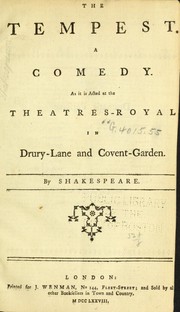
tragicomedy · 1623
The Tempest
play by William Shakespeare
- 1623
- tragicomedy
Summary
The Tempest is a play by William Shakespeare, probably written in 1610–1611, and thought to be one of the last plays he wrote alone. After the first scene, which takes place on a ship at sea during a storm, the rest of the play is set on a remote island, where Prospero, a magician, lives with his daughter Miranda and his two servants: Caliban, a savage monster figure, and Ariel, an airy spirit. The play contains music and songs that evoke the spirit of enchantment on the island. It explores many themes, including magic, betrayal, revenge, forgiveness, and family. In Act IV, a wedding masque serves as a play-within-a-play and contributes spectacle, allegory, and elevated language.
Source: Wikipedia (CC BY-SA).
Historical Background
The Tempest was probably composed in 1610–1611 and is considered one of the last plays Shakespeare wrote entirely alone, though he later collaborated with John Fletcher on other works. It was first printed in the 1623 First Folio, where it stands as the opening play, and it observes the classical unities of time, place, and action more closely than almost any other Shakespeare play. The play draws on contemporary accounts of the 1609 wreck of the Sea Venture off Bermuda during a voyage to the Virginia colony, which likely influenced its storm and island setting, as well as on Montaigne's essay "Of Cannibals" and Ovid's Metamorphoses. It belongs to the group of late "romances" or tragicomedies, alongside Pericles, Cymbeline, and The Winter's Tale, which blend tragic loss with eventual reconciliation and wonder. Prospero, the exiled Duke of Milan turned island magician, has long invited biographical readings as a figure for the playwright himself, especially given the epilogue's farewell tone, though scholars caution against reading it simply as Shakespeare's personal retirement statement.
The Story
Prospero, the rightful Duke of Milan, was deposed twelve years earlier by his brother Antonio, aided by the King of Naples, Alonso, and set adrift with his infant daughter Miranda. They landed on a remote island, where Prospero, through magic learned from his books, freed the spirit Ariel from imprisonment and subjugated Caliban, son of the witch Sycorax and the island's original inhabitant. When a ship carrying Antonio, Alonso, Alonso's son Ferdinand, and their courtiers passes near the island, Prospero has Ariel raise a tempest that wrecks it, scattering the passengers unharmed in separate groups. Ferdinand, believing his father drowned, meets Miranda, and the two fall instantly in love, a match Prospero secretly favors while testing Ferdinand's constancy through hard labor. Elsewhere, Alonso mourns Ferdinand as lost while Antonio persuades Sebastian to plot the murder of the sleeping Alonso, a scheme Ariel foils. In a comic subplot, Caliban joins the drunken butler Stephano and jester Trinculo in a bungled conspiracy to kill Prospero and seize the island, which Ariel and Prospero's spirits thwart with illusions. Prospero ultimately abandons vengeance for forgiveness, confronting and pardoning his enemies, restoring his dukedom, and blessing the betrothal of Ferdinand and Miranda. In the end he frees Ariel, renounces his magic by breaking his staff and drowning his book, and asks the audience, in the epilogue, to release him with their applause.
Themes
- Power, usurpation, and legitimate rule
- Colonialism and the control of land and native inhabitants
- Magic, illusion, and art as forms of power
- Revenge versus forgiveness and reconciliation
- Nature versus civilization (the "savage" and the "civilized")
- Freedom and servitude
- The bond between fathers and daughters
- Theatre and the nature of artistic creation
Literary Devices
- Play-within-a-play - the Act IV wedding masque frames spectacle and allegory within the drama
- Dramatic irony - the audience knows Prospero orchestrates events that the shipwrecked characters take as chance or fate
- Blank verse - elevated iambic pentameter marks noble speech and shifts tone from the prose of comic scenes
- Metatheatre - Prospero's stage-managing of illusions mirrors the playwright's own craft
- Symbol-laden setting - the island functions as a controlled stage for testing and transformation
- Soliloquy and aside - reveal private motives, notably in Antonio and Sebastian's plotting
- Music and song - Ariel's songs create the island's enchanted atmosphere and mark transitions
Symbolism
- The tempest/storm - represents Prospero's controlled power and the upheaval that precedes restoration
- The island - a liminal space outside ordinary law, symbolizing both utopian possibility and colonial contest
- Prospero's staff and book - emblems of magical and, by extension, theatrical/authorial power, renounced at the play's close
- Ariel - symbolizes airy, willing spirit and imagination in service, contrasted with Caliban's earthy resistance
- Caliban - embodies the colonized "native," read variously as savage, victim, or rightful heir to the island
Critical Interpretation
Twentieth-century postcolonial criticism transformed readings of The Tempest, with critics such as George Lamming and Aimé Césaire (whose 1969 play Une Tempête rewrites the story from Caliban's perspective) reframing Caliban as a colonized subject dispossessed of his island and language. This lens built on earlier readings that treated the play as a serene, apolitical romance about art and reconciliation, often associating Prospero with Shakespeare himself bidding farewell to the stage. Feminist critics have noted the marginal, largely silent role given to Miranda and the complete absence of Caliban's mother Sycorax except through report, questioning the play's patriarchal structuring of the island's history. New Historicist scholarship, including work associated with Stephen Greenblatt, situated the play within early modern travel writing and colonial venture literature, particularly accounts of the Bermuda shipwreck, to explore how the drama registers anxieties and justifications of empire. These competing frameworks make the play a frequently contested text in debates over authority, race, and representation.
Quotations
We are such stuff as dreams are made on, and our little life is rounded with a sleep.
A meditation on the illusory, dreamlike nature of the masque and of life itself, often read as Shakespeare's reflection on theatre.
O brave new world, that has such people in't!
Miranda's wonder at seeing other humans for the first time; later used ironically as the title of Aldous Huxley's dystopian novel.
Hell is empty, and all the devils are here.
Spoken while describing the terror of those aboard the storm-wrecked ship.
This island's mine, by Sycorax my mother, which thou tak'st from me.
Caliban's assertion of rightful inheritance, central to postcolonial readings of the play.
Misery acquaints a man with strange bedfellows.
A comic line, on discovering Caliban, that has become a widely used English proverb.
Influence
The Tempest has become one of Shakespeare's most reinterpreted plays, especially since the mid-twentieth century, when postcolonial writers made it a touchstone for exploring empire and resistance. Aimé Césaire's Une Tempête (1969) recast Caliban as a colonized revolutionary, and the play's themes have been taken up widely in Caribbean and African literary criticism. Its phrase "brave new world" gave Aldous Huxley the title of his 1932 novel. The character of Prospero has influenced countless subsequent depictions of the magician-artist figure, and the play's blend of romance, spectacle, and political allegory has made it a recurring reference point in discussions of colonialism, hospitality, and the ethics of power in literature classrooms worldwide.
Adaptations
- Aimé Césaire, Une Tempête (1969) - a postcolonial stage rewriting centering Caliban
- Forbidden Planet (1956) - science-fiction film loosely inspired by the play's plot
- Peter Greenaway, Prospero's Books (1991) - experimental film adaptation starring John Gielgud
- Julie Taymor, The Tempest (2010) - film adaptation with Helen Mirren as a gender-reversed "Prospera"
Related Works
- William Shakespeare, The Winter's Tale
- William Shakespeare, Cymbeline
- William Shakespeare, Pericles, Prince of Tyre
- Aimé Césaire, Une Tempête
- Aldous Huxley, Brave New World
Curator's Notes
- 1The Tempest is the first play printed in the 1623 First Folio, though not the first Shakespeare wrote.
- 2It is one of only two Shakespeare plays (with Love's Labour's Lost) with a plot not clearly borrowed from an identifiable earlier source narrative.
- 3The play is notable for largely observing the classical unity of time, with its action taking place in roughly three to four hours.
- 4Ariel and Caliban have no direct source in earlier known plays or stories, making them among Shakespeare's most original creations.
- 5The 1609 wreck of the English ship Sea Venture off Bermuda is widely believed to have influenced the play's opening storm.
For the Exam
UGC NET English frequently tests The Tempest through postcolonial theory, asking students to connect Caliban's dispossession to critics like Césaire or general postcolonial frameworks, and to identify the play as a late Shakespearean romance/tragicomedy alongside Cymbeline and The Winter's Tale. Expect questions on character-quote matching (especially "brave new world" and "such stuff as dreams are made on"), the play's use of the masque, and its position as the opening play of the 1623 First Folio. Questions may also probe the Prospero-as-Shakespeare biographical reading and its critical limitations.