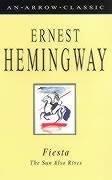
1926
The Sun Also Rises
novel by Ernest Hemingway
- 1926
- ◆ Nobel-winning author
Summary
The Sun Also Rises is the first novel by the American writer Ernest Hemingway, following his experimental novel-in-fragments In Our Time (1925). It portrays American and British expatriates who travel from Paris to the Festival of San Fermín in Pamplona and watch the running of the bulls and the bullfights. An early modernist novel, it received mixed reviews upon publication. Hemingway biographer Jeffrey Meyers writes that it is now "recognized as Hemingway's greatest work", and Hemingway scholar Linda Wagner-Martin calls it his most important novel. The novel was published in the United States in October 1926, by Charles Scribner's Sons. A year later, Jonathan Cape published the novel in London under the title Fiesta. It remains in print.
Source: Wikipedia (CC BY-SA).
Historical Background
Hemingway wrote The Sun Also Rises in 1925, drawing on a trip he made with a group of expatriate friends to the Festival of San Fermín in Pamplona, Spain, that summer. It followed his experimental short-story collection In Our Time (1925) and was his first full-length novel, published by Charles Scribner's Sons in October 1926 (issued in Britain the following year as Fiesta). The book emerged from the post-World War I "Lost Generation" milieu of American and British expatriates living in Paris, a term Hemingway attributed to Gertrude Stein and used as one of the novel's epigraphs, paired with a passage from Ecclesiastes that gives the book its title. Hemingway's spare, understated "iceberg theory" prose style, developed under the influence of Stein, Ezra Pound, and Sherwood Anderson, is fully realized here. The novel's protagonist, Jake Barnes, an American journalist rendered impotent by a war wound, and his unattainable love Lady Brett Ashley are widely understood to reflect the psychic and physical wounds of the war generation. The book's frank treatment of expatriate drift, drinking, and disillusionment made it controversial yet enormously influential on its first appearance.
The Story
Narrated by Jake Barnes, an American expatriate journalist living in Paris who was rendered sexually impotent by a war wound, the novel follows Jake and his circle of fellow expatriates through the cafés of Paris and then to Pamplona, Spain, for the Festival of San Fermín. Jake is in love with the twice-divorced Lady Brett Ashley, but his injury makes a conventional relationship impossible, and Brett moves restlessly among other men, including the boorish, insecure Robert Cohn, the amiable drunk Mike Campbell (Brett's fiancé), and the writer Bill Gorton. The group travels to Spain, first fishing in the countryside and then converging on Pamplona for the fiesta, its bullfights, and the running of the bulls. Tensions among the group erupt into jealousy and violence, particularly around Cohn, who has had a brief affair with Brett and cannot let her go. Brett becomes infatuated with the young, gifted bullfighter Pedro Romero, initiating an affair with him that appalls and further fractures the group and shocks the traditional bullfighting community. In the aftermath, the group disperses; Brett, having ended things with Romero to avoid corrupting him, summons Jake to Madrid to rescue her from financial and emotional trouble. The novel closes with Jake and Brett riding together in a taxi, contemplating the wonderful but unrealizable relationship they might have had, ending on Jake's famously ambiguous, understated line.
Themes
- The Lost Generation and postwar disillusionment
- Wounded masculinity and impotence
- Unattainable and destructive love
- Expatriate rootlessness and displacement
- Authenticity versus performance (the bullfight as ideal)
- Alcohol, hedonism, and evasion
- Antisemitism and social exclusion (Robert Cohn)
- Nature and ritual as sources of order
Literary Devices
- Iceberg theory (theory of omission) — meaning is left submerged beneath a spare, understated surface
- Understatement — emotional intensity conveyed through flat, restrained declarative prose
- Terse dialogue — naturalistic, clipped exchanges that imply more than they state
- Symbolic landscape — the shift from Paris to rural Spain marks moral and emotional contrast
- Irony — Jake's wound and his role as unattainable object of Brett's desire underscore the novel's bitter humor
- Repetition and parataxis — simple coordinated sentences ('and... and...') create rhythm and control emotion
- First-person limited narration — Jake's restrained voice filters and withholds judgment
Symbolism
- The bullfight and bullfighter (Romero) — authentic passion, skill, and grace under pressure ('aficion')
- Fishing trip in Burguete — a pastoral, uncorrupted counterpoint to Parisian and Pamplona excess
- Jake's war wound — the sterility and emasculation of the postwar generation
- The fiesta of San Fermín — chaotic release and the collapse of order and restraint
- Brett's cropped hair and androgynous style — shifting, modern gender roles
Critical Interpretation
Early reviewers were divided, some finding the characters shallow or dissolute, while others recognized a revolutionary new prose style; the novel is now widely regarded, per Hemingway scholars such as Jeffrey Meyers and Linda Wagner-Martin, as his greatest and most important work. Formalist and stylistic critics have focused on Hemingway's "iceberg theory" and minimalist prose, tracing its debt to Gertrude Stein and Ezra Pound. Biographical critics read Jake Barnes's wound and the expatriates' aimlessness as expressions of Hemingway's own Lost Generation milieu and World War I trauma. Feminist critics have debated Lady Brett Ashley as either a proto-liberated modern woman or a destructive femme fatale figure judged by a masculine narrative frame. The novel's treatment of Robert Cohn has drawn sustained scrutiny for its antisemitic characterization, prompting debate over whether the text endorses or merely depicts the prejudices of its narrator and social milieu. Critics have also examined the bullfight as a controlling symbolic structure for the novel's code of grace under pressure.
Quotations
You are all a lost generation.
Used as one of the novel's two epigraphs, giving the era its enduring label.
Isn't it pretty to think so?
Jake Barnes's closing line to Brett Ashley, the novel's famous understated final words.
Influence
The Sun Also Rises established Hemingway's spare, understated prose style as a dominant force in twentieth-century American fiction, influencing generations of writers who adopted his declarative sentences and dialogue-driven minimalism. It codified the "Lost Generation" as a literary and cultural label for the post-World War I expatriate sensibility. The novel's blend of journalistic precision and emotional restraint shaped later American realist and minimalist fiction, and its portrait of expatriate Paris helped canonize the city as a modernist literary setting.
Adaptations
- The Sun Also Rises (1957 film, directed by Henry King, starring Tyrone Power, Ava Gardner, and Errol Flynn)
Related Works
- A Farewell to Arms by Ernest Hemingway
- In Our Time by Ernest Hemingway
- The Great Gatsby by F. Scott Fitzgerald
- Tender Is the Night by F. Scott Fitzgerald
- A Moveable Feast by Ernest Hemingway
Curator's Notes
- 1The British edition, published by Jonathan Cape in 1927, was titled Fiesta and is still known by that title in many countries.
- 2The novel's epigraph pairing a Gertrude Stein remark with a passage from Ecclesiastes gave both the book's title and the era its 'Lost Generation' label.
- 3The story drew directly on a real trip Hemingway took with friends to the Pamplona bullfighting festival in the summer of 1925.
For the Exam
UGC NET English commonly tests The Sun Also Rises on: its status as a defining Lost Generation and Modernist text; Hemingway's iceberg theory and minimalist prose style; the significance of the title and its Ecclesiastes/Gertrude Stein epigraphs; the symbolism of Jake Barnes's war wound and the bullfight motif; and its place within Hemingway's oeuvre alongside A Farewell to Arms and In Our Time. Candidates should also know its publication year (1926) and alternate British title, Fiesta.