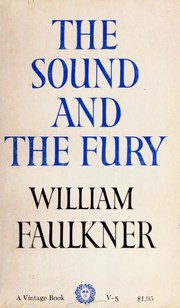
Southern Gothic · 1929
The Sound and the Fury
1929 novel by William Faulkner
- 1929
- Southern Gothic
- ◆ Nobel-winning author
Summary
The Sound and the Fury is a novel by the American author William Faulkner, published in 1929. Faulkner's fourth novel, it is the second to be set in Yoknapatawpha County and the first featuring the Compson family, both of which would reappear in his later fiction. The novel's highly experimental style, including its use of stream of consciousness and multiple different unreliable narrators, are hallmarks of modernist literature. Its bleak and candid portrait of Southern life in the early 20th century is paradigmatic of the Southern Gothic genre.
Source: Wikipedia (CC BY-SA).
Historical Background
The Sound and the Fury (1929) was William Faulkner's fourth novel and a decisive turn toward the formally radical fiction that would define his career. It is his second novel set in the fictional Yoknapatawpha County and the first to feature the Compson family, a once-prominent Southern dynasty in visible decline. Faulkner wrote the book in the mid-1920s, reportedly beginning with the image of a girl's muddy drawers as she climbs a tree, an image that grew into Caddy Compson, the novel's absent center. Composed after the commercial disappointment of his earlier novels, Faulkner later said he wrote it "for myself" without expectation of publication, which freed him toward experiment. The novel emerged amid the broader modernist ferment of the 1920s, alongside the stream-of-consciousness innovations of James Joyce and Virginia Woolf, and it channels those techniques toward a specifically Southern subject: the erosion of a planter-class family's honor, land, and coherence in the post-Civil War, post-Reconstruction South. Its structure—four sections narrated from radically different consciousnesses and time frames—reflects Faulkner's conviction that a single, linear telling could not capture how memory, trauma, and family decline actually register in the mind.
The Story
The novel recounts the disintegration of the Compson family through four sections, each dated and narrated differently. The first, April 7, 1928, is narrated by Benjy, a severely intellectually disabled thirty-three-year-old man whose fragmented, non-chronological perceptions drift between present moments and memories, centered above all on his beloved sister Caddy. The second section, June 2, 1910, is narrated by Quentin, a Harvard freshman obsessed with Caddy's lost virginity and the family's decayed sense of honor; his section traces, in fractured interior monologue, the day of his suicide by drowning. The third section, April 6, 1928, shifts to the embittered, materialistic Jason, Caddy's younger brother, who narrates in a comparatively linear but venomous voice as he schemes to control the household and steal money sent for Caddy's illegitimate daughter, Quentin. The fourth section, April 8, 1928 (Easter Sunday), moves to a third-person narration centered on Dilsey, the Black servant who has held the fracturing household together for years, and closes on the family's humiliation and the endurance of those who serve it. Caddy herself never narrates; she exists only through her brothers' recollections, the novel's central absence around which all four perspectives orbit.
Themes
- The decline of the Southern aristocracy
- Time, memory, and the impossibility of escaping the past
- Familial love, obsession, and betrayal
- Honor and its corruption
- Race and service in the post-Reconstruction South
- The failure of language and communication
- Loss of innocence
- Order versus chaos
Literary Devices
- Stream of consciousness — renders each narrator's raw, associative interior thought rather than ordered exposition
- Multiple unreliable narrators — four radically different consciousnesses fracture any single authoritative version of events
- Non-linear/achronological structure — memory and present moment interleave, especially in Benjy's and Quentin's sections
- Symbolic use of time — clocks, watches, and shadows recur to dramatize each character's relation to the past
- Shifting narrative voice and syntax — sentence structure and vocabulary change to mirror each narrator's mind (Benjy's simplicity, Quentin's fragmentation, Jason's cynicism)
- Biblical allusion and structure — the Easter weekend dating of the sections evokes a corrupted Passion narrative
- Interior monologue without conventional punctuation — used to convey Quentin's mental disintegration
Symbolism
- Caddy's muddy drawers — the loss of innocence and the family's descent, fixed in Benjy's memory
- Quentin's watch — the broken, obsessive relationship to time and the past
- The golf course (once the Compsons' pasture) — the family's lost land and status, mourned in Benjy's cries
- Water/the river — cleansing, escape, and death, tied to Quentin's suicide by drowning
- The Easter weekend setting — a corrupted or absent redemption for the Compson family
Critical Interpretation
Early reviewers were divided, some baffled by the novel's difficulty, but it steadily gained recognition as a landmark of American modernism and was central to Faulkner's 1949 Nobel Prize in Literature. Critics have long approached the novel through multiple lenses: formalist and New Critical readings praised its intricate structural symmetry and use of narrative voice to embody theme; psychoanalytic critics have examined Quentin's incestuous fixation on Caddy and Benjy's arrested consciousness; and feminist critics have interrogated Caddy's silencing, noting that the one character around whom the novel turns is denied a narrating voice of her own, existing only as her brothers construct her. Postcolonial and critical race scholars have focused on Dilsey and the novel's representation of Black endurance and labor within a white household's collapse, debating whether Faulkner's portrayal is compassionate or paternalistic. The novel is also frequently read as a meditation on modernist time consciousness, indebted to philosophical currents around subjective duration, and as a paradigmatic Southern Gothic text depicting the decay of the plantation aristocracy after the Civil War and Reconstruction.
Quotations
Caddy smelled like trees.
Benjy's recurring sensory association for his sister, emblematic of his non-verbal devotion to Caddy.
I give it to you not that you may remember time, but that you might forget it now and then for a moment and not spend all your breath trying to conquer it.
Mr. Compson's gift of the watch to Quentin, central to the novel's meditation on time.
They endured.
Faulkner's later-added Appendix line describing the Gibson family's steadfastness amid the Compsons' collapse; not part of the original 1929 text.
Influence
The Sound and the Fury helped establish stream-of-consciousness and multiple unreliable narration as viable structures for the American novel, influencing later Southern and modernist writers including Flannery O'Connor, Eudora Welty, Cormac McCarthy, and Toni Morrison, who has spoken of Faulkner's impact on her own explorations of memory, race, and fractured narrative voice. Its technique of withholding a central character's direct voice (Caddy) while making her the novel's gravitational center has been widely studied as a narrative strategy. The novel is a cornerstone text in the study of literary modernism and is frequently paired with Joyce's and Woolf's innovations as a defining instance of the form's reach into American fiction, and it cemented Faulkner's reputation as one of the twentieth century's most technically ambitious novelists.
Adaptations
- The Sound and the Fury (1959 film), directed by Martin Ritt, starring Yul Brynner and Joanne Woodward
- The Sound and the Fury (2014 film), directed by and starring James Franco
Related Works
- As I Lay Dying by William Faulkner
- Absalom, Absalom! by William Faulkner
- Ulysses by James Joyce
- Mrs Dalloway by Virginia Woolf
- Light in August by William Faulkner
Curator's Notes
- 1The novel's title is drawn from Macbeth's soliloquy: 'a tale told by an idiot, full of sound and fury, signifying nothing,' a direct reference to Benjy's narrating role.
- 2Faulkner reportedly considered Benjy's section the truest but most difficult expression of the story he wanted to tell.
- 3It is the first Faulkner novel to introduce the Compson family, who recur across his later fiction; it was his second novel set in Yoknapatawpha County.
- 4Faulkner later appended a genealogical 'Compson Appendix' (written for a 1946 anthology) that further elaborates the family's history.
- 5The novel sold poorly on first publication in 1929 and only found wide critical esteem in subsequent decades.
For the Exam
UGC NET English frequently tests The Sound and the Fury on: its status as a landmark of stream-of-consciousness technique and multiple unreliable narration; the four-part structure and each narrator's distinct consciousness (Benjy, Quentin, Jason, Dilsey); its position as Faulkner's first Compson-family novel and second Yoknapatawpha novel; the Macbeth-derived title and its thematic significance; its classification within Southern Gothic and American modernism; and Faulkner's 1949 Nobel Prize. Questions may also probe Caddy's structural absence, symbolism of time and water, and comparisons with Joyce and Woolf's modernist techniques.