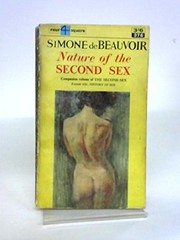
essay · 1949
The Second Sex
essay by Simone de Beauvoir
- 1949
- essay
Summary
The Second Sex is a 1949 book by the French existentialist philosopher Simone de Beauvoir, in which the author discusses the treatment of women in the present society as well as throughout all of history. Beauvoir researched and wrote the book in about 14 months between 1946 and 1949. She published the work in two volumes: Facts and Myths, and Lived Experience. Some chapters first appeared in the journal Les Temps modernes.
Source: Wikipedia (CC BY-SA).
Historical Background
Simone de Beauvoir wrote Le Deuxième Sexe in about fourteen months between 1946 and 1949, publishing it in two volumes: Facts and Myths and Lived Experience. It appeared in postwar France, where Beauvoir was established as a leading existentialist thinker alongside Jean-Paul Sartre, with whom she shared an intellectual partnership. Some chapters were first serialized in the journal Les Temps modernes, the review Sartre founded in 1945 with Beauvoir and other collaborators. Drawing on existentialist philosophy, biology, psychoanalysis, historical materialism, anthropology, and literature, Beauvoir set out to answer the question "What is a woman?" by examining how women have been constructed as the Other throughout Western history, myth, and culture. The book provoked immediate controversy on publication in France, drawing condemnation from conservative and religious quarters and being placed on the Vatican's Index of Prohibited Books. It was widely read yet also selectively excerpted and sometimes reductively translated into English, which affected its early reception in the Anglophone world. Despite this, it became a foundational text for twentieth-century feminist thought, informing the emergence of second-wave feminism in Europe and North America during the 1960s and 1970s.
The Story
The Second Sex is a work of philosophical and social analysis rather than a narrative, structured in two volumes. Volume I, Facts and Myths, examines biological, psychoanalytic, and historical accounts of woman, arguing that none adequately explains her subordinate position, then surveys how myths and literature—including depictions by male writers—have constructed "woman" as an idealized or degraded Other against which man defines himself as the neutral, universal subject. Volume II, Lived Experience, traces the formation of a woman across the stages of a life: childhood, girlhood, sexual initiation, marriage, motherhood, and old age, alongside chapters on the narcissist, the woman in love, and the mystic, before turning to the possibility of liberation through independence. Beauvoir's central argument, encapsulated in the declaration that one is not born, but rather becomes, a woman, is that femininity is not a biological given but a social and cultural construction imposed on women, who are consistently defined relationally as inessential Other to man's essential Self. She contends that women's historical confinement to immanence—repetitive, life-sustaining domestic roles—has denied them the transcendence, or self-creating freedom, that existentialism holds as the mark of authentic human existence. The book closes by calling for economic independence, changed social structures, and mutual recognition between the sexes as the route to women's liberation.
Themes
- Woman as the constructed Other
- Immanence versus transcendence
- The myth of the eternal feminine
- Existentialist freedom and situated liberty
- Marriage and motherhood as institutions of confinement
- Economic independence as the path to liberation
- The body and lived experience
- Complicity and mutual recognition between the sexes
Literary Devices
- Existentialist framework — applies Sartrean categories of Self/Other, immanence/transcendence, and situated freedom to the condition of women
- Synthesis across disciplines — weaves biology, psychoanalysis, historical materialism, anthropology, and literary criticism into a single argument
- Literary case studies — close readings of male authors including Henry de Montherlant, D. H. Lawrence, and Paul Claudel to illustrate how literature constructs the feminine myth
- Structural life-stages method — organizes Volume II as a chronological account of a woman's formation from childhood to old age
- Polemical essay style — combines rigorous argument with pointed, often ironic rhetorical address to the reader
- Phenomenological description — attends closely to lived, first-person bodily and social experience rather than abstract generalization
Symbolism
- The Other — woman defined not in herself but in relation to man, the assumed universal subject
- Immanence — domestic, cyclical, body-bound existence symbolizing enforced stasis and unfreedom
- Transcendence — projects, work, and creation symbolizing authentic existentialist freedom
- The eternal feminine — the mythic, essentialized image of Woman that obscures individual women's lived reality
Critical Interpretation
The Second Sex is widely regarded as a founding text of modern feminist theory and of what would become second-wave feminism. Its existentialist framework, adapting concepts from Sartre's Being and Nothingness, has been both praised for offering a rigorous philosophical account of gender subordination and critiqued by later feminists for implicitly valuing traditionally "masculine" transcendence over domestic and maternal experience. Beauvoir's phrase "one is not born, but rather becomes, a woman" is frequently cited as an early articulation of the sex/gender distinction, anticipating later theorists such as Judith Butler, who engaged critically with Beauvoir's account of gender as constructed. The book's early English translation was long criticized by scholars for omissions and errors that blunted its philosophical precision, a problem addressed by a more complete 2009 translation by Constance Borde and Sheila Malovany-Chevallier. Critics have also debated the text's Eurocentrism and its limited attention to race and class, issues taken up by later intersectional feminist scholarship. Nonetheless, the work remains a touchstone reference across feminist philosophy, gender studies, and existentialism.
Quotations
One is not born, but rather becomes, woman.
Beauvoir's central thesis on the social construction of femininity, opening Volume II.
He is the Subject, he is the Absolute — she is the Other.
From the Introduction, defining woman's position relative to man in Beauvoir's existentialist framework.
Influence
The Second Sex is credited with helping to launch second-wave feminism in Europe and the United States, influencing figures such as Betty Friedan, Kate Millett, and Shulamith Firestone. Its analysis of gender as constructed rather than natural laid groundwork for later feminist and gender theory, including the sex/gender distinction developed by subsequent scholars and Judith Butler's theory of gender performativity, which engages directly with Beauvoir's arguments. The book also shaped existentialist feminism and remains a standard reference in philosophy, women's studies, and literary theory curricula worldwide, cited across disciplines wherever the social construction of gender is discussed.
Related Works
- A Vindication of the Rights of Woman by Mary Wollstonecraft
- The Feminine Mystique by Betty Friedan
- Being and Nothingness by Jean-Paul Sartre
- Sexual Politics by Kate Millett
- Gender Trouble by Judith Butler
- A Room of One's Own by Virginia Woolf
Curator's Notes
- 1The book was placed on the Vatican's Index of Forbidden Books after its publication.
- 2Beauvoir wrote the roughly 1,000-page work in about fourteen months.
- 3A fuller, more philosophically accurate English translation by Constance Borde and Sheila Malovany-Chevallier was published only in 2009, sixty years after the original.
- 4Some chapters first appeared serialized in Les Temps modernes, the journal Sartre founded in 1945 with Beauvoir and other collaborators.
For the Exam
UGC NET English commonly tests The Second Sex under feminist literary theory and criticism, focusing on Beauvoir's Self/Other and immanence/transcendence framework, the thesis that one "becomes" rather than is "born" a woman, and her existentialist debt to Sartre. Candidates should know the two-volume structure (Facts and Myths; Lived Experience), the book's 1949 French publication, and its foundational role in second-wave feminism and later theorists like Judith Butler.