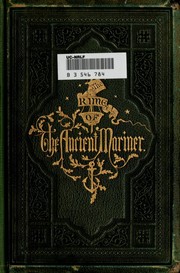
epic poem · 1798
The Rime of the Ancient Mariner
1798 poem by Samuel Taylor Coleridge
- 1798
- epic poem
- poetry
Summary
The Rime of the Ancient Mariner, written by English poet Samuel Taylor Coleridge in 1797–98 and published in 1798 in the first edition of Lyrical Ballads, is a poem that recounts the experiences of a sailor who has returned from a long sea voyage. Some modern editions use a revised version printed in 1817 that featured a gloss.
Source: Wikipedia (CC BY-SA).
Historical Background
Coleridge composed "The Rime of the Ancient Mariner" in 1797-98, largely while living at Nether Stowey during his close creative partnership with William Wordsworth. The poem opened the jointly published 1798 volume Lyrical Ballads, a collection that helped launch English Romanticism by turning away from eighteenth-century poetic diction toward ballad forms and imaginative, supernatural subject matter. In the Biographia Literaria (1817), Coleridge later explained the division of labour behind Lyrical Ballads: Wordsworth would treat ordinary life with the freshness of novelty, while Coleridge's task was to lend persons and incidents "in part at least supernatural" a "semblance of truth," securing "that willing suspension of disbelief for the moment, which constitutes poetic faith." The poem draws on maritime travel narratives, contemporary accounts of polar and southern-ocean voyages, and the diction and stanza patterns of traditional ballads. Coleridge revised the text for later editions, and in 1817 added a prose marginal gloss that reframes the narrative with an editorial, moralizing commentary running alongside the verse. The work reflects his engagement with questions of guilt, penance, and providence, and with the uncertain line between natural explanation and supernatural vision that runs through much of his poetry.
The Story
An old Mariner waylays a Wedding-Guest on his way to a wedding feast and, fixing him with his "glittering eye," compels him to hear his tale. The Mariner's ship is driven by a storm toward the South Pole and trapped among ice, until an Albatross appears, is welcomed by the crew as a bird of good omen, and guides the ship free. Without explained motive, the Mariner shoots the Albatross with his crossbow. The crew first condemns the act, then approves it once favourable winds return, making them complicit in the killing. The ship is becalmed near the equator; the sea rots, and the thirst-maddened crew hangs the dead bird around the Mariner's neck. A spectral ship arrives crewed by Death and "Life-in-Death," who dice for the souls aboard; Life-in-Death wins the Mariner, and the rest of the crew drop dead. Alone amid the corpses, the Mariner is finally moved to bless, unawares, the water-snakes playing in the moonlit sea; the Albatross falls from his neck and he is granted, in stages, the ability to pray and the mercy of a wind that carries the ship home, the dead crew's bodies animated by a troop of blessed spirits. Guided back to his native harbour, the Mariner is questioned by a Hermit, to whom he confesses; but the confession leaves him under a recurring compulsion to travel the earth telling his story wherever he recognizes the person who must hear it. He leaves the Wedding-Guest with the moral that one must love and pray for "all things both great and small," and the Guest turns from the wedding "a sadder and a wiser man."
Themes
- Sin, guilt, and penance
- Crime against nature and its consequences
- Isolation and alienation
- The supernatural and the boundary of natural explanation
- Suffering as a path to spiritual renewal
- Reverence for all living creatures
- Storytelling as compulsion and confession
- Providence and cosmic justice
Literary Devices
- Ballad form — quatrains with alternating tetrameter/trimeter and ABCB rhyme evoke folk tradition
- Archaism — deliberately antique diction and spelling lend the tale a timeless, legendary quality
- Marginal gloss (1817) — a prose commentary running beside the verse offers an interpretive, sometimes ironic counter-voice
- Repetition and refrain — incantatory repeated phrases build the poem's hypnotic, trance-like narration
- Vivid supernatural imagery — spectral ship, Death and Life-in-Death, animated corpses blur natural and supernatural
- Frame narrative — the Mariner's tale is told within the outer story of the Wedding-Guest, generating dramatic irony
- Alliteration and sound-patterning — dense sonic effects reinforce the ballad's musicality and mood
- Symbolic natural imagery — sun, moon, wind, and sea register the moral and spiritual state of the voyage
Symbolism
- The Albatross — an emblem of nature's grace and the burden of guilt once wantonly destroyed
- The sun — associated with judgment, thirst, and oppressive divine scrutiny
- The water-snakes — beauty in the lowliest creatures, whose blessing begins the Mariner's redemption
- Life-in-Death — a suspended, living damnation worse than death itself
- The wedding feast — ordinary human community and joy, from which the Mariner is permanently exiled
Critical Interpretation
Early responses, including some by Wordsworth, found the poem's supernatural machinery excessive, prompting Coleridge's later revisions and the added gloss. Nineteenth-century readers, and later critics such as John Livingston Lowes in The Road to Xanadu, traced its imagery to Coleridge's voracious reading in voyage and travel literature. Twentieth-century criticism split between moral-allegorical readings, which treat the poem as a parable of sin and redemption centred on reverence for creation, and readings, associated with critics like Humphry House and Robert Penn Warren, that stress its psychological and symbolic dimensions over strict allegory. Some critics have questioned whether the added marginal gloss should be read as authoritative moral guidance or as an ironic, unreliable frame that complicates rather than resolves the poem's meaning. The poem is also frequently discussed within Romanticism's broader concerns with the imagination, the sublime, and humanity's relationship to the natural world, and has attracted ecocritical readings focused on the Mariner's crime against a fellow creature.
Quotations
Water, water, every where, / Nor any drop to drink.
The becalmed crew's torment after the Albatross's death
Instead of the cross, the Albatross / About my neck was hung.
The crew burdens the Mariner with the dead bird as a mark of guilt
He prayeth best, who loveth best / All things both great and small.
The Mariner's closing moral to the Wedding-Guest
A sadder and a wiser man, / He rose the morrow morn.
The final lines describing the Wedding-Guest's transformation
Alone, alone, all, all alone, / Alone on a wide wide sea!
The Mariner's isolation amid his dead shipmates
Influence
The poem became a touchstone of English Romanticism and helped establish the aesthetic programme announced in Lyrical Ballads. Its fusion of ballad tradition with psychological and supernatural depth influenced later Romantic and Gothic writers and shaped subsequent treatments of guilt, isolation, and the uncanny in English poetry. Phrases and images from the poem, including the albatross as a burden of guilt and "water, water, everywhere," entered common English usage and later literary allusion. It has been cited as an influence on writers exploring maritime and psychological extremity, and its blending of narrative frame, gloss, and unreliable moral commentary has been studied as an early experiment in narrative technique.
Adaptations
- Gustave Doré's illustrated 1876 edition of the poem
- Iron Maiden's song "Rime of the Ancient Mariner" (1984), based on the poem
Related Works
- Lyrical Ballads (Wordsworth and Coleridge, 1798)
- Kubla Khan (Coleridge)
- Christabel (Coleridge)
- Frankenstein (Mary Shelley)
- Biographia Literaria (Coleridge, 1817)
Curator's Notes
- 1The poem opened the 1798 first edition of Lyrical Ballads, published anonymously with Wordsworth.
- 2Coleridge added the prose marginal gloss only in the 1817 Sibylline Leaves edition, decades after first composition.
- 3Coleridge's phrase about the 'willing suspension of disbelief,' coined in the Biographia Literaria while discussing this poem's aims, remains a standard term in literary criticism.
- 4The poem's vivid polar and oceanic imagery is often linked to Coleridge's extensive reading of contemporary travel and exploration narratives rather than personal seafaring experience.
For the Exam
UGC NET frequently tests this poem's place in Lyrical Ballads (1798) and Romantic literary history, Coleridge's theory of the supernatural and "willing suspension of disbelief" from the Biographia Literaria, the function of the 1817 marginal gloss, and the poem's ballad form and archaic diction. Expect questions on the symbolism of the Albatross, the roles of Death and Life-in-Death, the poem's structure as a frame narrative, and its closing moral. Familiarity with famous lines and their exact attribution to specific parts of the poem is commonly examined.