Summary
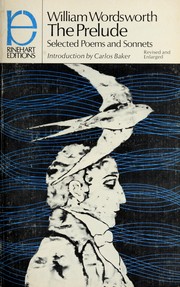
The Prelude or, Growth of a Poet's Mind; An Autobiographical Poem is an autobiographical poem in blank verse by the English poet William Wordsworth. Intended as the introduction to the more philosophical poem The Recluse, which Wordsworth never finished, The Prelude is an extremely personal work and reveals many details of Wordsworth's life.
Source: Wikipedia (CC BY-SA).
Historical Background
Wordsworth began The Prelude in 1798–99 while living in Germany with his sister Dorothy, at the urging of Samuel Taylor Coleridge, who envisioned it as the introductory portion of a vast philosophical poem, The Recluse. Composition continued for decades: a two-part version appeared in 1799, a thirteen-book version was completed in 1805, and Wordsworth continued revising it, producing an expanded fourteen-book text. He never published the poem in his lifetime, regarding it as a private preparatory exercise addressed to Coleridge rather than a finished public work. It appeared in print only in 1850, shortly after Wordsworth's death, under the title The Prelude, or, Growth of a Poet's Mind — a title supplied by his widow Mary. The poem grew directly out of the Romantic preoccupation with childhood, memory, and the formative power of nature, shaped by Wordsworth's Lake District upbringing, his time at Cambridge, his residence in revolutionary France, and his disillusionment with the Reign of Terror. Because multiple versions survive, scholars distinguish the 1805 and 1850 texts, which differ notably in tone and theological emphasis, the later version being more conventionally religious.
The Story
The Prelude traces the growth of the poet's own mind from infancy to maturity, structured as an extended address to Coleridge. It opens with the "glad preamble," Wordsworth's sense of liberation and vocation as he sets out to write. Subsequent books recount his childhood in the Lake District, where formative encounters with nature — boat-stealing, skating, birds'-nesting — instill both joy and a sense of nature's disciplining, almost moral presence, embodied in the concept of "spots of time," intense memories that retain a renovating power over the mind. The poem follows him to Cambridge, then to London, where he registers the confusing multiplicity of urban life, and to France during the Revolution, where he initially embraces revolutionary idealism before recoiling in horror from the Terror and the subsequent wars, a crisis that produces deep spiritual and imaginative despair. The later books describe his recovery of imaginative power, aided by nature and by his sister Dorothy, and culminate in the ascent of Mount Snowdon, an epiphany in which the natural scene becomes an emblem of the mind's own creative and unifying power. The poem closes with Wordsworth affirming his and Coleridge's shared prophetic vocation as poets, and the completed work itself stands as proof of the very growth it describes.
Themes
- The growth and formation of the poetic mind
- Nature as moral and spiritual teacher
- Memory and the persistence of childhood experience
- The Imagination as a redemptive, unifying power
- Disillusionment with the French Revolution
- The relationship between self and the natural world
- Poetic vocation and the figure of the poet-prophet
- Time, loss, and recollection
Literary Devices
- Blank verse — sustained unrhymed iambic pentameter giving the poem its meditative, epic gravity
- Spots of time — Wordsworth's own term for charged autobiographical memories that renew and sustain the mind
- Apostrophe — the poem is framed throughout as a direct address to Coleridge
- Egotistical sublime — Keats's term (later applied by critics) for Wordsworth's absorption of external nature into the drama of his own consciousness
- Blank-verse epic structure — books and an invocation modeled on Milton's Paradise Lost
- Symbolic landscape — natural scenes (crags, rivers, mountains) function as emblems of psychological and spiritual states
- Retrospective narration — the mature poet's voice continually reflects on and reinterprets the child's experience
Symbolism
- The Boat-stealing episode — nature's disciplining, almost punitive presence awakening conscience in the child
- Mount Snowdon — the mind's imaginative power to perceive unity beneath the sensory world
- The River Derwent — the nurturing, originating flow of formative experience
- Crossing the Alps (Simplon Pass) — the sublime and the imagination's power exceeding what the senses can grasp
Critical Interpretation
The Prelude has long been central to debates over Romantic subjectivity. Twentieth-century critics such as M. H. Abrams read the poem as a secularized spiritual autobiography, transposing the structure of religious conversion narrative onto the growth of the poet's mind, and situated it within Romantic natural supernaturalism. Keats's phrase "the egotistical sublime," originally applied to Wordsworth generally, has often been invoked to describe the poem's tendency to draw the external world into the orbit of the poet's own consciousness. Later, deconstructive and historicist critics, including Geoffrey Hartman and Jerome McGann, questioned the poem's claims to imaginative transcendence and examined how it displaces or evades the political turbulence of the French Revolution that it also narrates. Textual scholars have debated the relative merits of the 1805 and 1850 versions, with many modern readers and editors preferring the earlier, less doctrinally revised 1805 text as closer to Wordsworth's original imaginative achievement.
Quotations
There are in our existence spots of time, / That with distinct pre-eminence retain / A renovating virtue
Wordsworth's key formulation of memory's power to restore and sustain the mind.
Fair seed-time had my soul, and I grew up / Fostered alike by beauty and by fear
Describes nature's dual, disciplining influence on the young poet.
Influence
The Prelude is regarded as one of the founding texts of Romantic autobiography and the poetry of self-consciousness, decisively shaping the tradition of the long introspective poem. Its model of the mind's growth through memory influenced Victorian poets such as Tennyson and Matthew Arnold, and its psychological attentiveness to childhood anticipated later explorations of consciousness in poetry and prose alike. As a work published only posthumously, it also altered posterity's understanding of Wordsworth himself, revealing the private, decades-long labor behind his public reputation and reshaping twentieth-century criticism's account of Romanticism, particularly through its influence on scholars of the imagination such as M. H. Abrams.
Related Works
- Lyrical Ballads — William Wordsworth and Samuel Taylor Coleridge
- The Recluse — William Wordsworth (unfinished)
- Paradise Lost — John Milton
- Biographia Literaria — Samuel Taylor Coleridge
- Tintern Abbey — William Wordsworth
Curator's Notes
- 1Wordsworth never published The Prelude in his lifetime; it appeared only in 1850, months after his death, and the now-familiar title was chosen by his widow, Mary Wordsworth.
- 2The poem was originally intended merely as a preparatory exercise leading into a much larger, never-completed philosophical poem, The Recluse.
- 3Because Wordsworth revised the poem across decades, there exist distinct 1799, 1805, and 1850 versions, and scholars still debate which best represents his intentions.
- 4The poem is addressed throughout to Samuel Taylor Coleridge, who had urged Wordsworth to undertake it.
For the Exam
UGC NET frequently tests The Prelude as the paradigmatic Romantic autobiographical/confessional long poem, asking about its subtitle ("Growth of a Poet's Mind"), its posthumous 1850 publication, its address to Coleridge, its relation to the unfinished Recluse, and key concepts such as "spots of time" and the "egotistical sublime." Questions may also probe the difference between the 1805 and 1850 texts and Wordsworth's theory of poetic imagination and nature as expressed in the poem.