allegory · 1678
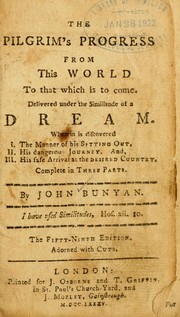
The Pilgrim’s Progress
by John Bunyan
1678 Christian allegory written by John Bunyan
- 1678
- allegory
Summary
The Pilgrim's Progress from This World, to That Which Is to Come is a 1678 Christian allegory written by the English nonconformist preacher John Bunyan. It is commonly regarded as one of the most significant works of Protestant devotional literature and of wider early modern English literature. It has been translated into more than 200 languages and has never been out of print. It appeared in Dutch in 1681, in German in 1703 and in Swedish in 1727. The first North American edition was issued in 1681. It has also been cited as the first novel written in English. According to literary editor Robert McCrum, "there's no book in English, apart from the Bible, to equal Bunyan's masterpiece for the range of its readership, or its influence on writers as diverse as William Hogarth, C. S. Lewis, Nathaniel Hawthorne, Herman Melville, Charles Dickens, Louisa May Alcott, George Bernard Shaw, William Thackeray, Charlotte Brontë, Mark Twain, John Steinbeck and Enid Blyton." The lyrics of the hymn "To be a Pilgrim" are based on the novel.
Source: Wikipedia (CC BY-SA).
Historical Background
John Bunyan (1628–1688), a Bedfordshire tinker turned Nonconformist preacher, wrote the bulk of The Pilgrim's Progress during one of his imprisonments for unlicensed preaching, the Conventicle Acts having criminalized worship outside the established Church of England. Published in 1678, with an expanded Part II following in 1684, the book emerged from a deeply Puritan milieu shaped by intense scrutiny of conscience, biblical literalism, and the spiritual autobiography tradition Bunyan had already practiced in Grace Abounding to the Chief of Sinners (1666). Its prose draws on the plain, vivid idiom of the Authorized (King James) Bible and on popular traditions of allegory and homiletic exemplum rather than on classical or courtly literary models. Bunyan had little formal education, and the book's power lies partly in its fusion of homely, everyday English speech with urgent theological seriousness. It was written, as the narrator states, in the form of a dream, a framing device that let Bunyan present doctrinal and psychological truths as concrete adventure. The book found an immediate and vast readership across social classes, went through multiple editions in Bunyan's lifetime, and became, alongside the Bible, one of the most widely read and translated works in the English language.
The Story
The narrator falls asleep and dreams of a man named Christian, burdened by a great weight on his back, who reads in a book (the Bible) that his city, the City of Destruction, is doomed. Warned by Evangelist, he flees his home and family and sets out for the Celestial City, seeking the Wicket Gate. Along the way he is nearly diverted by Mr. Worldly Wiseman into seeking relief through Morality, but Evangelist redirects him to the true path. Christian loses his burden at the foot of the Cross, passes through the Interpreter's House where he receives instructive visions, and journeys on through trials including the Hill Difficulty, the Valley of Humiliation (where he fights the monster Apollyon), and the terrifying Valley of the Shadow of Death. He is joined by Faithful, and together they pass through Vanity Fair, a town holding a perpetual worldly market, where Faithful is martyred and ascends to heaven while Christian is imprisoned but escapes. Christian gains a new companion, Hopeful, and the pair endure the seizure and imprisonment by Giant Despair in Doubting Castle before escaping using the key called Promise. After crossing the Delectable Mountains and being warned against the false shortcut through Bypath Meadow and the deceptions of Ignorance and Flatterer, they cross the River of Death and are received into the Celestial City. Part II, published in 1684, follows Christian's wife Christiana and their children on the same journey, guided by Greatheart, showing the pilgrimage as accessible to the whole Christian community.
Themes
- The individual's spiritual journey and salvation
- Sin, conviction, and conversion
- The trials and temptations of worldly life
- Perseverance and faith under adversity
- The contrast between the earthly and the eternal city
- Christian community and companionship in faith
- The deceptiveness of false doctrine and worldly wisdom
- Grace versus works
Literary Devices
- Allegory — characters, places, and events are systematic embodiments of spiritual states and doctrines
- Personification/naming allegory — characters bear names that declare their moral function (Mr. Worldly Wiseman, Giant Despair, Hopeful)
- Dream-vision frame — the entire narrative is presented as the narrator's dream, licensing symbolic license
- Biblical allusion and quotation — dense weaving of scriptural language and marginal citations throughout
- Episodic/quest structure — a linear journey through discrete symbolic trials toward a fixed goal
- Plain style — colloquial, direct English prose rather than ornate literary diction
- Dialogue-driven exposition — doctrinal points are worked out through conversations between characters
Symbolism
- The Burden — the weight of sin carried by Christian until he reaches the Cross
- The Wicket Gate — the narrow entrance representing the beginning of true faith
- Vanity Fair — the seductions and corruptions of worldly society and commerce
- The Slough of Despond — despair and doubt that mire the believer early in the journey
- Doubting Castle and Giant Despair — despair as a spiritual imprisonment from which faith (the key Promise) delivers the pilgrim
- The Celestial City — heaven, the believer's ultimate destination and reward
Critical Interpretation
Critical reception has long framed The Pilgrim's Progress as the great vernacular monument of English Puritanism, prized for making Calvinist theology accessible through concrete narrative and everyday speech. Early admirers praised its plain style as a democratic achievement, in contrast to the learned, Latinate prose of the period. Some critics and literary historians, following claims like those noted by Robert McCrum, have credited the work with anticipating the English novel through its attention to individual psychology, realistic dialogue, and sequential narrative, even though its allegorical scheme sets it apart from later realist fiction. Twentieth-century critics examined its structure as spiritual autobiography, tracing affinities with Bunyan's own conversion narrative in Grace Abounding to the Chief of Sinners. Feminist and social-historical readings have given increasing attention to Part II, noting how Christiana's communal, family-oriented pilgrimage complicates the individualist, masculine model of Part I. The book has also been studied for its place in the Nonconformist print culture of Restoration England and its enormous, cross-class popular readership.
Quotations
As I walked through the wilderness of this world, I lighted on a certain place where was a den, and I laid me down in that place to sleep: and, as I slept, I dreamed a dream.
The narrator's dream-vision frame, establishing the allegorical mode of the whole work
Some things are of that nature as to make / One's fancy chuckle, while his heart doth ache.
Bunyan's prefatory verse for Part II, reflecting on the mixture of delight and seriousness in his allegory
"What a fool," quoth he, "am I, thus to lie in a stinking dungeon, when I may as well walk at liberty! I have a key in my bosom, called Promise, that will, I am persuaded, open any lock in Doubting Castle."
Christian's exclamation at Doubting Castle, realizing he holds the key called Promise to escape Giant Despair
So I awoke, and behold it was a dream.
The narrator waking, closing the dream-vision frame
Influence
The Pilgrim's Progress became one of the most widely read books in the English language after the Bible, shaping devotional and popular literature across the Anglophone Protestant world. Its allegorical vocabulary (Vanity Fair, Slough of Despond, Giant Despair) entered common English usage and furnished titles and imagery for later writers, including Thackeray's Vanity Fair. It influenced the spiritual and moral imagination of novelists such as Nathaniel Hawthorne, Louisa May Alcott (Little Women structures its plot around the allegory), and Mark Twain, and was foundational reading in missionary and Nonconformist education. C. S. Lewis's The Pilgrim's Regress directly responds to it, and its dream-vision, quest structure has been cited as an influence on the development of the English novel's narrative techniques.
Adaptations
- To Be a Pilgrim, a hymn based on verses from the novel, adapted by Percy Dearmer
- The Pilgrim's Progress, an opera by Ralph Vaughan Williams (1951)
Related Works
- Grace Abounding to the Chief of Sinners by John Bunyan
- The Pilgrim's Regress by C. S. Lewis
- Vanity Fair by William Makepeace Thackeray
- Little Women by Louisa May Alcott
- The Faerie Queene by Edmund Spenser
- Paradise Lost by John Milton
Curator's Notes
- 1Bunyan wrote much of the book while imprisoned in Bedford for preaching without a license.
- 2It has been translated into more than 200 languages and has reportedly never been out of print since 1678.
- 3It has been argued by some literary historians to be a candidate for the first novel written in English, despite its allegorical form.
- 4Bunyan published a Part II in 1684, following Christian's wife Christiana and their children on the same pilgrimage.
- 5Phrases and place-names it coined, such as 'Vanity Fair' and 'Slough of Despond,' passed into general English usage.
For the Exam
UGC NET English commonly tests The Pilgrim's Progress as the foundational Puritan allegory bridging medieval allegorical tradition and the emerging English novel. Expect questions on its genre classification (prose allegory/dream-vision), authorship and biographical context (Bunyan's imprisonment and Nonconformist background), the allegorical names and set-piece episodes (Vanity Fair, Slough of Despond, Doubting Castle, Giant Despair), its relationship to Puritan spiritual autobiography, and its claimed status as a precursor of the English novel. Comparative questions may link it to Spenser's Faerie Queene or later Victorian works it influenced, such as Thackeray's Vanity Fair.