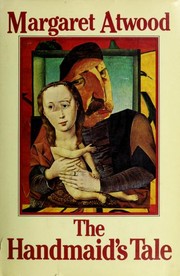
feminist science fiction · 1985
The Handmaid's Tale
1985 novel by Margaret Atwood
- 1985
- feminist science fiction
- social science fiction novel
- science fiction
- dystopian fiction
- historical fiction
Summary
The Handmaid's Tale is a futuristic dystopian novel by Canadian author Margaret Atwood published in 1985. It is set in a near-future New England in a patriarchal, totalitarian theonomic state known as the Republic of Gilead, which has overthrown the United States government. The protagonist, a woman named Offred, occupies the role of a "handmaid": women who are forcibly assigned to bear children for high status men.
Source: Wikipedia (CC BY-SA).
Historical Background
Margaret Atwood wrote The Handmaid's Tale in the mid-1980s, partly while living in West Berlin before the fall of the Wall, drawing on her sense of surveillance and totalitarian control. Published in 1985, the novel emerged amid the rise of the American religious right, Reagan-era politics, and renewed feminist debates over reproductive rights, pornography, and women's roles. Atwood has repeatedly stated her rule was to include no event or technology that did not have a historical precedent somewhere in human history—Puritan New England theocracy, Nazi Germany, the Romanian Ceaușescu regime's birth policies, slavery, and totalitarian surveillance states all inform Gilead's institutions. The novel's setting, the Republic of Gilead, is built atop Cambridge, Massachusetts, evoking America's Puritan founding and its legacy of religious extremism. Atwood, a Canadian, writes as an outside observer of American political culture, and the novel belongs to the tradition of speculative fiction (a term Atwood herself prefers to science fiction) that extrapolates from real social and political tendencies. It won the 1985 Governor General's Award and the first Arthur C. Clarke Award (1987), and was a finalist for the 1986 Booker Prize, cementing its status as a landmark of twentieth-century dystopian literature alongside Orwell's Nineteen Eighty-Four and Huxley's Brave New World.
The Story
The novel is narrated by Offred, a Handmaid in the Republic of Gilead, a theocratic totalitarian state that has overthrown the United States government in response to a fertility crisis. Stripped of her former name, family, and identity, Offred is assigned to bear children for a high-ranking Commander and his wife, Serena Joy, under a rigid caste system of Wives, Handmaids, Marthas, Aunts, and Econowives. Through fragmented memories, Offred recalls her earlier life with her husband Luke and daughter, both lost when she was captured attempting to flee to Canada, and her indoctrination at the Red Center under the brutal Aunt Lydia. In the present, Offred navigates the claustrophobic household of the Commander, who initiates secret, forbidden meetings with her that break Gilead's rules, and Serena Joy, who arranges a clandestine liaison between Offred and the chauffeur Nick to increase the chances of pregnancy. Offred also reconnects with her friend Moira, now a prostitute at a state-sanctioned brothel, and becomes entangled with Ofglen, a member of an underground resistance network called Mayday. As Offred's relationships deepen and the risks multiply, she is caught between despair, complicity, and small acts of rebellion. The novel ends ambiguously as Offred is taken away in a van, uncertain whether it signals rescue or arrest. A closing section, "Historical Notes," frames the entire narrative as a transcribed cassette-tape testimony discovered and studied by future academics at a 2195 symposium, reframing Offred's personal account as a historical artifact subject to scholarly interpretation and doubt.
Themes
- Control of women's bodies and reproductive autonomy
- Totalitarianism and the machinery of state power
- Language, naming, and the erasure of identity
- Complicity, silence, and survival under oppression
- Religious fundamentalism as political instrument
- Memory and storytelling as resistance
- Gender roles and enforced hierarchies among women
- The fragility of civil rights and historical amnesia
Literary Devices
- First-person fragmented narration — mirrors Offred's psychological trauma and unreliable, reconstructed memory
- Flashback and non-linear structure — juxtaposes the 'time before' with Gileadean present to sharpen critique
- Framed narrative (the Historical Notes epilogue) — destabilizes the authenticity and authority of Offred's testimony
- Euphemism and Newspeak-like renaming — 'Ceremony,' 'Salvaging,' 'Particicution' mask violence with bureaucratic language
- Dramatic irony and ambiguity — the open ending withholds resolution to implicate the reader in uncertainty
- Symbolic use of color-coded costume — visually encodes the caste and reproductive system of Gilead
- Intertextual allusion to the Bible and Puritan history — grounds Gilead's ideology in real theological precedent
- Direct address and self-conscious narration — Offred repeatedly questions her own reconstruction of events
Symbolism
- The red habit — fertility, blood, sin, and enforced visibility of the Handmaids
- Serena Joy's tulips and garden — suppressed female desire and fertility displaced into ornament
- The mock-Latin phrase 'Nolite te bastardes carborundorum' — hidden resistance and solidarity passed between Handmaids
- Eyes and the Eyes (secret police) — surveillance, complicity, and loss of privacy
- Scrabble game with the Commander — forbidden intellectual and verbal freedom under patriarchal control
- The empty, hollowed-out chandelier and light fixtures — the threat and history of suicide/escape within Gilead households
Critical Interpretation
The Handmaid's Tale has been central to feminist literary criticism since its publication, read as a critique of patriarchal control over reproduction and a warning against complacency about hard-won rights. Some early feminist critics debated whether the novel's focus on a white, heterosexual, middle-class protagonist limited its intersectional scope, a critique later engaged with more directly in Atwood's sequel, The Testaments. Critics have situated it within the dystopian tradition alongside Orwell and Huxley, emphasizing Atwood's insistence that every element of Gilead has historical precedent, which grounds the novel's mode of "speculative fiction" rather than pure science fiction. Poststructuralist and narratological readings focus heavily on the "Historical Notes" epilogue, arguing it destabilizes Offred's authority as narrator and comments on how women's testimony is historically filtered, doubted, and academically appropriated by patriarchal institutions. The novel is also widely taught for its treatment of language as an instrument of power, and its ambiguous ending has generated extensive debate over interpretations of hope, complicity, and resistance.
Quotations
Nolite te bastardes carborundorum.
Mock-Latin phrase scratched into Offred's closet by a previous Handmaid, becoming a covert token of resistance.
Context is all.
Offred's recurring reflection, echoing Aunt Lydia's teaching, on how meaning and morality shift depending on circumstance.
I am a cloud, congealed around a central object, the shape of a pear, which is hard and more real than I am.
Offred describing her sense of reduction to a womb/reproductive vessel during the Ceremony.
Influence
The Handmaid's Tale is one of the most influential dystopian novels of the late twentieth century, frequently paired with Orwell's Nineteen Eighty-Four and Huxley's Brave New World in discussions of totalitarian fiction. It helped establish and popularize feminist dystopia as a distinct literary mode, shaping later works exploring gendered oppression, reproductive control, and state surveillance. The 2017 Hulu television adaptation renewed the novel's cultural prominence, and its red-cloaked, white-bonneted Handmaid costume became an internationally recognized symbol of protest at reproductive-rights demonstrations. Atwood's own 2019 sequel, The Testaments, extended the novel's world and won the Booker Prize, further cementing its literary legacy.
Adaptations
- Film (1990), directed by Volker Schlöndorff, screenplay by Harold Pinter
- Opera (2000) by Poul Ruders, libretto by Paul Bentley
- Television series The Handmaid's Tale (2017–2025, Hulu), starring Elisabeth Moss
Related Works
- Nineteen Eighty-Four by George Orwell
- Brave New World by Aldous Huxley
- The Testaments by Margaret Atwood
- We by Yevgeny Zamyatin
- The Bell Jar by Sylvia Plath
- Oryx and Crake by Margaret Atwood
Curator's Notes
- 1Atwood wrote much of the novel on a manual typewriter while living in West Berlin in 1984, before the fall of the Berlin Wall.
- 2Atwood's self-imposed rule was to include no invented technology or event that did not have a real historical precedent.
- 3The novel won the inaugural Arthur C. Clarke Award for science fiction in 1987.
- 4The red Handmaid costume from the Hulu adaptation has been widely adopted as a real-world protest symbol at reproductive-rights rallies.
- 5The book was a finalist for the 1986 Booker Prize, decades before its sequel The Testaments won the award in 2019.
For the Exam
UGC NET English frequently tests The Handmaid's Tale under dystopian/feminist fiction and postmodern narrative technique. Expect questions on Atwood's biographical and Canadian literary context, the novel's genre classification (speculative vs. science fiction), its narrative structure (frame narrative, the "Historical Notes" epilogue), feminist theoretical approaches to the text, key symbols (the red habit, Nolite te bastardes carborundorum), and comparisons with Orwell's Nineteen Eighty-Four and Huxley's Brave New World as canonical dystopias.