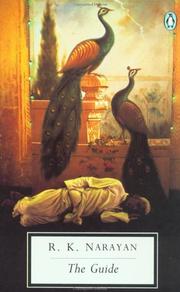
fiction · 1958
The Guide
novel by Indian author R.K. Narayan
- 1958
- fiction
- philosophical fiction
Summary
The Guide is a 1958 novel written in English by the Indian author R. K. Narayan. Like most of his works, the events of this novel take place in Malgudi, a fictional town in South India. The novel describes the transformation of the protagonist, Raju, from a tour guide to a spiritual guide and then one of the greatest holy men of India.
Source: Wikipedia (CC BY-SA).
Historical Background
R. K. Narayan published The Guide in 1958, during a highly productive period in which he had established his fictional South Indian town of Malgudi as the setting for most of his fiction. Narayan wrote much of the novel while on a Rockefeller Foundation fellowship in the United States, and the book appeared as his international reputation was rising, aided by Graham Greene's longstanding championing of his work to British publishers. The novel draws on Narayan's recurring concerns: the encounter between traditional Hindu social and religious life and the pressures of modernity, tourism, commerce, and colonial-era institutions such as the railway. It reflects his lasting interest in sainthood, imposture, and the porous line between the two, treated with irony rather than solemnity. The Guide won the Sahitya Akademi Award in 1960, the first novel written in English to receive India's national literary honour, cementing Narayan's status as a major voice of Indian writing in English. The novel is notable for its structure, alternating between past and present through flashback, and for its ambiguous, much-debated ending, which continues to generate critical discussion about redemption, self-transformation, and the reliability of Raju as narrator of his own past.
The Story
The novel centers on Raju, a railway tour guide in Malgudi who becomes entangled with Rosie, an unhappily married woman and gifted classical dancer whose archaeologist husband, Marco, neglects her artistic passion. Raju encourages and manages Rosie's career as a dancer, and the two become lovers; Rosie leaves Marco and, under Raju's management and the stage name Nalini, rises to fame as a celebrated performer. As Raju grows wealthy and complacent through Rosie's success, his judgment deteriorates: he forges Rosie's signature on a legal document concerning jewelry left by Marco, is discovered, and is sentenced to prison. The narrative moves between this past, recounted largely through Raju's own recollections to a villager named Velan, and his present situation: released from prison, Raju drifts to a remote village and takes shelter in an abandoned temple by a river. Mistaken by the credulous villagers for a holy man because of his beard and manner, Raju is drawn ever deeper into the role of spiritual guide, dispensing counsel he does not really possess. When drought strikes the region, the villagers come to believe that Raju must undertake a fast to bring rain, as tradition holds a holy man's austerity can do. Raju, trapped by his own accumulated deceptions and the villagers' faith, cannot easily refuse and undertakes the fast. The novel ends as a weakened Raju, on the final day of his fast, wades into the river at dawn, telling Velan that the rain is coming as his legs give way beneath him — leaving open whether this is death, miracle, or ambiguous transcendence.
Themes
- Illusion versus reality and the making of a false saint
- Transformation and the instability of identity
- Tension between tradition and modernity in post-independence India
- Karma, guilt, and moral consequence
- The corrupting effect of success and material comfort
- Art, performance, and the exploitation of talent
- Irony of sainthood thrust upon an unwilling imposter
- Selfhood, freedom, and imprisonment (literal and spiritual)
Literary Devices
- Frame narrative and flashback — the novel alternates between Raju's first-person recollections and third-person present-tense village scenes
- Dramatic and situational irony — Raju's spiritual authority arises entirely from villagers' misreading of him
- Unreliable narration — Raju's self-serving retelling of his own past invites reader skepticism
- Symbolic setting — the river, the abandoned temple, and the railway carry recurring symbolic weight
- Comic and satiric tone — gentle irony undercuts both Raju's opportunism and villagers' credulity
- Circular/parallel structure — Raju's earlier role as tourist 'guide' mirrors his later role as spiritual 'guide'
Symbolism
- The river — sustenance, purification, and the site of Raju's final ambiguous act
- The abandoned temple — decayed tradition repurposed and reanimated through belief
- The railway and tourism — the intrusion of modern commerce into traditional life
- Rosie's dance — authentic art versus the ways it is packaged and commodified
- Raju's beard and appearance — the arbitrary, external signs by which sanctity is conferred
Critical Interpretation
Critics have long debated the novel's famously ambiguous ending, disagreeing over whether Raju achieves genuine spiritual transformation, dies a meaningless death still trapped in performance, or occupies a deliberately unresolved middle ground that is the novel's real point. Many readings emphasize Narayan's characteristic irony, arguing that the novel is less about mysticism than about the human tendency to construct and believe convenient fictions, both social and religious. Postcolonial critics have read the novel's juxtaposition of an English-educated, commercially minded Raju against village tradition as an allegory of independent India's negotiation between modernity and inherited belief. Feminist critics have examined Rosie/Nalini as a rare Narayan heroine who achieves independent artistic success despite being defined largely through the men who manage her. The novel's reception was shaped in part by Graham Greene's advocacy of Narayan in the West, and it remains central to discussions of Narayan's ironic, understated comic realism and his place in the Indian English novel tradition alongside contemporaries like Mulk Raj Anand and Raja Rao.
Quotations
Velan, it's raining in the hills. I can feel it coming up under my feet, up my legs—
Raju's final words to Velan as his fast ends and his legs give way, the novel's famously ambiguous closing line
He realized that he had no alternative: he must play the role that Velan had given him.
Narration capturing Raju's entrapment in the holy-man role imposed on him by the villagers' faith
Influence
The Guide is widely regarded as one of the most influential Indian English novels, helping establish Malgudi as a lasting fictional territory in South Asian literature comparable to other great localized fictional worlds. It broadened international readership for Indian English fiction in the mid-twentieth century, aided by Graham Greene's advocacy, and its ironic treatment of sainthood and self-invention influenced later Indian writers exploring the gap between public role and private self. The novel's success, including the Sahitya Akademi Award, helped legitimize Indian English fiction as a serious literary tradition rather than a derivative colonial form, paving the way for later generations of Indian novelists writing in English.
Adaptations
- Guide (1965), Hindi-language film directed by Vijay Anand, starring Dev Anand and Waheeda Rehman
Related Works
- Swami and Friends by R. K. Narayan
- The Financial Expert by R. K. Narayan
- The English Teacher by R. K. Narayan
- Untouchable by Mulk Raj Anand
- Kanthapura by Raja Rao
- A House for Mr Biswas by V. S. Naipaul
Curator's Notes
- 1The Guide was awarded the Sahitya Akademi Award, one of India's highest literary honours, in 1960 — the first novel written in English to receive it.
- 2Narayan wrote portions of the novel while in the United States on a Rockefeller Foundation fellowship, far from the Malgudi setting he depicts.
- 3The 1965 Hindi film adaptation, Guide, is itself considered a landmark of Indian cinema and departs from the novel's ending.
- 4Malgudi, the fictional town in which The Guide and most of Narayan's novels are set, has no single real-world location but is often associated with towns in South India such as Mysore.
For the Exam
UGC NET English questions on The Guide typically focus on its place in Indian English fiction and R. K. Narayan's Malgudi cycle, the significance of its Sahitya Akademi Award, its narrative technique of alternating past and present through Raju's flashbacks, and the ambiguity of its ending as a site of critical debate. Examiners may also test knowledge of character relationships (Raju, Rosie/Nalini, Marco, Velan), the theme of the unwitting or reluctant holy man, and comparisons with Narayan's other Malgudi novels and with contemporaries like Mulk Raj Anand and Raja Rao in the postcolonial Indian novel tradition.