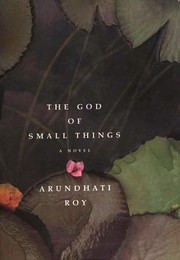
magic realist fiction · 1997
The God of Small Things
1997 novel by Arundhati Roy
- 1997
- magic realist fiction
Summary
The God of Small Things is the 1997 debut novel written by Indian author Arundhati Roy. The novel follows the seven-year-old twins Estha and Rahel as they navigate their childhood and the circumstances surrounding the arrival of their British cousin to Ayemenem, India. The novel's events are set against the backdrop of social discrimination and political upheaval in 1960s Kerala, with casteism and British colonialism in India being central themes.
Source: Wikipedia (CC BY-SA).
Historical Background
Arundhati Roy wrote The God of Small Things over several years while living in Delhi, publishing it in 1997 as her debut novel; she had previously trained as an architect and written screenplays. The book appeared fifty years after Indian independence and won the Booker Prize that year, making Roy the first Indian woman and non-expatriate Indian writer to receive it. The narrative draws on Roy's own background: she grew up partly in Ayemenem, Kerala, in a Syrian Christian family, a milieu closely echoed in the novel's setting. The book is set against the specific history of Kerala — a region with a strong Communist Party presence, a visible Syrian Christian community, and rigid caste hierarchies coexisting with claims of progressive politics. Roy interweaves this regional and historical specificity (Communist politics, colonial legacies, the Kerala backwaters) with an intimate family tragedy. The novel's nonlinear structure, moving between 1969 and the early 1990s, and its dense, poetic, neologism-rich prose marked a distinctive departure from realist conventions in Indian English fiction, and its commercial and critical success significantly boosted global visibility for Indian writing in English.
The Story
The novel centers on fraternal twins Estha and Rahel, growing up in Ayemenem, Kerala, in a Syrian Christian family that runs a pickle factory. The narrative moves between 1969, when the twins are seven, and the early 1990s, when they are reunited as adults. In 1969, their English-Indian cousin Sophie Mol visits with her mother Margaret Kochamma, setting off a chain of events. The twins' mother, Ammu, divorced and living under her family's disapproval, enters into a secret relationship with Velutha, a Paravan (untouchable) carpenter at the family's pickle factory. The relationship transgresses the caste-based "Love Laws" that dictate who should be loved, and how, and how much. When the affair is discovered and Sophie Mol drowns in the river, the family's fear and prejudice lead them to falsely implicate Velutha, who is brutally beaten by police and dies in custody. Ammu is driven from the family home and dies alone and impoverished; the twins are separated for over twenty years, Estha sent away and rendered silent by trauma. The adult sections show Rahel returning to Ayemenem and the twins' eventual, devastating reunion, as the novel circles back to reveal the full, forbidden intimacy at the story's center. Roy tells the story achronologically, withholding and repeating key scenes so that the reader assembles the tragedy gradually, from fragments and a child's-eye perspective.
Themes
- Caste and untouchability
- Transgression of social and sexual boundaries (the 'Love Laws')
- Childhood innocence and its loss
- Colonial legacy and Anglophilia in postcolonial India
- Gender, patriarchy, and women's constrained autonomy
- Family, shame, and social respectability
- Political hypocrisy (Communism and caste in Kerala)
- Memory, time, and the persistence of the past
Literary Devices
- Nonlinear/fractured narrative — the story loops between 1969 and the 1990s, withholding the central tragedy until late
- Free indirect discourse and a child's perspective — much of the narration filters events through Estha and Rahel's perception
- Neologism and wordplay — invented compounds and capitalized phrases (e.g. 'Two Thoughts') render a child's linguistic imagination
- Repetition and refrain — recurring phrases and images (the 'Love Laws', the river) accrue meaning with each return
- Foreshadowing — the narrative repeatedly hints at Sophie Mol's death and Velutha's fate long before revealing them fully
- Lyrical, sensory prose style — dense imagery and rhythm give the novel a poetic, almost incantatory texture
- Symbolic use of setting — the Meenachal river and the decaying History House anchor the novel's moral and historical concerns
Symbolism
- The Meenachal River — connection and transgression, but also death and irrevocable loss
- The History House — the weight of colonial and caste history bearing down on the present
- The 'Love Laws' — the invisible social codes governing permissible desire and relationship
- Small things versus Big things — the private, intimate, and easily crushed set against impersonal historical and social forces
- Sophie Mol's death — the catalyst that exposes and hardens the family's prejudices
Critical Interpretation
The God of Small Things has been widely read through postcolonial and feminist frameworks, examining how caste, gender, and the residue of British colonialism intersect to constrain the novel's characters, especially Ammu and Velutha. Critics have discussed Roy's experimental, poetic prose style — its neologisms, repetitions, and nonlinear structure — as a formal enactment of trauma and childhood memory, while others have situated the novel within debates about the global marketing and reception of Indian English fiction after its Booker Prize win. The novel's frank treatment of caste violence and inter-caste sexual transgression has drawn both praise for its unflinching social critique and controversy in India, including obscenity charges related to its depiction of sexuality that were later dismissed by the Kerala High Court. Scholars have also debated its portrayal of Kerala's Communist movement as complicit in caste oppression despite its egalitarian rhetoric, reading the novel as a critique of political hypocrisy alongside its intimate family narrative.
Quotations
Little events, ordinary things, smashed and reconstituted. Imbued with new meaning.
They all tampered with the laws that lay down who should be loved and how. And how much.
Referring to the 'Love Laws' that govern permissible relationships in the novel
Things can change in a day.
Influence
The God of Small Things, and its Booker Prize win, significantly raised the international profile of Indian writing in English and encouraged Western publishers to seek out new Indian novelists, contributing to a wave of interest in South Asian fiction in the late 1990s and 2000s. Its stylistic ambition — a lyrical, nonlinear, child-centered narrative addressing caste and political violence — has been cited as an influence on subsequent Indian English novelists exploring similarly intimate, historically embedded family stories. Roy's success also demonstrated that a debut novel steeped in regional Indian specificity could achieve major global literary recognition without diluting its social critique.
Related Works
- Midnight's Children by Salman Rushdie
- A Fine Balance by Rohinton Mistry
- The Inheritance of Loss by Kiran Desai
- Untouchable by Mulk Raj Anand
- The Ministry of Utmost Happiness by Arundhati Roy
Curator's Notes
- 1The God of Small Things was Arundhati Roy's debut novel, and she did not publish another novel for twenty years, until The Ministry of Utmost Happiness (2017).
- 2Roy trained as an architect before becoming a writer, and has spoken about how spatial and structural thinking shaped the novel's nonlinear form.
- 3The novel made Roy the first Indian woman and non-expatriate Indian author to win the Booker Prize.
- 4The novel faced obscenity charges in India over its depiction of sexuality, filed by a lawyer in Kerala; the case was ultimately dismissed by the Kerala High Court a decade later.
- 5Roy has continued to be an outspoken political essayist and activist alongside her fiction writing.
For the Exam
UGC NET frequently tests The God of Small Things on: its 1997 publication and Booker Prize win; its setting in Ayemenem, Kerala and the Syrian Christian milieu; the twins Estha and Rahel as narrative center; the caste transgression at the plot's core (Ammu and Velutha, the "Love Laws"); its nonlinear, fragmented narrative technique; and its place within postcolonial and feminist literary criticism as a critique of caste, gender, and political hypocrisy in post-independence India.