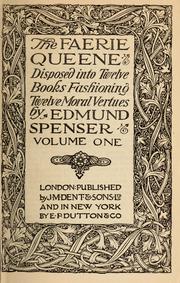
fantasy · 1590
The Faerie Queene
English epic poem by Edmund Spenser
- 1590
- fantasy
Summary
The Faerie Queene is an English epic poem by Edmund Spenser. Books I–III were first published in 1590, then republished in 1596 together with books IV–VI. The Faerie Queene is notable for its form: at 3,848 stanzas and nearly 35,000 lines, it is one of the longest poems in the English language; it is also the work in which Spenser invented the verse form known as the Spenserian stanza. On a literal level, the poem follows several knights as a means to examine different virtues. The poem is also an allegorical work. As such, it can be read on several levels, including as praise of Queen Elizabeth I. In Spenser's "Letter of the Authors", he states that the entire epic poem is "cloudily enwrapped in Allegorical devices", and that the aim of publishing The Faerie Queene was to "fashion a gentleman or noble person in virtuous and gentle discipline".
Source: Wikipedia (CC BY-SA).
Historical Background
Edmund Spenser began The Faerie Queene while in the service of the Earl of Leicester and later composed much of it in Ireland, where he held an administrative post. Books I–III were published in 1590, dedicated to Queen Elizabeth I; a revised edition with Books IV–VI appeared in 1596. Spenser prefaced the poem with a "Letter of the Authors" to Sir Walter Ralegh explaining his intent: to "fashion a gentleman or noble person in vertuous and gentle discipline" through allegory modeled on Ariosto and Tasso. The poem was conceived as a twelve-book (later reduced) national epic in the tradition of Virgil and the Italian romance-epic, blending Arthurian legend, chivalric romance, and Protestant moral allegory to honor Elizabeth as Gloriana. Spenser invented the Spenserian stanza (eight iambic pentameter lines plus a closing alexandrine, rhyming ababbcbcc) for the work. The poem remained unfinished at his death in 1599; only six of the planned twelve books, plus the fragmentary "Mutabilitie Cantos," survive.
The Story
The Faerie Queene is organized around six completed books, each following a knight who embodies and is tested in a particular virtue, all operating under commission from Gloriana, the Faerie Queene, who represents Elizabeth I. Book I follows the Redcrosse Knight (Holiness), who battles the dragon Errour, is deceived by the sorcerer Archimago and the false Duessa, and is ultimately reunited with the truth-figure Una before slaying a great dragon, allegorizing the Protestant soul's struggle against Catholic corruption and sin. Book II follows Sir Guyon (Temperance), whose trials culminate in the destruction of the Bower of Bliss, the domain of the enchantress Acrasia. Book III introduces Britomart, a female knight representing Chastity, whose quest is bound up with her love for Artegall. Book IV treats Friendship, Book V treats Justice through Artegall's adventures (with topical allegory of Elizabethan politics, including the execution of Mary, Queen of Scots), and Book VI treats Courtesy through Sir Calidore. The surviving "Two Cantos of Mutabilitie," probably intended for a later book, depict the Titaness Mutabilitie challenging the Olympian gods for cosmic rule, arbitrated by Nature. Throughout, the literal chivalric narrative operates as sustained allegory of moral, religious, and political meaning.
Themes
- Holiness and the struggle against sin
- Temperance and self-restraint
- Chastity and virtuous love
- Friendship and loyalty
- Justice and political order
- Courtesy and civility
- The instability of the material world (mutability)
- Protestant nationalism and praise of Elizabeth I
Literary Devices
- Allegory — characters, places, and events consistently signify moral, religious, and political meanings
- Spenserian stanza — Spenser's invented nine-line stanza (ababbcbcc) with a closing alexandrine
- Archaism — deliberately antiquated diction evoking Chaucer and medieval romance
- Personification — abstract virtues and vices embodied as knights, monsters, and enchanters
- Romance-epic structure — interlaced quests modeled on Ariosto and Tasso
- Topical/political allegory — figures and events alluding to Elizabethan court and religious politics
- Ekphrasis and elaborate descriptive set-pieces — e.g., the House of Pride, the Bower of Bliss
- Numerology and symbolic patterning — structural use of numbers (e.g., twelve books, virtues) tied to Renaissance cosmology
Symbolism
- The Redcrosse Knight — Everyman/English Protestant soul, and St. George
- Una — Truth and the true (Protestant) Church
- Duessa — Falsehood and the Catholic Church (associated with Mary, Queen of Scots)
- Gloriana, the Faerie Queene — Queen Elizabeth I and ideal glory/majesty
- The Bower of Bliss — seductive but corrupting sensual pleasure
- Britomart — chastity as active virtue, and a figure linked to Elizabeth
Critical Interpretation
Criticism of The Faerie Queene has long centered on its allegorical method and unfinished, sprawling form. C. S. Lewis's influential mid-twentieth-century readings (in The Allegory of Love and English Literature in the Sixteenth Century) framed Spenser as heir to medieval allegorical romance and praised the poem's moral seriousness and "golden" style. Later critics, including A. C. Hamilton and others associated with the rise of New Historicism, emphasized the poem's dense engagement with Elizabethan politics, religion, and colonial Ireland, reading its allegory as inseparable from Tudor propaganda and Spenser's own colonial administrative career. Feminist critics have examined the poem's complex treatment of female power through figures like Britomart, Belphoebe, and the Faerie Queene herself, set against the poem's patriarchal moral framework. The poem's incompleteness has also generated scholarly debate about its intended twelve-book structure and the significance of the surviving Mutabilitie Cantos as a coda on cosmic change. Modern scholarship continues to explore Spenser's syncretic use of classical, biblical, and Italian Renaissance sources.
Quotations
Fierce warres and faithfull loves shall moralize my song.
Closing line of the opening Proem stanza, announcing the poem's dual matter of chivalric conflict and love, cast as moral allegory.
A gentle knight was pricking on the plaine,
The famous opening line introducing the Redcrosse Knight.
And all for love, and nothing for reward.
From the meditation on guardian angels who serve and defend humankind purely out of love; often quoted regarding selfless service.
Influence
The Faerie Queene shaped the course of English poetry for centuries. Its invented stanza form, the Spenserian stanza, was revived by later poets, including James Thomson in the eighteenth century (The Castle of Indolence) and, in the Romantic era, Lord Byron (Childe Harold's Pilgrimage), Percy Bysshe Shelley (Adonais), and John Keats (The Eve of St. Agnes). Spenser's archaic diction and allegorical method influenced Milton, who praised him as a moral teacher, and left a lasting mark on the English pastoral and epic traditions. The poem cemented Spenser's reputation as "the poet's poet" and established a model for combining national myth-making, moral allegory, and elaborate verse artistry that later poets continued to study and imitate.
Related Works
- Orlando Furioso by Ludovico Ariosto
- Gerusalemme Liberata by Torquato Tasso
- Le Morte d'Arthur by Thomas Malory
- The Shepheardes Calender by Edmund Spenser
- Paradise Lost by John Milton
- The Canterbury Tales by Geoffrey Chaucer
Curator's Notes
- 1At roughly 35,000 lines and 3,848 stanzas, The Faerie Queene is one of the longest poems in the English language.
- 2Spenser invented the Spenserian stanza specifically for this poem.
- 3The poem was left unfinished at Spenser's death in 1599, with only six of a planned twelve (or more) books completed.
- 4Spenser addressed a prefatory 'Letter of the Authors' to Sir Walter Ralegh explaining the poem's allegorical purpose.
- 5Queen Elizabeth I reportedly granted Spenser a pension after the poem's publication.
For the Exam
UGC NET frequently tests the Spenserian stanza's form and origin, the allegorical scheme of Books I–VI and their associated virtues (Holiness, Temperance, Chastity, Friendship, Justice, Courtesy), the identification of Redcrosse, Una, Duessa, Britomart, and Gloriana, the poem's dedication to Elizabeth I, the "Letter to Ralegh," and Spenser's stated aim of fashioning "a gentleman or noble person in vertuous and gentle discipline." Questions also probe influence on later poets who used the Spenserian stanza.