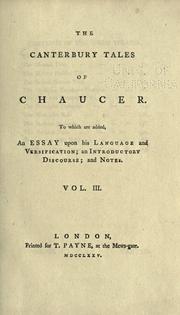
English-language literature · 1387
The Canterbury Tales
collection of stories written in Middle English by Geoffrey Chaucer
- 1387
- English-language literature
Summary
The Canterbury Tales are an anthology of twenty-four short stories written in Middle English by Geoffrey Chaucer between 1387 and 1400. They are mostly in verse, and are presented as part of a fictional storytelling contest held by a group of pilgrims travelling from London to Canterbury in order to visit the shrine of Saint Thomas Becket at Canterbury Cathedral.
Source: Wikipedia (CC BY-SA).
Historical Background
Geoffrey Chaucer (c.1343–1400), a court poet, diplomat, and customs official under Richard II, composed The Canterbury Tales in Middle English between roughly 1387 and 1400, leaving it unfinished at his death. It drew on his wide reading of French, Italian (notably Boccaccio's Decameron), and classical literature, as well as his own experience travelling on royal business, to fashion something new in English letters: a frame narrative uniting stories told by pilgrims of sharply differing social rank, occupation, and temperament. The pilgrims gather at the Tabard Inn in Southwark before riding to Canterbury Cathedral, shrine of the martyred Archbishop Thomas Becket, a popular medieval pilgrimage destination. Chaucer's plan, announced in the General Prologue, called for each of roughly thirty pilgrims to tell four tales, which would have produced well over a hundred stories; only twenty-four survive, several unfinished. Written mostly in verse (with two prose pieces), the work is prized for founding a vernacular literary tradition in English at a time when French and Latin dominated serious writing, and for its unprecedented social range, from knight and prioress to miller, pardoner, and wife of Bath.
The Story
The work opens with the General Prologue, in which the narrator describes twenty-nine pilgrims assembling at the Tabard Inn before setting out for Canterbury. The Host, Harry Bailly, proposes a storytelling contest to pass the journey, with a free meal for whoever tells the best tale. What follows is a sequence of tales linked by prologues and dramatic interludes in which the pilgrims argue, interrupt, and comment on one another, so that the frame narrative becomes as vivid as the tales themselves. The Knight's noble romance of Palamon and Arcite is answered by the Miller's bawdy fabliau of adultery and trickery; the Wife of Bath's Prologue offers a lengthy defense of female experience and mastery in marriage before her tale of a knight who must learn what women truly want; the Pardoner boasts of his own hypocrisy before telling a moral tale against greed; and other pilgrims, including the Clerk, the Franklin, the Merchant, and the Prioress, contribute stories ranging from courtly romance to fable, saint's legend, and moral exemplum. The collection breaks off incomplete, closing with the Parson's sober prose treatise on penance and Chaucer's own "Retraction," in which the poet asks forgiveness for his worldlier writings.
Themes
- Estates satire and social hierarchy
- Authority versus experience
- Courtly love and its parodies
- Marriage, sovereignty, and gender
- Religious corruption and hypocrisy
- Fortune and mutability
- Storytelling and the nature of fiction
- Pilgrimage as spiritual and social journey
Literary Devices
- Frame narrative — pilgrimage and storytelling contest unify diverse, independent tales
- Estates satire — pilgrims represent a cross-section of medieval social types and professions
- Dramatic irony — gaps between a narrator's self-presentation and the narrator's own tale expose hypocrisy
- Fabliau — bawdy comic tales of trickery among the lower-status pilgrims
- Free indirect characterization — the General Prologue's portraits blend narratorial praise with unwitting critique
- Interlaced dialogue — prologues and links stage arguments and rivalries between pilgrims
- Multivocality — differing tale genres and registers reflect each teller's social position and outlook
Symbolism
- The pilgrimage to Canterbury — the mingling of spiritual purpose and worldly company
- The Tabard Inn and Southwark setting — a threshold between everyday London life and the sacred journey
- Spring and the reviving natural world (opening lines) — renewal prompting the urge to pilgrimage
- The Pardoner's relics — false sanctity used for profit
Critical Interpretation
Critical approaches to The Canterbury Tales have long debated how far Chaucer endorses or ironizes his pilgrim-narrators, particularly whether the General Prologue's narrator is a naive reporter or a knowing satirist. D. W. Robertson's exegetical school read the tales through medieval Christian allegory and patristic morality, while later critics such as E. Talbot Donaldson emphasized Chaucer's dramatic irony and the gap between the "Chaucer the pilgrim" persona and the historical author. Feminist criticism has focused intensively on the Wife of Bath as both a proto-feminist voice and a male-authored construction shaped by antifeminist tradition. New Historicist and social-historical readings, including work by Lee Patterson, situate the tales within late-medieval anxieties about class mobility, labor, and the Peasants' Revolt. The text's unfinished, multivocal structure has also invited reader-response and narratological study of how the tales' order and rivalries construct meaning, since the surviving manuscripts (notably the Ellesmere and Hengwrt) themselves disagree on tale order.
Quotations
Whan that Aprille with his shoures soote / The droghte of March hath perced to the roote
The famous opening lines describing April rains reviving the parched earth and stirring the desire to go on pilgrimage.
He was a verray, parfit gentil knyght.
The narrator's summary praise of the Knight, held up as an ideal of chivalric virtue.
Wommen desiren to have sovereynetee / As wel over hir housbond as hir love.
The answer to the tale's central riddle about what women most desire.
Radix malorum est Cupiditas.
The Pardoner's Latin refrain, 'greed is the root of evils,' preached hypocritically by a corrupt seller of pardons.
Influence
The Canterbury Tales helped establish Middle English, rather than French or Latin, as a language capable of sophisticated literary art, and Chaucer's use of the London dialect influenced the development of standard literary English. Its frame-narrative structure and mingling of high and low genres shaped later English storytelling collections and influenced writers from the fifteenth-century Chaucerians through Shakespeare, Dryden, and beyond. The Wife of Bath in particular became a touchstone figure for later explorations of gender and voice in English literature, and the work's blend of social satire, psychological characterization, and generic variety is widely credited with advancing the possibilities of vernacular narrative art in England.
Adaptations
- Pier Paolo Pasolini's film I racconti di Canterbury (The Canterbury Tales, 1972)
Related Works
- Giovanni Boccaccio, The Decameron
- Geoffrey Chaucer, Troilus and Criseyde
- John Gower, Confessio Amantis
- William Langland, Piers Plowman
- Christine de Pizan, The Book of the City of Ladies
Curator's Notes
- 1No single authoritative manuscript survives in Chaucer's own hand; scholars rely chiefly on the Hengwrt and Ellesmere manuscripts, which differ in tale order.
- 2The work was left unfinished at Chaucer's death in 1400, with far fewer tales completed than the roughly one hundred originally planned.
- 3The Canterbury Tales was among the first books printed in English, by William Caxton in the 1470s.
- 4Chaucer wrote the tales mostly in verse but included two pieces in prose, the Tale of Melibee and the Parson's Tale.
For the Exam
UGC NET English commonly tests the General Prologue's estates-satire portraits (Knight, Prioress, Wife of Bath, Pardoner, Miller), the frame-narrative structure and pilgrimage motif, Chaucer's role as founder of English vernacular poetry, Middle English language features, and thematic questions on marriage/sovereignty (Wife of Bath) and religious corruption (Pardoner). Questions also probe manuscript history (Hengwrt/Ellesmere) and Chaucer's position between medieval and early Renaissance sensibilities.