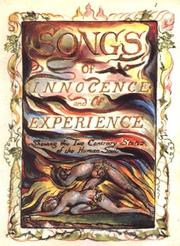
poetry · 1794
Songs of Innocence and of Experience
poetry collection by William Blake
- 1794
- poetry
Summary
Songs of Innocence and of Experience is a collection of illustrated poems by William Blake. Originally, Blake illuminated and bound Songs of Innocence and Songs of Experience separately. It was only in 1794 that Blake combined the two sets of poems into a volume titled Songs of Innocence and of Experience Shewing the Two Contrary States of the Human Soul. Even after beginning to print the poems together, Blake continued to produce individual volumes for each of the two sets of poetry.
Source: Wikipedia (CC BY-SA).
Historical Background
William Blake, poet, painter, and engraver, wrote Songs of Innocence in 1789 and issued it alongside the newly composed Songs of Experience in a single illuminated volume in 1794, titled Songs of Innocence and of Experience Shewing the Two Contrary States of the Human Soul. Blake was both author and printmaker: he etched text and design together on copper plates using his own technique of illuminated printing, then hand-coloured each copy, so no two surviving copies are identical. Working largely outside the literary establishment and unrecognized in his lifetime, Blake used the deceptively simple form of children's verse and hymn-like lyric to explore questions about God, society, and the human psyche. Paired poems, such as "The Lamb" and "The Tyger," or the two poems each titled "Holy Thursday" and "The Chimney Sweeper," set the pastoral, trusting vision of childhood innocence against the corrupted, institutionalized world of adult experience. Blake's radical sympathies, his visionary religious dissent, and his critique of organized religion, child labour, and social injustice in Georgian England inform the whole collection. It is now regarded as a founding text of English Romanticism and one of the most widely studied short poetic sequences in English literature.
The Story
Songs of Innocence and of Experience is not a narrative but a sequence of short lyrics arranged around "the two contrary states of the human soul." The Innocence poems, written first, present a pastoral world of children, lambs, shepherds, and nurses, voiced in simple, songlike measures evoking trust and protective care; poems such as "The Lamb," "The Shepherd," and "Infant Joy" imagine a world watched over by a gentle, immanent God. The Experience poems, composed later, answer and darken this vision, exposing poverty, repression, institutional cruelty, and adult disillusionment; poems such as "The Tyger," "London," and "The Sick Rose" confront violence, urban suffering, and corrupted desire. Many Experience poems directly mirror an Innocence counterpart with the same or a related title, inviting readers to compare the two "contrary states" rather than follow any linear plot: the trusting chimney sweeper of Innocence, comforted by a dream of angelic release, is answered by the embittered child of Experience who blames "God and his Priest and King." Structurally, the collection builds meaning through this dialogic pairing and repetition of imagery, such as the lamb and the tiger, the flower and the rose, so that innocence and experience are shown not as a simple progression from childhood to adulthood but as two permanent, interpenetrating perspectives on existence, neither of which alone gives the whole truth.
Themes
- Innocence versus experience as contrary states of the soul
- Childhood and the loss of innocence
- Organized religion and institutional hypocrisy
- Social injustice, poverty, and child labour
- Nature and the divine in the created world
- Repression of desire and sexuality
- The dual nature of God and creation (the Lamb and the Tyger)
- Political radicalism and critique of authority
Literary Devices
- Contrary pairing - companion poems in Innocence and Experience mirror and answer each other
- Symbolic imagery - concrete emblems (lamb, tyger, rose, chimney sweep) carry abstract meaning
- Rhetorical questioning - poems like "The Tyger" proceed almost entirely through unanswered questions
- Simple, song-like meter and rhyme - hymn and nursery-rhyme forms mask complex irony
- Illuminated printing - hand-etched text and image designed as a unified visual-verbal work
- Irony - innocent, childlike voices expose adult and institutional corruption
- Repetition and refrain - incantatory repetition builds intensity, as in "Tyger Tyger, burning bright"
Symbolism
- The Lamb - Christ-like innocence, gentleness, and divine tenderness
- The Tyger - the fearsome, sublime, and inexplicable power within creation
- The chimney sweeper - exploited, suffering childhood and social injustice
- The rose (in "The Sick Rose") - beauty and love corrupted by hidden, destructive desire
- London's chartered streets and "mind-forg'd manacles" - self-imposed and institutional oppression
- The nurse and shepherd figures - protective authority, benevolent in Innocence, more anxious or controlling in Experience
Critical Interpretation
Songs of Innocence and of Experience was largely ignored by Blake's contemporaries and only gained serious critical attention in the twentieth century, when scholars such as Northrop Frye situated Blake within a coherent visionary mythology and argued for the philosophical depth beneath the collection's simple surfaces. Critics have long debated whether Innocence and Experience represent a developmental sequence, with Experience simply correcting Innocence's naivety, or whether Blake intends both states as equally partial and necessary perspectives, neither sufficient alone. E. D. Hirsch and others have explored the theological and Swedenborgian influences on Blake's contrary states, while later critics have emphasized the collection's political radicalism, reading poems such as "London" and the "Chimney Sweeper" poems as direct indictments of industrial-era child labour, poverty, and institutional religion. The illuminated format itself has become a major critical concern, with scholars such as W. J. T. Mitchell examining how Blake's hand-coloured designs interact with, complicate, or ironize the printed text, meaning the poems cannot be fully understood as words alone.
Quotations
Tyger Tyger, burning bright, / In the forests of the night
Opening lines of Blake's most anthologized poem, questioning the maker of fearsome creation.
What immortal hand or eye, / Could frame thy fearful symmetry?
The poem's recurring rhetorical question about the source of the Tyger's terrible beauty.
Did he who made the Lamb make thee?
Directly links "The Tyger" to its Innocence companion poem "The Lamb."
And mark in every face I meet / Marks of weakness, marks of woe.
Blake's indictment of urban suffering in late-eighteenth-century London.
In every cry of every Man, / In every Infants cry of fear, / In every voice: in every ban, / The mind-forg'd manacles I hear
Famous image of self-imposed and institutional psychological oppression.
And so he was quiet, and that very night, / As Tom was a sleeping he had such a sight!
From the dream of angelic release comforting the exploited sweep-boy.
Influence
Long neglected in Blake's own lifetime, Songs of Innocence and of Experience became, from the late nineteenth and especially the twentieth century onward, one of the most influential and widely taught works of English poetry. Its contrary-states structure and symbolic method shaped later Romantic and Victorian poets' engagement with childhood, nature, and social critique, and its illuminated, hybrid text-image form anticipated later experiments in multimedia and artists' books. "The Tyger" and "The Lamb" are among the most frequently anthologized poems in the English language and are staples of school curricula worldwide. The collection's political conscience, particularly its attacks on child labour and institutional religion, influenced later socially engaged poetry, while its visionary symbolism fed into twentieth-century readings of Blake as a precursor of psychological and mythopoeic literature, notably through Northrop Frye's influential study Fearful Symmetry.
Adaptations
- Benjamin Britten's song cycle Songs and Proverbs of William Blake and choral settings of individual Blake lyrics
- Various composers, including Ralph Vaughan Williams, have set individual Songs (such as "The Lamb") to music
- Allen Ginsberg recorded musical settings of several Songs of Innocence and of Experience poems in the 1970s
Related Works
- The Marriage of Heaven and Hell by William Blake
- Milton: A Poem by William Blake
- Jerusalem: The Emanation of the Giant Albion by William Blake
- Lyrical Ballads by William Wordsworth and Samuel Taylor Coleridge
- Fearful Symmetry by Northrop Frye (critical study)
Curator's Notes
- 1Blake hand-printed and hand-coloured each copy of the work himself using his invented relief-etching process, so surviving copies vary in colour and detail.
- 2Songs of Innocence (1789) was originally issued as a separate volume before Blake combined it with the newly written Songs of Experience in 1794.
- 3Blake continued to produce individual copies of Songs of Innocence alone even after creating the combined volume.
- 4"The Tyger" and "The Lamb" form one of the most famous companion-poem pairs in English literature, each answering the other from Experience and Innocence.
- 5Blake worked as a professional engraver, which is why he was able to design, etch, print, and colour his own illuminated books rather than relying on conventional publishers.
For the Exam
UGC NET English frequently tests Songs of Innocence and of Experience on: the significance of "contrary states" as Blake's organizing concept; close reading and comparison of companion poems, especially "The Lamb" versus "The Tyger" and the two "Chimney Sweeper" and "Holy Thursday" poems; identification of famous lines and their speakers; Blake's critique of institutional religion, child labour, and urban poverty in "London"; his place within Romanticism and as a precursor to Romantic symbolism and visionary poetry; and the significance of illuminated printing as a fusion of visual and verbal art. Candidates should be able to quote key lines accurately and explain symbolic imagery.