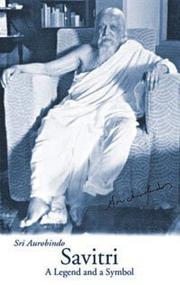
religious text · 1940
Savitri
Sri Aurobindo's major poetic work, an epic in blank verse, describing his vision of existence and explores the reason for ignorance, darkness, suffering and pain, the purpose of life on earth and the prospect of a glorious future for humanity.
- 1940
- religious text
- religious literature
- epic poem
- poetry
Summary
Savitri: A Legend and a Symbol is an epic poem in blank verse by Sri Aurobindo. Consisting of nearly 24,000 lines, it is based on the legend of Savitri and Satyavan in the Mahabharata, which Sri Aurobindo reinterpreted as a symbolic myth of the Vedic cycle.
Sri Aurobindo described the work as a "symbolic epic of the aim of supramental Yoga". It narrates the spiritual ascent of the king Aswapati to the highest planes of consciousness to bring down a divine power, and the subsequent birth and yoga of Savitri who must descend into the grip of death and ignorance to conquer them. The poem was written as an experiment in "mantric" poetry, intended to express a direct vision from the "Overhead" planes of consciousness.
Source: Wikipedia (CC BY-SA).
Historical Background
Sri Aurobindo began Savitri: A Legend and a Symbol early in his career and continued revising it for decades, largely during his years of spiritual practice in Pondicherry after withdrawing from active politics, until his death in 1950. It grew from a modest narrative poem into a vast epic of nearly 24,000 lines of blank verse, making it one of the longest poems in English. Aurobindo drew its narrative frame from the tale of Satyavan and Savitri told in the Mahabharata, where a princess wins back her husband's life from Yama, the god of death, through devotion and steadfast will. He transformed this legend into a symbolic vehicle for his philosophy of Integral Yoga and of the supramental transformation of earthly life, treating the story as what he called a legend and a symbol at once. He described his method as an attempt at "mantric" poetry, verse meant to carry a direct vision from the "Overhead" planes of consciousness rather than merely to describe or argue. The poem remained subject to continuous revision in his final years, dictated to secretaries including Nirodbaran, and it reached its complete published form only after Aurobindo's death.
The Story
Savitri unfolds across twelve books as a symbolic epic rather than a conventional linear narrative. It opens with the primordial darkness before dawn and the awakening of consciousness in Satyavan's world. The poem follows Aswapati, king and spiritual seeker, whose long inner ascent through successive planes of consciousness forms the central movement of the work, as he travels through the worlds of Night, Life, and Mind in search of a power capable of transforming earthly existence. Through his aspiration he wins the boon of a divine birth: the Divine Mother will descend to earth as his daughter, Savitri. The narrative then turns to Savitri's birth, her meeting and love for Satyavan, and her foreknowledge, granted by the sage Narad, that Satyavan is fated to die within a year. Savitri chooses to marry him regardless, and on the appointed day, as Satyavan dies in the forest, she confronts Yama, the god of Death, directly. Through a sustained dialogue and spiritual contest with Death, Savitri's love, truth, and yogic will prevail, and Satyavan is restored to life. The poem closes with their return to a transfigured earthly existence, symbolizing the possibility of a divine life within human embodiment.
Themes
- The conquest of death through love and spiritual will
- The evolution of consciousness from Matter toward the Divine
- The descent of the Divine into earthly life (avatarhood)
- Integral Yoga and the transformation of human nature
- The problem of suffering, ignorance, and cosmic evil
- The symbolic marriage of soul and world
- Ascent through planes of consciousness
- The destiny of earth and humanity
Literary Devices
- Blank verse — sustained unrhymed iambic pentameter carrying the poem's visionary sweep
- Symbolism — characters and events function as spiritual symbols rather than realistic figures
- Extended cosmic imagery — recurring figures of light, darkness, dawn, and the abyss
- Epic invocation and cosmology — the poem opens with a cosmogonic vision in the epic tradition
- Mantric diction — language aimed at direct spiritual suggestion rather than description
- Allegorical characterization — Aswapati, Savitri, and Satyavan embody stages of the soul's journey
- Dialogue as philosophical debate — the confrontation between Savitri and Death carries the poem's central argument
Symbolism
- Savitri — the Divine Word/Mother-force descending to redeem earthly life
- Satyavan — the human soul bound to death, ignorance, and mortality
- Aswapati — the awakened spiritual aspirant and type of the evolving seeker
- Death (Yama) — the principle of limitation and negation that must be spiritually overcome
- The forest and the fated day — the field of human mortality and destiny
- Dawn/light imagery — the emergence of higher consciousness into the world of Night
Critical Interpretation
Critical response to Savitri has largely developed within and around the Sri Aurobindo Ashram and among scholars of Indian English poetry, who read it as a major achievement of modern Indian spiritual literature and among the longest and most ambitious poems in English. Commentators have focused on Aurobindo's own account of "mantric" or "overhead" poetry, examining whether the poem's language achieves the direct visionary transmission he claimed for it, distinguishing it from poetry that merely describes mystical experience. Scholars situate the work within the tradition of the philosophical and spiritual epic, comparing its ambition to Milton and Dante while noting its distinct grounding in Vedantic and Vedic thought and in Aurobindo's own doctrine of Integral Yoga and supramental evolution. Some literary critics outside devotional circles have questioned the poem's accessibility and its resistance to conventional narrative or aesthetic analysis, given its length and its subordination of plot to metaphysical argument. Nonetheless it remains a central text for the study of Indian English poetry and of modern engagements with the Mahabharata legend.
Quotations
All can be done if the God-touch is there.
A widely cited line from Book One, Canto I ("The Symbol Dawn"), expressing the poem's faith in the transformative power of the Divine within human effort.
Influence
Savitri has become a foundational text within the Sri Aurobindo Ashram and the wider community of Integral Yoga, studied as both a spiritual and literary work. It is regarded as a landmark of Indian English poetry, cited for its scale and its attempt to fuse epic form with a distinctly modern Indian spiritual vision drawn from Vedic and Vedantic sources. Its reworking of the Mahabharata legend of Savitri and Satyavan has influenced later retellings and discussions of the story in Indian English literature and continues to be a reference point for scholars examining the relationship between traditional Indian narrative material and modern English verse.
Related Works
- The Mahabharata (Vana Parva) — source of the Savitri-Satyavan legend
- Paradise Lost by John Milton — comparable philosophical/spiritual epic in blank verse
- The Life Divine by Sri Aurobindo — prose exposition of the philosophy underlying the poem
- The Synthesis of Yoga by Sri Aurobindo — companion articulation of Integral Yoga
- The Divine Comedy by Dante — comparable epic of spiritual ascent
Curator's Notes
- 1At nearly 24,000 lines, Savitri is among the longest poems in the English language.
- 2Sri Aurobindo worked and reworked the poem over several decades, revising it almost until his death in 1950.
- 3In his last years Aurobindo dictated revisions of the poem to secretaries, including Nirodbaran, as his eyesight failed.
- 4The poem's base story is drawn directly from an episode in the Mahabharata, one of the great Sanskrit epics.
For the Exam
UGC NET English questions on Savitri typically test identification of the poem as an Indian English epic by Sri Aurobindo, its source in the Mahabharata legend of Savitri and Satyavan, its structure in twelve books of blank verse, and its philosophical basis in Integral Yoga and the concept of the supramental. Candidates should be able to identify the three central figures (Aswapati, Savitri, Satyavan) and their symbolic roles, and place the poem within the tradition of Indian English poetry alongside other major figures of the movement.