Summary
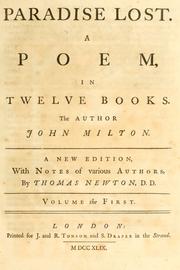
Paradise Lost is an epic poem in blank verse by the English poet John Milton (1608–1674). The poem concerns the biblical story of the fall of man: the temptation of Adam and Eve by the fallen angel Satan and their expulsion from the Garden of Eden. The first version, published in 1667, consists of ten books with over ten thousand lines of verse. A second edition followed in 1674, arranged into twelve books with minor revisions throughout. It is considered to be Milton's masterpiece, and it helped solidify his reputation as one of the greatest English poets.
Source: Wikipedia (CC BY-SA).
Historical Background
Milton had begun composing Paradise Lost by the late 1650s, and continued the work after the Restoration of 1660, when the republican cause he had served as Oliver Cromwell's Latin Secretary collapsed and he faced arrest, imprisonment, and the burning of his books. By this time he was completely blind, having lost his sight by 1652, and he composed the poem orally, dictating verses to his daughters and various amanuenses who transcribed them. Drawing on a lifetime of classical, biblical, and theological learning, Milton set out, in his own words, to "justify the ways of God to men," fusing the epic conventions of Homer and Virgil with Christian subject matter. The poem was first published in 1667 in ten books; a second edition in 1674, the year of Milton's death, reorganized it into twelve books, the now-standard form, with minor revisions. Composed against the backdrop of civil war, regicide, and the failure of the English republic, the poem reflects Milton's deep engagement with questions of liberty, obedience, tyranny, and free will. It stands as the major achievement of English literary epic and the culmination of Milton's lifelong ambition to write a great national poem.
The Story
Paradise Lost narrates the biblical Fall of Man. It opens in medias res in Hell, where Satan and his rebel angels lie chained on a burning lake after their defeat in the War in Heaven and expulsion from Heaven for rebelling against God. Satan rallies his followers, has the palace Pandemonium built, and resolves to corrupt God's new creation, mankind, as revenge. He journeys through Chaos to Earth and the Garden of Eden, where Adam and Eve live in innocence. God, foreseeing the Fall, sends the angel Raphael to warn Adam of the danger and to recount the War in Heaven and the creation of the world. Satan, disguised first as various creatures and finally entering a serpent, tempts Eve into eating the forbidden fruit of the Tree of Knowledge while she and Adam are separated; Adam, learning what she has done, knowingly eats it too out of love and solidarity, unwilling to be parted from her. Their sin brings shame, discord, and mortality into the world. God sends the angel Michael to show Adam a vision of future human history, including suffering, but also the eventual redemption through Christ. The poem closes with Adam and Eve, chastened but hopeful, expelled from Eden and setting out hand in hand into the fallen world.
Themes
- The Fall of Man and original sin
- Free will versus predestination
- Obedience and disobedience to divine authority
- The nature of good and evil
- Temptation and the loss of innocence
- Pride, ambition, and rebellion
- Hierarchy and order in creation
- Redemption and providence
Literary Devices
- Epic simile — extended Homeric/Virgilian comparisons that expand the poem's scale and range of reference
- Blank verse — unrhymed iambic pentameter, chosen by Milton as fit for epic and free of "the troublesome and modern bondage of rhyming"
- In medias res structure — the narrative begins in Hell after the rebellion, with earlier events recounted later
- Epic invocation — direct addresses to a heavenly Muse at the openings of key books
- Grand style — elevated, Latinate diction and syntax that heighten the poem's solemnity
- Characterization of Satan — a psychologically complex antagonist whose rhetoric and heroic posturing have generated centuries of critical debate
- Cosmic scope — action ranging across Heaven, Hell, Chaos, and Earth
- Allusion — dense weaving of classical mythology and biblical and theological reference
Symbolism
- The Tree of Knowledge — the boundary of obedience and the occasion of the Fall
- Light and darkness — divine truth and grace versus Satanic blindness and despair
- The Garden of Eden — prelapsarian innocence and harmony, lost through sin
- Satan's serpent form — deceit, degradation, and the corruption of a once-glorious being
- Chains and the burning lake of Hell — the self-imposed bondage of rebellion against God
Critical Interpretation
Paradise Lost has generated one of the most enduring critical controversies in English literature: the question of Satan's role. Romantic critics such as William Blake and Percy Bysshe Shelley saw Satan as the poem's true hero, with Blake famously suggesting Milton was "of the Devil's party without knowing it," reading Satan's defiance as a figure of energetic rebellion against tyranny. Twentieth-century critics, notably C. S. Lewis, pushed back against this "Satanist" reading, arguing that the poem is a deliberately orthodox Christian epic in which Satan's grandeur is a calculated illusion that unravels as the poem progresses, exposing his self-deception and diminishment. Other major strands of criticism include feminist readings examining Milton's depiction of Eve and gender hierarchy, historicist approaches situating the poem within the politics of the English Civil War and Restoration, and theological readings exploring Milton's Arminian views on free will. William Empson's Milton's God offered a provocative, morally troubled reading of God as a problematic authority figure, extending the debate over the poem's theodicy.
Quotations
Better to reign in Hell, than serve in Heaven.
Satan, rallying himself after the fall from Heaven, articulating his defiant creed
The mind is its own place, and in itself / Can make a Heav'n of Hell, a Hell of Heav'n.
Satan, addressing his fellow fallen angels on the burning lake
Long is the way / And hard, that out of Hell leads up to Light.
Narrator, describing the arduous journey out of Hell toward Earth
What in me is dark / Illumine, what is low raise and support; / That to the highth of this great argument / I may assert Eternal Providence, / And justify the ways of God to men.
The narrator's invocation, stating the poem's theodical purpose
Influence
Paradise Lost profoundly shaped English literature's engagement with epic form, biblical narrative, and the figure of Satan as a complex antagonist. It influenced the Romantic poets—Blake, Shelley, Byron, and Wordsworth—who admired and reworked its depiction of rebellion and sublime cosmic scope. Its blank verse helped establish that form as a serious vehicle for major English poetry beyond drama. The poem's imaginative treatment of Satan, Hell, and cosmic warfare left a lasting mark on the Gothic tradition and later fantasy and science fiction, and its theological and psychological exploration of temptation and free will continued to inform philosophical and literary treatments of evil for centuries after.
Related Works
- Paradise Regained by John Milton
- Samson Agonistes by John Milton
- The Divine Comedy by Dante Alighieri
- The Faerie Queene by Edmund Spenser
- Genesis (Book of, biblical source text)
- Frankenstein by Mary Shelley
Curator's Notes
- 1Milton, completely blind by the time he composed the poem, dictated its lines to amanuenses, including his daughters.
- 2The first edition (1667) was organized into ten books; the 1674 second edition reorganized it into the now-standard twelve books.
- 3Milton reportedly received a modest sum, often cited as five pounds, for the copyright of the poem from his publisher.
- 4Milton chose blank verse deliberately, defending it in a prefatory note as a recovery of "ancient liberty" from the constraint of rhyme.
For the Exam
UGC NET frequently tests Paradise Lost on its publication history (1667 in ten books; 1674 in twelve), Milton's biography and blindness, the epic's opening invocation and theodicy ("justify the ways of God to men"), the character of Satan and the Romantic "Satanist" critical debate (Blake, Shelley) versus C. S. Lewis's orthodox reading, Milton's use of blank verse, and thematic questions on free will, obedience, and the Fall. Questions may also probe Milton's other works (Paradise Regained, Samson Agonistes, Areopagitica) and his place in the Puritan/Restoration literary context.