tragedy · 1604
Othello
theatrical play by William Shakespeare
- 1604
- tragedy
- theatre
Summary
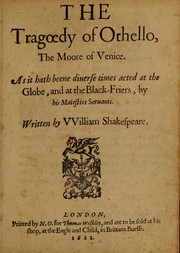
The Tragedy of Othello, the Moor of Venice, often shortened to Othello, is a tragedy written by William Shakespeare around 1603. Set in Venice and Cyprus, the play depicts the Moorish military commander Othello as he is manipulated by his ensign, Iago, into suspecting his wife Desdemona of infidelity. Othello is widely considered one of Shakespeare's greatest works and is usually classified among his major tragedies alongside Macbeth, King Lear, and Hamlet. Unpublished in the author's life, the play survives in one quarto edition from 1622 and in the First Folio.
Source: Wikipedia (CC BY-SA).
Historical Background
Othello was written by William Shakespeare around 1603-1604, during the reign of James I, when the King's Men (Shakespeare's company) enjoyed royal patronage. A performance is recorded at the court of King James on 1 November 1604. The play draws its plot from a novella in Giovanni Battista Giraldi Cinthio's Gli Hecatommithi (1565), an Italian collection of tales, though Shakespeare transformed the source considerably, most notably by expanding and darkening the role of the villain, here named Iago. The play was not published during Shakespeare's lifetime; it survives in a single quarto edition printed in 1622 and in the First Folio of 1623, and the two texts differ in some respects. Set against the backdrop of Venetian-Ottoman conflict over Cyprus in the late sixteenth century, the play reflects contemporary English fascination with the Mediterranean world, with Venice as a symbol of civil order and commerce, and with the figure of the Moor as an outsider within Christian European society. Othello belongs to Shakespeare's mature tragic period, composed in close proximity to Hamlet, King Lear, and Macbeth, and is distinguished among them by its concentrated domestic and psychological focus rather than matters of state or succession.
The Story
Othello, a Moorish general in the service of Venice, secretly marries Desdemona, daughter of the Venetian senator Brabantio, angering her father, who accuses Othello of witchcraft before the Venetian Senate. The Senate dismisses the charge and sends Othello to defend Cyprus against an Ottoman fleet, which is destroyed by a storm before battle can occur. Othello's ensign Iago, resentful at being passed over for promotion in favor of Cassio and driven by suspicion and malice, plots to destroy Othello by convincing him that Desdemona is unfaithful with Cassio. Iago manipulates Roderigo, a rejected suitor of Desdemona, and his own wife Emilia, who unwittingly obtains Desdemona's handkerchief, a keepsake from Othello, which Iago plants in Cassio's lodgings as false evidence of the affair. Through insinuation and staged appearances, Iago inflames Othello's jealousy until he becomes convinced of Desdemona's guilt. Othello smothers Desdemona in their bed. Emilia then reveals Iago's deception, exposing the truth of the handkerchief plot. Othello, realizing his fatal error, kills himself beside Desdemona's body. Iago is arrested but refuses to explain his motives, and the surviving Venetian officials are left to administer justice as the play closes.
Themes
- Jealousy and its destructive power
- Manipulation and deception
- Race and otherness
- Appearance versus reality
- Reputation and honor
- Trust and betrayal
- Gender and the ideology of female chastity
- Outsider status and belonging
Literary Devices
- Dramatic irony — the audience knows Iago's villainy while Othello and others trust him, generating sustained tension
- Soliloquy — Iago's asides and soliloquies expose his schemes and rationalizations directly to the audience
- Animal imagery — recurring bestial and monstrous imagery ("an old black ram," "the beast with two backs") degrades human relationships
- Handkerchief as plot device — a small object engineered by Iago into seemingly damning proof of adultery
- Foil characters — Iago's cynicism and Cassio's courtliness set off contrasting facets of Othello's character
- Verse and prose shifts — Othello's controlled blank verse deteriorates into broken syntax and prose as jealousy overtakes him
- Insinuation and equivocation — Iago's manipulative rhetoric relies on suggestion, half-truths, and strategic silence rather than direct lies
Symbolism
- The handkerchief — symbolizes love, fidelity, and, once misappropriated, false proof of betrayal
- Black and white imagery — reflects the play's preoccupation with race, purity, and corruption
- Light and darkness — associated with truth and concealment, especially around Desdemona's murder
- The storm at sea — represents the chaotic, uncontrollable forces of passion and fate
Critical Interpretation
Othello has long attracted debate over race, gender, and villainy. A. C. Bradley's Shakespearean Tragedy (1904) treated Othello as a noble hero destroyed by Iago's near-motiveless malignity, a reading indebted to Coleridge's earlier description of Iago's "motiveless malignity." F. R. Leavis countered Bradley by locating a tragic flaw in Othello himself, arguing his self-regarding pride makes him complicit in his own destruction. Twentieth- and twenty-first-century criticism has increasingly foregrounded race, examining how the play stages and interrogates early modern English attitudes toward Moors and blackness, and how Othello's status as a racial and cultural outsider in Venice conditions his vulnerability to Iago's manipulation. Feminist critics have examined the play's treatment of Desdemona, Emilia, and Bianca, and the ideology of female chastity and obedience that underlies the men's judgments of women. Psychoanalytic and postcolonial approaches have further explored Iago's motivations and Othello's internalized outsider status. The play continues to be read as both a domestic tragedy of jealousy and a profound meditation on identity, prejudice, and trust.
Quotations
O, beware, my lord, of jealousy; It is the green-ey'd monster which doth mock The meat it feeds on.
Iago warns Othello against jealousy even as he deliberately provokes it
I am not what I am.
Iago's early declaration of duplicity and concealed identity
Who steals my purse steals trash... But he that filches from me my good name Robs me of that which not enriches him And makes me poor indeed.
Iago on the value of reputation, spoken to manipulate Othello
Then must you speak Of one that loved not wisely but too well.
Othello's self-assessment shortly before his suicide
Put out the light, and then put out the light.
Othello, contemplating Desdemona's murder, conflating a candle with her life
Influence
Othello has had a profound influence on subsequent literature and drama as the paradigmatic tragedy of jealousy and manipulation. Its villain Iago became a touchstone for literary depictions of calculated malice and psychological manipulation, influencing the construction of scheming antagonists across later fiction and drama. The play's exploration of an outsider figure destroyed by prejudice and insecurity has made it a central text in postcolonial and race-conscious literary criticism and rewriting, inspiring numerous adaptations, reimaginings, and critical responses that interrogate its representation of Othello's Moorish identity. Coleridge's description of Iago's "motiveless malignity" entered common critical vocabulary for villainy without clear motive. The play's operatic, cinematic, and stage afterlife, notably Verdi's Otello, has kept it continuously present in world culture as a defining study of trust, deception, and destructive jealousy.
Adaptations
- Verdi's opera Otello (1887), with libretto by Arrigo Boito, is among the most celebrated operatic adaptations of Shakespeare
- Orson Welles's film Othello (1951)
- Laurence Olivier's film Othello (1965), based on his stage performance
- Oliver Parker's film Othello (1995), starring Laurence Fishburne
- O (2001), a modern high-school-set film adaptation
Related Works
- Hamlet by William Shakespeare
- King Lear by William Shakespeare
- Macbeth by William Shakespeare
- Gli Hecatommithi by Giovanni Battista Giraldi Cinthio (source narrative)
- Otello, opera by Giuseppe Verdi and Arrigo Boito
Curator's Notes
- 1Othello survives in two early printed forms, the 1622 quarto and the 1623 First Folio, which differ in a number of readings and passages
- 2The play was performed at the court of King James I on 1 November 1604, one of the earliest recorded performances
- 3Shakespeare took the bare plot from a single novella in Cinthio's Italian collection Gli Hecatommithi but invented much of Iago's characterization and motivation
- 4In Cinthio's source, the Iago-figure is driven by frustrated desire for Desdemona; Shakespeare leaves Iago's motives more ambiguous and unsettling
- 5Giuseppe Verdi's opera Otello, with a libretto by Arrigo Boito, is regarded as one of the finest operatic treatments of any Shakespeare play
For the Exam
UGC NET frequently tests Othello on its classification as one of Shakespeare's four major tragedies, its source in Cinthio's Gli Hecatommithi, the publication history (1622 quarto and 1623 First Folio), and the character triad of Othello, Iago, and Desdemona. Expect questions on Iago's rhetorical manipulation and motives, the symbolism of the handkerchief, Coleridge's phrase "motiveless malignity," Bradley's and Leavis's contrasting critical readings, and thematic questions on jealousy, race, and appearance versus reality. Candidates should also be able to identify famous lines and their speakers, and situate the play within the broader chronology of Shakespeare's tragic period.