Summary
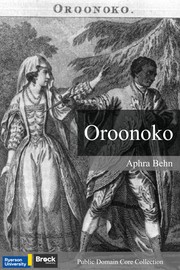
Oroonoko: or, the Royal Slave is a work of prose fiction by Aphra Behn (1640–1689), first published in 1688 by William Canning and reprinted later that year in the compilation Three Histories by Mrs. A. Behn. The eponymous hero is a Ghanaian prince from Coramantien who is tricked into slavery and sold to Dutch colonists in Surinam where he meets the narrator. Behn's text is a first-person account of Oroonoko's life, love, and rebellion.
Source: Wikipedia (CC BY-SA).
Historical Background
Aphra Behn (1640-1689), one of the first Englishwomen to earn her living by writing, published Oroonoko: or, the Royal Slave in 1688, near the end of her career, through the publisher William Canning; it was reprinted later that year in the collection Three Histories. Behn had spent time in the English colony of Surinam in the early 1660s, and her narrator claims eyewitness authority, blending travel writing, romance, and what has been called an early slave narrative. The novella tells of Oroonoko, grandson and heir of the king of Coramantien on the African coast, who is betrayed into slavery and transported to Surinam, where the English female narrator meets and befriends him. Published the year before her death, during the political turbulence around the Glorious Revolution, Behn - a committed royalist - frames Oroonoko's nobility partly through his birthright as a prince, linking the story to contemporary debates about kingship and legitimate authority. Oroonoko is widely regarded as a landmark in the development of the English novel and among the earliest English prose fictions to make slavery and colonial exploitation central subjects, though critics continue to debate whether it is genuinely anti-slavery protest or a narrative more invested in aristocratic honor than in a general critique of bondage. It remains foundational to scholarship on gender, race, and empire in Restoration-era literature.
The Story
Oroonoko is grandson and heir of the king of Coramantien in Africa. He falls in love with Imoinda, daughter of a general, but his aged grandfather the king also desires her and takes her into his harem, from which Oroonoko contrives to see her secretly. When their meeting is discovered, Imoinda is sold into slavery as punishment, though Oroonoko is told she was executed. Later, Oroonoko himself is deceived by an English slave-ship captain who offers him friendship and hospitality aboard his ship, then treacherously captures and sells him into slavery. He is transported to the English colony of Surinam, where, unexpectedly, he discovers Imoinda has also been sold there. The young English narrator, who has befriended the enslaved prince (renamed Caesar by the colonists), recounts his dignity, eloquence, and physical grace, and describes the couple's reunion and Imoinda's pregnancy. When the colonists repeatedly defer their promised manumission, Oroonoko organizes and leads a slave uprising, but the rebels are betrayed and captured after being promised pardon. Oroonoko is brutally whipped in punishment. Fearing for Imoinda's fate and his unborn child's future in slavery, and determined to avenge himself on his captors, Oroonoko kills Imoinda with her consent, intending to then kill the colony's leaders and die fighting. Too grief-stricken and weakened to carry this out immediately, he is discovered beside her body and is captured. He is executed by dismemberment, meeting his death with stoic, unflinching courage, while the narrator recounts the events as a memorial to his heroism.
Themes
- Slavery and colonial exploitation
- Kingship, nobility, and legitimate authority
- Betrayal and broken promises
- Love and constancy under oppression
- Race and European perceptions of the 'noble savage'
- Gender and the position of the female narrator/author
- Honor, heroism, and stoic suffering
- Colonial Surinam as contested space
Literary Devices
- First-person eyewitness narration - the narrator repeatedly asserts she witnessed events herself to claim truth and authority
- Framing as 'true history' - the subtitle and narratorial asides insist the tale is factual, not romance
- Irony - Christian European colonists behave less honorably than the 'heathen' prince they enslave
- Digression and travel-writing description - ethnographic asides on Surinam's flora, fauna, and indigenous peoples interrupt the plot
- Hyperbolic idealization - Oroonoko and Imoinda are described in the conventions of European romance heroes despite their African origin
- Foreshadowing - early betrayals (Imoinda's sale, the captain's treachery) anticipate the final betrayal of the rebellion
Symbolism
- Oroonoko's scarred, mutilated body - the cost of slavery inscribed literally on the heroic figure
- Imoinda's pregnancy - hope for a future generation, extinguished by slavery's threat to that future
- The name 'Caesar' imposed on Oroonoko - colonial erasure of identity even while invoking classical grandeur
- The Surinam landscape - an Edenic, richly described 'New World' that is simultaneously a site of violence and exploitation
Critical Interpretation
Oroonoko has occupied a central and contested place in literary criticism since the late twentieth-century recovery of Aphra Behn's work. Critics disagree over whether the text should be read as an early anti-slavery statement or as a narrative whose sympathy for Oroonoko rests chiefly on his royal status rather than on opposition to slavery as an institution. Scholars have examined the tension between Behn's female narrator, who occupies an ambiguous position of both sympathy and complicity within the colonial slave economy, and the text's investment in monarchist ideology, given Behn's own royalist politics. The novella is frequently discussed in postcolonial and feminist criticism for its intersection of race, gender, and empire, and for the narrator's self-conscious claims to authorship and authority as a woman writer. Its status as a proto-novel and as one of the earliest English fictional treatments of transatlantic slavery has made it a staple of studies on the rise of the novel and on Restoration prose fiction more broadly.
Influence
Oroonoko is widely credited as an important precursor to the English novel and one of the earliest works of English fiction to center slavery and colonialism. It influenced later abolitionist and sentimental literature, and its dramatic adaptation by Thomas Southerne in 1695 became one of the most frequently performed plays of the eighteenth century, keeping the story before English audiences long after Behn's death. The recovery and reassessment of Behn's career in twentieth-century feminist scholarship, notably associated with critics such as Virginia Woolf's admiring remarks on Behn as a professional woman writer, restored Oroonoko to a central place in the literary canon and in studies of gender, race, and the origins of the novel.
Adaptations
- Thomas Southerne's stage tragedy Oroonoko (1695), a highly popular adaptation performed throughout the eighteenth century
Related Works
- Thomas Southerne, Oroonoko (1695 play)
- Daniel Defoe, Robinson Crusoe (1719)
- Aphra Behn, The Rover (1677)
- Jonathan Swift, Gulliver's Travels (1726)
Curator's Notes
- 1Aphra Behn was one of the first English women to earn her living as a professional writer.
- 2Behn is believed to have visited Surinam herself in the early 1660s, before it passed from English to Dutch control.
- 3Oroonoko was published in 1688, the same year as the Glorious Revolution that deposed James II.
- 4Virginia Woolf praised Behn in A Room of One's Own for opening the way for later women writers to earn a living by the pen.
For the Exam
UGC NET English commonly tests Oroonoko as an early landmark of the English novel and an early fictional treatment of slavery and colonialism, alongside Behn's identity as a pioneering professional woman writer. Expect questions on the novella's full title and 1688 publication date, its Surinam setting, the narrator's claim to eyewitness authenticity, the tragic fates of Oroonoko and Imoinda, its relationship to Thomas Southerne's 1695 stage adaptation, and its significance in feminist and postcolonial literary criticism regarding gender, race, and empire in Restoration literature.