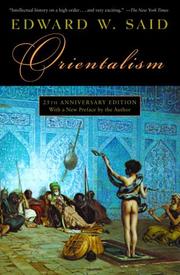
non-fiction · 1978
Orientalism
by Edward Said
1978 non-fiction work by Edward Said
- 1978
- non-fiction
- postcolonialism
- literary criticism
- history of ideas
Summary
Orientalism is a 1978 book by Edward Said, in which he establishes the term "Orientalism" as a critical concept to describe the Western world's commonly contemptuous depiction and portrayal of the Eastern world. Societies and peoples of the Orient are those who inhabit regions throughout Asia and North Africa. Said argues that Orientalism, in the sense of the Western scholarship about the Eastern world, is inextricably tied to the imperialist societies that produced it, which makes much Orientalist work inherently political and servile to power.
Source: Wikipedia (CC BY-SA).
Historical Background
Edward Said, a Palestinian-American literary and cultural critic teaching at Columbia University, published Orientalism in 1978, at a moment of intense ferment in postcolonial thought following decolonization movements across Asia and Africa. Trained in comparative literature and influenced by Michel Foucault's theories of discourse and power/knowledge, as well as by Antonio Gramsci's concept of cultural hegemony, Said set out to examine how Western scholarship, literature, and art had constructed "the Orient" not as a neutral geographic fact but as an ideological invention serving European colonial interests. Writing in the wake of the 1967 Arab-Israeli War and amid ongoing Western involvement in the Middle East, Said drew on his own background as an Arab intellectual educated in Western institutions to interrogate the disciplines of Orientalist scholarship, philology, and area studies. The book surveys several centuries of French, British, and later American writing about the Middle East, arguing that this body of knowledge cannot be separated from the imperial projects it accompanied and justified. Orientalism became a foundational text of postcolonial studies, reshaping literary criticism, history, anthropology, and area studies.
The Story
Orientalism is a work of cultural and literary criticism rather than a narrative, organized as a sustained argument developed across three main chapters. Said begins by defining "Orientalism" in three interlocking senses: an academic discipline studying the East, a style of thought based on an ontological distinction between "Orient" and "Occident," and a corporate institution for dominating and having authority over the Orient. Drawing on Foucauldian discourse analysis, he contends that the Orient is less a fixed geographical reality than a system of representations produced by Western political, economic, and cultural power, roughly from the late eighteenth century onward, coinciding with European colonial expansion into the Middle East and Asia. Said traces the genealogy of Orientalist scholarship through figures such as Silvestre de Sacy, Ernest Renan, and later British and French colonial administrators and writers, showing how literary, philological, and administrative texts recycled stereotypes of the Oriental as irrational, despotic, sensual, and fundamentally "other" to the rational, democratic West. He examines British and French Orientalism as the classical tradition before turning to twentieth-century American Orientalism, particularly as it relates to the Middle East and Islam, arguing that media, policy, and academic discourse continued to reproduce essentializing images. Throughout, Said insists that this discourse says more about the West's self-definition and will to power than about the East itself, and he closes by calling for a self-aware, non-essentializing scholarship attentive to its own political entanglements.
Themes
- Discourse and the production of knowledge as power
- The Orient as a Western invention
- Colonialism and cultural hegemony
- Self/Other and civilizational binaries
- Essentialism and stereotype
- Complicity of scholarship with empire
- Representation versus reality
- The politics of academic disciplines
Literary Devices
- Discourse analysis — applies Foucault's method to trace how statements about the Orient form a coherent, self-reinforcing system of knowledge
- Genealogical survey — traces Orientalist scholarship historically from the eighteenth century to the present to show continuity of underlying assumptions
- Close reading of colonial and scholarly texts — analyzes travel writing, philology, and administrative documents as literary artifacts revealing ideological bias
- Binary deconstruction — exposes and dismantles the East/West, rational/irrational oppositions structuring Orientalist thought
- Case studies of individual Orientalists — uses figures like Renan and Lane as exemplars of broader institutional patterns
- Polemical argumentation — combines scholarly analysis with an explicitly political critique of imperialism
Symbolism
- The Orient — functions less as a real place than as a symbolic screen for Western fantasies, fears, and desires
- The veil/harem imagery — recurring Orientalist tropes symbolizing Western projections of Eastern sensuality and mystery
- The philologist/scholar — emblematic of knowledge production as an instrument of colonial authority
Critical Interpretation
Orientalism sparked one of the most consequential debates in twentieth-century humanities scholarship, effectively founding postcolonial studies as a field and influencing critics such as Gayatri Spivak and Homi Bhabha, who extended and complicated Said's framework. Admirers credit the book with exposing the ideological underpinnings of area studies and Western representations of the Middle East and Islam, and with demonstrating literature's entanglement with imperial power. Critics, notably historian Bernard Lewis, challenged Said's characterization of the Orientalist scholarly tradition as monolithic and politically motivated, arguing he overlooked genuine scholarly achievement and internal diversity within Orientalist studies. Other scholars, including Aijaz Ahmad, criticized Said for insufficient attention to class and for an inconsistent, sometimes essentializing use of Foucauldian theory alongside humanist assumptions he elsewhere critiques. Later commentators have also questioned the book's near-exclusive focus on the Middle East as representative of "the Orient" broadly, and its limited engagement with resistance and agency among colonized peoples. Despite these debates, the book's central insight—that knowledge about other cultures is never innocent of power—remains foundational to postcolonial and cultural criticism.
Quotations
The Orient was almost a European invention.
Said's foundational thesis that the Orient is a Western discursive construction rather than a neutral geographic given.
Influence
Orientalism is widely regarded as the founding text of postcolonial studies, transforming literary and cultural criticism by demonstrating how power and knowledge intertwine in representations of non-Western peoples. It directly shaped the work of subsequent postcolonial theorists, including Gayatri Chakravorty Spivak and Homi Bhabha, and reoriented fields such as comparative literature, history, anthropology, and Middle East studies toward critical self-examination of their colonial legacies. The book popularized discourse analysis within literary studies and prompted a broad reassessment of canonical Western literature's depictions of the East, influencing readings of writers from Flaubert to Kipling and Conrad. Its methodology and central concept of "Orientalism" entered common academic and popular vocabulary as shorthand for exoticizing, essentializing representations of non-Western cultures.
Related Works
- Culture and Imperialism — Edward Said
- Black Skin, White Masks — Frantz Fanon
- Can the Subaltern Speak? — Gayatri Chakravorty Spivak
- The Location of Culture — Homi Bhabha
- Discipline and Punish — Michel Foucault
Curator's Notes
- 1Said was a professional pianist and music critic in addition to his academic work, and later co-founded the West-Eastern Divan Orchestra with Daniel Barenboim.
- 2Orientalism has been translated into dozens of languages and remains one of the most cited works in the humanities.
- 3The book's critique of Bernard Lewis sparked a public and long-running scholarly feud between the two men.
- 4Said published a follow-up work, Culture and Imperialism (1993), extending the arguments of Orientalism to literature more broadly.
For the Exam
UGC NET English frequently tests Orientalism as the founding text of postcolonial theory, asking students to identify Said's three definitions of Orientalism, his debt to Foucault (discourse, power/knowledge) and Gramsci (hegemony), and the East/West binary he critiques. Expect questions on the book's influence on Spivak and Bhabha, its role in establishing postcolonial studies, and critiques by Bernard Lewis and Aijaz Ahmad. Students should also be able to apply Saidian Orientalism as a lens to canonical colonial-era texts.