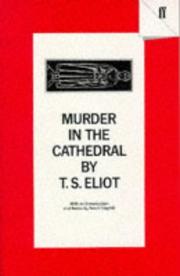
theatre · 1935
Murder in the Cathedral
by T. S. Eliot
play by T. S. Eliot
- 1935
- theatre
- ◆ Nobel-winning author
Summary
Murder in the Cathedral is a verse drama by T. S. Eliot, first performed in 1935. The play portrays the assassination of Archbishop Thomas Becket in Canterbury Cathedral during the reign of Henry II in 1170. Eliot drew heavily on the writing of Edward Grim, a clerk who was an eyewitness to the event.
Source: Wikipedia (CC BY-SA).
Historical Background
T. S. Eliot wrote Murder in the Cathedral for the 1935 Canterbury Festival, where it was first performed in the Chapter House of Canterbury Cathedral, close to the very site of Thomas Becket's murder in 1170. Commissioned as a religious drama for a specifically ecclesiastical occasion, the play reflects Eliot's own conversion to Anglo-Catholicism in 1927 and his deepening interest in Christian martyrdom, sacrifice, and the relationship between spiritual and temporal power. Eliot drew on the eyewitness account of Edward Grim, a clerk who witnessed Becket's assassination, as well as on medieval chronicle sources, to reconstruct the events leading to the Archbishop's death at the hands of four knights acting on behalf of King Henry II. Structurally and stylistically, the play revives elements of medieval liturgical drama and classical Greek tragedy, including a Chorus of the Women of Canterbury who comment on and respond to the action. Written in a flexible, rhythmic verse influenced by Eliot's earlier poetic innovations, the play marked his major entry into verse drama and established a mode he would continue to develop in later plays such as The Family Reunion and The Cocktail Party.
The Story
Set in December 1170, the play dramatizes the final days of Archbishop Thomas Becket, who returns to Canterbury after seven years of exile in France following his conflict with King Henry II over the rights and independence of the Church. The Women of Canterbury, forming the Chorus, express foreboding and anxiety at his return, sensing impending disaster. Becket is confronted by Four Tempters, who successively urge him toward physical safety and compromise with the King, temporal power and political alliance, a coalition with the barons against the King, and finally—most dangerously—spiritual pride through seeking martyrdom for the glory it would bring him. Becket resists all four temptations, recognizing that true sacrifice must not be sought for personal glory, famously articulating that treason lies in "the last temptation, the greatest treason: to do the right deed for the wrong reason." On Christmas morning, Becket delivers a sermon to his congregation reflecting on martyrdom and peace. Four Knights then arrive as agents of Henry II, accuse Becket of treachery, and, after he refuses to flee or yield, murder him within the cathedral. The play closes with the Knights turning to address the audience directly to justify their action on political grounds, followed by the Chorus's lament and a final invocation of praise to God amid suffering.
Themes
- Martyrdom and sacrifice
- Spiritual pride versus humility
- Church versus state authority
- Free will and predestination
- Doing the right deed for the wrong reason
- Suffering and communal witness
- Time, eternity, and the sacred
Literary Devices
- Verse drama — blends poetic rhythm with dramatic dialogue, reviving a form largely dormant on the modern stage
- Greek chorus — the Women of Canterbury function as a collective voice of foreboding, suffering, and communal witness
- The Four Temptations — a structured, quasi-allegorical scene in which abstract tempters test Becket's resolve
- Liturgical and ritual patterning — the play's shape echoes church liturgy and medieval mystery plays
- Direct address / sermon — Becket's Christmas sermon interrupts the dramatic action with theological reflection
- Anachronism and choric commentary — the Knights' modern-toned self-justifying speeches to the audience break dramatic convention
Symbolism
- Canterbury Cathedral — the sacred space where temporal violence intrudes upon spiritual authority
- The Four Tempters/Knights — embodiments of worldly temptation and political violence
- The Chorus of Women — the suffering, watching community that bears witness to sacred history
- Blood/martyrdom — sacrifice as both literal death and spiritual purification
Critical Interpretation
Critics have long read Murder in the Cathedral as a meditation on martyrdom and the temptation of spiritual pride, centering on Becket's Fourth Temptation—the desire for martyrdom itself as a form of self-glorification—as the play's psychological and theological crux. Scholars associated with Christian and Anglo-Catholic readings, following Eliot's own stated concerns, emphasize the play's exploration of doing "the right deed for the wrong reason." Formalist critics have focused on Eliot's revival of verse drama and his adaptation of Greek tragic structure (the Chorus, messenger reports, ritual patterning) alongside medieval mystery-play conventions. Some commentators have criticized the play as more successful as poetic meditation than as dramatic action, noting its static, ritualistic quality and minimal external conflict once Becket's inner struggle is resolved. Others have examined its historical and political dimensions, reading the confrontation between Becket and the knights as an enduring dramatization of the tension between church and state authority. The play is frequently discussed alongside Eliot's broader modernist project and his turn toward explicitly religious art in the 1930s.
Quotations
The last temptation is the greatest treason: To do the right deed for the wrong reason.
Becket, resisting the Fourth Tempter's offer of glorious martyrdom
End will be simple, sudden, God-given.
Becket, speaking to the First Priest in Part I about the approach of his fate
Influence
Murder in the Cathedral helped revive verse drama as a viable modern theatrical form and encouraged a mid-twentieth-century tradition of poetic and religious drama in Britain, influencing later playwrights working in verse and religious theatre, including Christopher Fry. It reinforced Eliot's standing as a major voice in modern drama, complementing his poetic reputation, and paved the way for his subsequent plays, which moved poetic drama toward more contemporary drawing-room settings while retaining its concern with spiritual crisis. The play remains a touchstone for discussions of religious and historical drama in twentieth-century English literature.
Adaptations
- 1951 film adaptation directed by George Hoellering, with a screenplay co-written by Eliot
Related Works
- The Waste Land by T. S. Eliot
- The Family Reunion by T. S. Eliot
- The Cocktail Party by T. S. Eliot
- A Man for All Seasons by Robert Bolt
- Becket by Jean Anouilh
Curator's Notes
- 1The play was first performed in the Chapter House of Canterbury Cathedral, near the actual site of Becket's murder in 1170.
- 2Eliot based much of the murder scene on the eyewitness account of Edward Grim, a clerk present at the assassination.
- 3The play was commissioned for the Canterbury Festival of 1935.
- 4A film version was released in 1951, directed by George Hoellering, with Eliot involved in adapting the screenplay.
For the Exam
UGC NET frequently tests Murder in the Cathedral as a landmark of modern verse drama and religious theatre. Expect questions on the Four Temptations (especially the fourth, martyrdom for wrong reasons), the function of the Chorus of Women of Canterbury, the theme "the right deed for the wrong reason," Eliot's revival of poetic drama, and the play's debt to Greek tragedy and medieval liturgical forms. Questions may also link the play to Eliot's Anglo-Catholic conversion and his broader modernist and dramatic output.