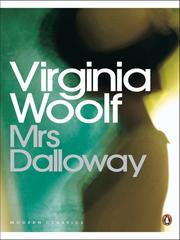
modernist literature · 1925
Mrs Dalloway
1925 novel by Virginia Woolf
- 1925
- modernist literature
- psychological fiction
Summary
Mrs Dalloway is a novel by Virginia Woolf published on 14 May 1925. It details a day in the life of Clarissa Dalloway, a wealthy woman in post-First World War London.
Source: Wikipedia (CC BY-SA).
Historical Background
Virginia Woolf composed Mrs Dalloway between 1922 and 1924, publishing it on 14 May 1925 with the Hogarth Press, which she ran with her husband Leonard Woolf. It followed her earlier, more conventional novels and marked her full commitment to modernist experimentation, growing out of a short story, "Mrs Dalloway in Bond Street," and an abandoned draft called "The Hours." The novel is set on a single June day in post-First World War London and reflects Woolf's preoccupation with the lingering psychological damage of the war, embodied in the shell-shocked veteran Septimus Warren Smith, whose fate she originally conceived as intertwined with Clarissa's own. Woolf drew on her own experience of mental illness and periods of institutionalization in shaping Septimus's breakdown and his treatment by fashionable Harley Street doctors, offering an implicit critique of contemporary psychiatric practice. The book also reflects Woolf's engagement with class, gender, and the constrained possibilities open to women like Clarissa within upper-middle-class English society. Structurally and stylistically, the novel was shaped by Woolf's ongoing experiments with stream-of-consciousness narration, influenced by contemporaries such as James Joyce and Marcel Proust, and by her theoretical essays of the period on fiction, in which she argued against materialist, plot-driven realism in favor of rendering the flux of consciousness itself.
The Story
The novel unfolds over a single Wednesday in mid-June in London, several years after the First World War. Clarissa Dalloway, a fifty-something society hostess, spends the morning walking through London to buy flowers for a party she is hosting that evening, her thoughts drifting between the present moment and memories of her youth at Bourton, especially her old suitor Peter Walsh and her intense friendship with Sally Seton. Peter, recently returned from India, visits Clarissa that morning, and their charged, unresolved history resurfaces. Running in parallel is the story of Septimus Warren Smith, a young war veteran suffering from severe shell shock and hallucinations, haunted by the death of his friend Evans. Septimus and his Italian wife, Lucrezia, consult the fashionable psychiatrist Sir William Bradshaw, who recommends institutionalized "rest," a prospect Septimus finds intolerable. The narrative moves fluidly between characters' interior consciousnesses via free indirect discourse, connecting strangers through shared moments, such as a car backfiring or an aeroplane writing in the sky. That afternoon, Septimus, terrified of losing his autonomy to the doctors, kills himself by jumping from a window. That evening, at Clarissa's party, Sir William Bradshaw arrives and mentions the suicide; Clarissa, though shaken and identifying deeply with Septimus's act, ultimately returns to her guests, affirming her attachment to life. The novel closes with Peter Walsh's overwhelming sense of Clarissa's continuing, magnetic presence.
Themes
- Time, memory, and the persistence of the past
- Trauma and the psychological aftermath of war
- The constraints of gender and class in English society
- Mental illness and the failures of psychiatric authority
- The tension between social conformity and inner authenticity
- Communication, connection, and human isolation
- Mortality and the fear/embrace of death
- The fluidity and multiplicity of consciousness
Literary Devices
- Stream of consciousness — narration renders characters' unfiltered flow of thought and sensation
- Free indirect discourse — third-person narration merges seamlessly with characters' interior voices
- Interior monologue — extended immersion in a single character's private thoughts
- Doubling — Clarissa and Septimus function as psychological mirrors despite never meeting
- Big Ben's chimes as structural motif — the striking clock punctuates and unifies the single-day timeline
- Fluid time shifts (tempus/duration play) — narration glides between present action and remembered past without transition
- Symbolic motif patterning — recurring images (flowers, water, waves) recur to link disparate minds
- Unity of time — the entire novel compresses into one day, echoing classical dramatic unity
Symbolism
- Flowers — beauty, transience, and Clarissa's affirmation of life
- Big Ben and the chiming clocks — the inexorable, external passage of time versus subjective inner time
- The aeroplane skywriting — modern spectacle and the elusive human search for shared meaning
- Waves and the sea — the ebb and flow of consciousness and mortality
- Septimus's suicide/the open window — escape, freedom, and the limits of social/medical control over the self
Critical Interpretation
Mrs Dalloway has been central to feminist criticism, notably readings influenced by Woolf's own essays (such as A Room of One's Own) that examine Clarissa's constrained social role, suppressed desires, and the novel's exploration of female interiority and same-sex attachment through her memories of Sally Seton. Critics have long debated the significance of the Clarissa–Septimus "double" structure, reading Septimus's suicide as both a sacrificial counterpoint that allows Clarissa to reaffirm life and as a devastating indictment of postwar medical and social institutions, particularly the complacent authority of Sir William Bradshaw. Formalist and narratological critics have focused on Woolf's innovations in free indirect discourse and her "tunnelling process" (her own term) for moving between minds, situating the novel within modernist experiments alongside Joyce and Proust. Later criticism, including queer and disability studies approaches, has examined the novel's treatment of trauma, sanity, and non-normative desire. Historicist critics read the novel against the trauma of the First World War and the British class system of the 1920s.
Quotations
Mrs Dalloway said she would buy the flowers herself.
The novel's famous opening sentence, establishing Clarissa's perspective and the day's action.
For there she was.
The novel's closing words, spoken from Peter Walsh's perspective as he perceives Clarissa's presence.
She would not say of any one in the world now that they were this or were that.
Clarissa reflecting on the irreducibility and complexity of individual identity.
Influence
Mrs Dalloway is regarded as a landmark of modernist fiction, extending the stream-of-consciousness techniques pioneered by James Joyce and Dorothy Richardson and consolidating Woolf's reputation as a major innovator of narrative form. Its single-day structure and psychological depth influenced later novelists' experiments with time and consciousness, and it directly inspired Michael Cunningham's 1998 novel The Hours, which interweaves Woolf's own life, a reader of Mrs Dalloway, and a modern-day recasting of Clarissa. The novel remains a touchstone in feminist literary criticism and in discussions of literary representations of trauma and mental illness.
Adaptations
- The Hours (1998), a novel by Michael Cunningham inspired by Mrs Dalloway, later adapted into the 2002 film The Hours directed by Stephen Daldry
- Mrs Dalloway (1997), a film directed by Marleen Gorris, starring Vanessa Redgrave
Related Works
- To the Lighthouse by Virginia Woolf
- Ulysses by James Joyce
- A Room of One's Own by Virginia Woolf
- The Hours by Michael Cunningham
- In Search of Lost Time by Marcel Proust
Curator's Notes
- 1The novel grew out of Woolf's earlier short story 'Mrs Dalloway in Bond Street' and a draft she called 'The Hours.'
- 2The character Clarissa Dalloway had appeared earlier in Woolf's first novel, The Voyage Out (1915).
- 3Woolf originally planned for Clarissa herself to die at the end before developing Septimus as her tragic counterpart instead.
- 4The Hogarth Press, which published the novel, was founded and run by Virginia and Leonard Woolf.
For the Exam
UGC NET English frequently tests Mrs Dalloway on: its stream-of-consciousness and free indirect discourse technique; the Clarissa–Septimus doubling and its thematic function; its single-day ('unity of time') structure and use of Big Ben as a time motif; its status as a landmark of British modernism alongside Joyce and Proust; its treatment of war trauma, psychiatry, and gender; and its relationship to Woolf's essays and to Michael Cunningham's The Hours. Questions may also probe the novel's publication (Hogarth Press, 1925) and its opening/closing lines.