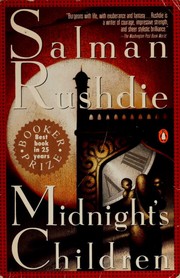
magic realist fiction · 1981
Midnight's Children
1981 novel by Salman Rushdie
- 1981
- magic realist fiction
- historical fiction
Summary
Midnight's Children is the second novel by Indian-British writer Salman Rushdie, published in 1981 by Jonathan Cape with cover design by Bill Botten, about India's transition from British colonial rule to independence and partition. It is a postcolonial, postmodern and magical realist story told by its chief protagonist, Saleem Sinai, set in the context of historical events. The style of preserving history with fictional accounts is self-reflexive. In the way it interweaves a personal with a national biography it has similarities to Günter Grass's The Tin Drum.
Source: Wikipedia (CC BY-SA).
Historical Background
Salman Rushdie's second novel, published in 1981 by Jonathan Cape, followed the comparative failure of his debut, Grimus, and grew from Rushdie's own return to Bombay after years in England and his desire to reclaim India's chaotic, plural reality in fiction. He began writing in the mid-1970s, and the composition overlapped with the political turbulence of Indira Gandhi's Emergency (1975-77), which becomes central to the novel's later sections. The narrative binds the private life of narrator Saleem Sinai, born at the exact moment of India's independence on 15 August 1947, to the public history of the subcontinent through Partition, the Indo-Pakistani wars, and the Emergency. Rushdie drew on oral storytelling traditions, the Arabian Nights, Hindu and Islamic mythology, Bombay talkies, and Indian English idiom, fusing them with European modernist and postmodernist techniques to create a hybrid form suited to a newly independent, heterogeneous nation. The novel's interweaving of personal and national biography has often been compared to Gunter Grass's The Tin Drum. Its 1981 publication won the Booker Prize, and it was later named "Booker of Bookers" and "Best of the Booker," cementing its status as a foundational text of postcolonial and Indian English literature and a landmark of magical realism outside Latin America.
The Story
Saleem Sinai narrates his life story to his companion and eventual wife Padma, insisting his fate is inextricably tied to the fate of the Indian nation, since he was born at the exact stroke of midnight on 15 August 1947, the instant of independence. He discovers that all children born in India during that first hour possess magical gifts, and that he, born precisely at midnight, can telepathically convene them in the Midnight Children's Conference, a parliament of magical youth mirroring and satirizing the new nation's fractious politics. Saleem's narrative reaches back three generations, beginning with his grandfather Aadam Aziz in Kashmir, through his parents in Amritsar and Bombay, tracing a family saga entangled with Partition, the India-Pakistan wars, and the Bangladesh Liberation War. A pivotal revelation is that Saleem was switched at birth with another midnight's child, Shiva, by a nurse acting on private motives, so that the boy raised as wealthy is biologically poor and vice versa, undercutting any notion of pure lineage or destiny. Saleem's oversized nose gives him telepathic powers linking him to the other children, while his rival Shiva possesses devastating physical strength; their opposition structures much of the plot. The novel moves through Saleem's childhood, exile to Pakistan, involvement in the Bangladesh war, and his eventual sterilization and the destruction of the midnight's children during the Emergency, when Indira Gandhi's government (thinly fictionalized as the Widow) hunts them down. The book closes with Saleem, disintegrating and fragmenting like the nation itself, contemplating his son Aadam and the next generation of India, as he approaches a chaotic end amid the crowds of Bombay.
Themes
- History and personal destiny intertwined
- Postcolonial nationhood and identity
- Memory, unreliable narration, and truth
- Fragmentation and multiplicity versus wholeness
- Partition and communal violence
- Hybridity of language, culture, and religion
- Political authoritarianism and the Emergency
- Storytelling as a means of survival and resistance
Literary Devices
- Magical realism — supernatural elements (telepathy, prophetic births) presented within a realistic historical setting
- Unreliable narration — Saleem repeatedly admits to errors and revisions in his own account
- Allegory — Saleem's body and fate allegorize the fractured Indian nation
- Frame narrative — Saleem's oral storytelling to Padma frames the entire novel
- Intertextuality — echoes of the Arabian Nights, Hindu epics, and Bombay cinema conventions
- Metafiction — the novel self-consciously comments on its own act of narration and history-writing
- Hyperbole and grotesque imagery — exaggerated bodily and historical detail used for satirical and symbolic effect
- Nonlinear, digressive chronology — the narrative loops backward and forward across generations
Symbolism
- Saleem's cracking, disintegrating body — the fragmentation of the postcolonial Indian nation
- The Midnight's Children's Conference — India's plural, quarrelsome democratic promise
- Saleem's oversized nose — perception, connection, and inherited destiny
- The perforated sheet through which Aadam Aziz first sees his wife — partial, mediated knowledge and fragmented vision
- The spittoon — memory and the accumulated debris of personal and national history
- The Widow (Indira Gandhi figure) — authoritarian erasure of individual and collective identity during the Emergency
Critical Interpretation
Midnight's Children is widely regarded as a founding text of postcolonial literature and of magical realism in English, frequently discussed alongside Gabriel Garcia Marquez's One Hundred Years of Solitude for its use of the fantastic to narrate national history. Postcolonial critics, drawing on Homi Bhabha's theories of hybridity and the 'third space,' have engaged with the novel's treatment of hybridity, nation, and narration, seeing Saleem's fragmented, unreliable storytelling as embodying the instability of postcolonial identity and historiography. The novel has also been read through postmodern lenses for its metafictional self-awareness and its skepticism toward any single, authoritative version of history. Some critics have raised questions about the novel's representation of women and its ambivalent, at times satirical, portrayal of Indian political figures, particularly Indira Gandhi, whose fictionalized depiction led to a real defamation claim over one sentence in the book. Its blending of Bombay cinema idiom, oral narrative tradition, and English-language modernism has been central to debates about the possibilities and politics of writing India in English.
Quotations
I was born in the city of Bombay ... once upon a time.
Opening line, fusing Saleem's precise historical birth with fairy-tale storytelling convention.
To understand just one life, you have to swallow the world.
Saleem on the impossibility of narrating a self apart from history.
I had been mysteriously handcuffed to history, my destinies indissolubly chained to those of my country.
Saleem's statement of the novel's central premise linking individual and national fate.
Influence
Midnight's Children is credited with opening the door for a new generation of Indian writers in English, including Arundhati Roy, Vikram Chandra, and Kiran Desai, by demonstrating that Indian English fiction could be linguistically inventive, historically ambitious, and commercially and critically successful on the world stage. Its Booker Prize win in 1981, and later recognitions as "Booker of Bookers" and "Best of the Booker," established it as a benchmark for postcolonial fiction and helped popularize magical realism as a mode for narrating national history beyond Latin America. The novel's techniques of self-conscious, digressive narration and its fusion of the personal with the political have influenced numerous subsequent works engaging with nationhood, memory, and identity in the postcolonial world.
Adaptations
- Midnight's Children (2012 film), directed by Deepa Mehta with a screenplay by Salman Rushdie
Related Works
- The Tin Drum by Gunter Grass
- One Hundred Years of Solitude by Gabriel Garcia Marquez
- The God of Small Things by Arundhati Roy
- Shame by Salman Rushdie
- The Satanic Verses by Salman Rushdie
- A Fine Balance by Rohinton Mistry
Curator's Notes
- 1Saleem Sinai's birth at the exact midnight of Indian independence, 15 August 1947, is the structuring conceit of the entire novel.
- 2Midnight's Children won the Booker Prize in 1981 and was later awarded the 'Booker of Bookers' (1993) and 'Best of the Booker' (2008) as the best novel in the prize's history.
- 3A sentence about Indira Gandhi in the novel led to a defamation dispute, which resulted in the sentence being removed from later editions.
- 4Rushdie wrote the screenplay for the 2012 film adaptation, directed by Deepa Mehta.
For the Exam
UGC NET frequently tests Midnight's Children as the exemplary text of postcolonial Indian English fiction and magical realism: expect questions on its publication year (1981) and Booker Prize wins, the narrator Saleem Sinai and his midnight birth conceit, the Midnight's Children's Conference, techniques of magical realism and metafiction, its relation to Gunter Grass's The Tin Drum, and Rushdie's place in the Indian English canon alongside later writers like Arundhati Roy.