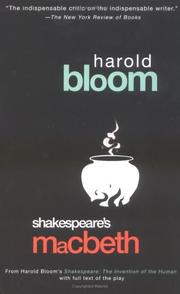
tragedy · 1606
Macbeth
tragic play by William Shakespeare from the early 1600s
- 1606
- tragedy
Summary
The Tragedy of Macbeth, often shortened to Macbeth, is a tragedy by William Shakespeare, estimated to have been first performed in 1606. It dramatises the physically violent and damaging psychological effects of political ambitions and power. It was first published in the Folio of 1623, possibly from a prompt book, and is Shakespeare's shortest tragedy. Scholars believe Macbeth, of all the plays that Shakespeare wrote during the reign of King James I, contains the most allusions to James, patron of Shakespeare's acting company.
Source: Wikipedia (CC BY-SA).
Historical Background
Macbeth was composed around 1606, early in the reign of James I, who had succeeded Elizabeth I in 1603 and was patron of Shakespeare's company, the King's Men. The play is widely read as flattering the new king: it dramatises the Stuart claim to descent from Banquo, engages with James's own writings on witchcraft and kingship, and alludes to the Gunpowder Plot of 1605 through its concern with equivocation and treason. Shakespeare drew his central narrative from Raphael Holinshed's Chronicles of England, Scotland, and Ireland, compressing and altering the historical record of the eleventh-century Scottish king to build a tighter, more damning tragedy. No authoritative text survives from Shakespeare's lifetime; the play was first printed in the First Folio of 1623, seven years after his death, in a text that scholars regard as showing signs of later revision, possibly by Thomas Middleton, particularly in the Hecate scenes. At under 2,100 lines, it is Shakespeare's shortest tragedy, and its compressed, breathless pace has long been read as reinforcing its themes of unchecked ambition and moral freefall.
The Story
Returning victorious from battle, the Scottish generals Macbeth and Banquo encounter three witches who prophesy that Macbeth will become Thane of Cawdor and then king, and that Banquo's descendants will be kings. When the first prophecy is quickly confirmed, Macbeth, spurred on by his wife's ambition, murders King Duncan while he is a guest in Macbeth's castle and seizes the throne. Consumed by guilt and paranoia, the couple find their crime breeding further violence: Macbeth has Banquo murdered to protect his line, though Banquo's son Fleance escapes, and he later orders the slaughter of Macduff's wife and children after Macduff flees to England. Lady Macbeth, tormented by what she has done, descends into sleepwalking madness and eventually dies. Macbeth, increasingly isolated and fatalistic, returns to the witches, who give him prophecies he misreads as guarantees of safety. As Malcolm, Duncan's son, marches on Scotland with an English army, using Birnam Wood as camouflage in apparent fulfilment of one prophecy, Macduff—revealed to have been born by caesarean section, and so not "of woman born"—kills Macbeth in single combat, and Malcolm is restored to the throne.
Themes
- Ambition and its corrupting power
- The nature of evil and moral choice
- Fate versus free will
- Guilt and conscience
- Kingship and political order
- Gender and masculinity
- Appearance versus reality
- The disruption of the natural order
Literary Devices
- Soliloquy — reveals Macbeth's inner turmoil and moral deliberation directly to the audience
- Dramatic irony — the audience perceives the witches' equivocal prophecies and Macbeth's self-deception before he does
- Blood imagery — recurring motif marking guilt that cannot be washed away
- Pathetic fallacy — disordered weather and unnatural events mirror the moral chaos unleashed by regicide
- Equivocation — ambiguous, double-meaning language used by the witches and echoed throughout the play
- Foreshadowing — early prophecies and omens anticipate later catastrophe
- Blank verse — Shakespeare's use of unrhymed iambic pentameter to render psychological intensity
Symbolism
- Blood — guilt, violence, and the impossibility of moral cleansing
- The dagger — Macbeth's murderous intent visualized as a hallucination
- Darkness and night — concealment of evil deeds and moral blindness
- Sleep — innocence and peace, which Macbeth murders along with Duncan
- Clothing (ill-fitting garments) — the illegitimacy of Macbeth's stolen kingship
Critical Interpretation
Macbeth has attracted sustained critical attention to its treatment of evil, agency, and gender. A. C. Bradley's Shakespearean Tragedy (1904) established an influential character-centred reading focused on Macbeth's tragic imagination and moral struggle. Twentieth-century critics increasingly examined the play's ambiguous supernaturalism, debating whether the witches determine Macbeth's fate or merely voice temptations he was already inclined toward, a question central to arguments about free will versus predestination. Feminist criticism has scrutinised Lady Macbeth and the witches as sites of anxiety about female power and transgressive femininity, particularly Lady Macbeth's invocation to be "unsexed." Historicist critics have read the play within Jacobean politics, linking its concerns with legitimate kingship, treason, and equivocation to the Gunpowder Plot and to James I's own beliefs about witchcraft and divine-right monarchy. The play's textual history, including probable additions by Thomas Middleton, has also generated significant bibliographic scholarship.
Quotations
Fair is foul, and foul is fair.
Spoken by the witches; establishes the play's pervasive theme of moral inversion and equivocation.
Is this a dagger which I see before me, / The handle toward my hand?
Macbeth's soliloquy before Duncan's murder, marking his descent into hallucination and guilt.
Will all great Neptune's ocean wash this blood / Clean from my hand?
Macbeth immediately after killing Duncan, expressing the ineradicability of his guilt.
Out, damned spot! out, I say!
Lady Macbeth sleepwalking, haunted by imagined bloodstains from the murder.
Tomorrow, and tomorrow, and tomorrow / Creeps in this petty pace from day to day.
Macbeth's response to news of his wife's death, voicing despair at life's futility.
Life's but a walking shadow, a poor player / That struts and frets his hour upon the stage / And then is heard no more.
Continuation of Macbeth's nihilistic meditation on meaninglessness.
Influence
Macbeth has become one of the most frequently performed and adapted of Shakespeare's tragedies, shaping later literature's treatment of ambition, guilt, and the psychology of murder. Its exploration of a criminal protagonist's tortured conscience influenced the development of the tragic villain-hero across subsequent drama and fiction, and its supernatural machinery helped establish conventions for the literary use of witches and prophecy. The play's language has entered common English usage extensively, and theatrical superstitions surrounding it (the taboo on naming it inside a theatre, referring to it instead as "the Scottish play") attest to its enduring cultural mystique.
Adaptations
- Verdi's opera Macbeth (1847, revised 1865)
- Akira Kurosawa's film Throne of Blood (1957), a Japanese adaptation
- Roman Polanski's film Macbeth (1971)
- Justin Kurzel's film Macbeth (2015)
- Joel Coen's film The Tragedy of Macbeth (2021)
Related Works
- Hamlet by William Shakespeare
- King Lear by William Shakespeare
- Othello by William Shakespeare
- Raphael Holinshed's Chronicles of England, Scotland, and Ireland
- Doctor Faustus by Christopher Marlowe
Curator's Notes
- 1At roughly 2,000 lines, Macbeth is Shakespeare's shortest surviving tragedy.
- 2No text of the play survives from before the First Folio of 1623, published seven years after Shakespeare's death.
- 3Actors traditionally avoid saying the play's title inside a theatre, calling it "the Scottish play" instead.
- 4The historical Macbeth actually reigned over Scotland for roughly seventeen years, a far longer and more stable rule than the play depicts.
- 5Some scholars attribute the Hecate scenes and certain songs to a later reviser, possibly Thomas Middleton.
For the Exam
UGC NET frequently tests Macbeth on its Jacobean context (James I, the Gunpowder Plot, witchcraft beliefs), its status as Shakespeare's shortest tragedy, the Aristotelian concept of the tragic hero and hamartia as applied to Macbeth, the role and ambiguity of the witches and the theme of equivocation, Lady Macbeth's role in gender criticism, key soliloquies and imagery patterns (blood, sleep, clothing), and the Holinshed source material. Questions also probe textual issues, including the suspected Middleton additions.