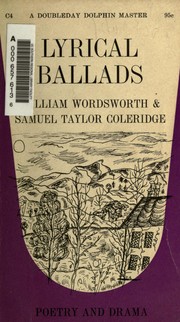
1798
Lyrical Ballads
debut poetry collection (1798) by Coleridge and Wordsworth
- 1798
Summary
Lyrical Ballads, with a Few Other Poems is a collection of poems by William Wordsworth and Samuel Taylor Coleridge, first published in 1798 and generally considered to have marked the beginning of the English Romantic movement in literature. The immediate effect on critics was modest, but it became and remains a landmark, changing the course of English literature and poetry. The 1800 edition is famous for the Preface to the Lyrical Ballads, something that has come to be known as the manifesto of Romanticism.
Source: Wikipedia (CC BY-SA).
Historical Background
Lyrical Ballads, with a Few Other Poems appeared anonymously in September 1798, the fruit of a close collaboration between Samuel Taylor Coleridge and William Wordsworth during their year together in Somerset, near Nether Stowey and Alfoxden. The two poets, in daily conversation about the aims of poetry, conceived a volume that would test new principles of subject and diction against the artificial, ornate verse fashionable in the later eighteenth century. Their agreed division of labour, as later recalled by Coleridge in Biographia Literaria, gave Coleridge the task of lending 'a semblance of truth' to persons and incidents 'in part at least supernatural,' while Wordsworth was to give 'the charm of novelty to things of every day' by awakening the mind to the wonder beneath ordinary life. The 1798 edition opened with Coleridge's The Rime of the Ancyent Marinere and closed with Wordsworth's Lines Written a Few Miles above Tintern Abbey. A second, two-volume edition followed in 1800 under Wordsworth's name alone, considerably expanded and prefaced by his famous critical Preface, further enlarged in 1802, which became the era's key statement of Romantic poetic theory.
The Story
As a collection rather than a single narrative, Lyrical Ballads has no continuous plot but a deliberate structural logic: poems move between the strange and the familiar, the supernatural and the everyday. Coleridge's principal contribution, The Rime of the Ancient Mariner, narrates a sailor's tale of transgression, curse, and penance after he kills an albatross at sea, bringing supernatural retribution upon his ship, followed by a long spiritual ordeal of guilt, isolation, and partial redemption, related to a wedding guest he detains. Wordsworth's poems, by contrast, dwell on rural figures and humble incidents — beggars, leech-gatherers, abandoned mothers, simple children, ruined cottages — treated with unusual seriousness, alongside meditative pieces such as Tintern Abbey, which reflects on memory, nature, and the growth of the poet's mind. The volume's argument, made explicit in the 1800 Preface, is critical and programmatic as much as narrative: poetry should use 'the real language of men' drawn from humble and rustic life, purged of poetic diction, because such life presents human passions in their simplest, most durable form, and because the poet's task is to trace the workings of imagination and feeling in ordinary experience.
Themes
- the supernatural and moral guilt
- nature as a moral and spiritual teacher
- the dignity of humble and rustic life
- memory and the growth of the mind
- sympathy, suffering, and outcasts
- the language and diction proper to poetry
- imagination versus mechanical reason
- isolation and reintegration into community
Literary Devices
- Ballad form and archaic diction — Coleridge revives medieval balladry and antique spelling in the Mariner for atmosphere and estrangement
- Blank verse meditation — Wordsworth's Tintern Abbey uses unrhymed iambic pentameter for reflective, conversational movement
- Gothic and supernatural machinery — spectral figures, curses, and omens generate terror and moral allegory in the Mariner
- Plain, deliberately unadorned diction — Wordsworth's programme of using ordinary speech rather than elevated poetic diction
- Framed narrative and interruption — the Mariner's tale is told to a wedding guest, creating dramatic distance and urgency
- Nature imagery as symbol — landscape, weather, and season externalize inward states across both poets' contributions
- The dramatic monologue/dialogue of rustic speakers — poems built around a single humble voice or encounter
- Marginal gloss (added 1817) — later prose commentary framing the Mariner's supernatural events, though not present in the 1798 text
Symbolism
- The albatross — hospitality, natural bond, and the burden of unmotivated sin
- The becalmed ship and rotting sea — spiritual stasis and isolation after transgression
- Water-snakes blessed 'unaware' — the involuntary return of love and grace
- Rustic and ruined figures (leech-gatherer, ruined cottage) — endurance and the moral worth hidden in humble life
- Tintern Abbey's landscape — memory as a source of continuity between past and present selves
Critical Interpretation
Contemporary reviewers were largely unimpressed or puzzled by the 1798 volume, finding Coleridge's Mariner obscure and archaic and Wordsworth's rustic subjects unpoetic; Robert Southey's notice was notably hostile. The 1800 Preface, however, became a touchstone of Romantic theory, later engaged critically by Coleridge himself in Biographia Literaria (1817), where he questioned Wordsworth's claims about the 'real language of men' and distinguished fancy from imagination. Twentieth-century critics, including M. H. Abrams and scholars of Romanticism, have treated the volume as the founding document of English Romantic poetics, examining its theories of poetic diction, the sublime, and the relationship between nature and mind. Critical attention to the Mariner has ranged from moral-allegorical readings (crime, penance, and grace) to psychological and proto-symbolist interpretations of guilt and imagination, while Wordsworth's contributions are read within debates over sentimentality, social sympathy, and the representation of poverty and rural labour in an age of enclosure and war.
Quotations
Water, water, every where, / Nor any drop to drink.
The Mariner describes the ship's becalmed torment after killing the albatross.
He prayeth best, who loveth best / All things both great and small.
The poem's closing moral, spoken by the Mariner to the Wedding-Guest.
Instead of the cross, the Albatross / About my neck was hung.
The crew burdens the Mariner with the dead bird as a mark of guilt.
A sadder and a wiser man, / He rose the morrow morn.
The poem's final couplet, describing the Wedding-Guest after hearing the tale.
Influence
Lyrical Ballads is conventionally treated as the inaugural text of English Romanticism, redirecting poetry away from Augustan diction toward emotional immediacy, natural speech, and the inner life. Wordsworth's Preface shaped later Romantic and Victorian poetics and remains a core document in the history of literary criticism, while Coleridge's Mariner established a lasting model for the literary supernatural ballad and influenced later narrative poetry, Gothic fiction, and discussions of imagination in criticism, notably Coleridge's own Biographia Literaria.
Related Works
- Biographia Literaria by Samuel Taylor Coleridge
- The Prelude by William Wordsworth
- Christabel by Samuel Taylor Coleridge
- Kubla Khan by Samuel Taylor Coleridge
- Songs of Innocence and of Experience by William Blake
Curator's Notes
- 1The 1798 volume was published anonymously, with neither Wordsworth's nor Coleridge's name on the title page.
- 2The Rime of the Ancient Mariner originally appeared with deliberately archaic spelling ('Ancyent Marinere'), later modernized.
- 3The famous prose gloss running beside the Mariner's text was added only in the 1817 Sibylline Leaves edition, not in 1798 or 1800.
- 4The 1800 edition dropped Coleridge's name from the title page, listing Wordsworth as sole author despite Coleridge's contributions.
- 5The collection was conceived during long walking conversations between Coleridge and Wordsworth in the Quantock Hills.
For the Exam
UGC NET frequently tests the 1798/1800/1802 publication history, the Wordsworth-Coleridge division of poetic labour as described in Biographia Literaria (Wordsworth's 'things of every day' vs Coleridge's 'persons and incidents... supernatural'), the content and arguments of the 1800 Preface (real language of men, emotion recollected in tranquility, definition of a poet), and close reading of The Rime of the Ancient Mariner's structure, symbolism, and the later-added marginal gloss.