Summary
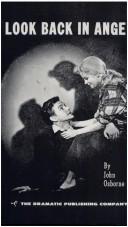
Look Back in Anger (1956) is a realist play written by John Osborne. It focuses on the life and marital struggles of an intelligent and educated but disaffected young man of working-class origin, Jimmy Porter, and his equally competent yet impassive upper-middle-class wife Alison. The supporting characters include Cliff Lewis, an amiable Welsh lodger who attempts to keep the peace; and Helena Charles, Alison's snobbish friend.
Source: Wikipedia (CC BY-SA).
Historical Background
Look Back in Anger was written in weeks in 1955 and premiered at the Royal Court Theatre, London, on 8 May 1956, directed by Tony Richardson and presented by George Devine's newly formed English Stage Company. Its arrival is widely treated as a watershed in postwar British theatre, breaking with the genteel drawing-room drama associated with Terence Rattigan and Noël Coward. Osborne, then an unknown actor-playwright, drew on his own strained first marriage (to actress Pamela Lane) and on a broader mood of disillusionment among young, educated but socially stranded Britons in the austere years after the Second World War and the loss of empire. Critic Kenneth Tynan's enthusiastic review helped rescue the play from indifferent early notices and turn it into a cultural event. The label "angry young men," coined by the Royal Court's press officer George Fearon and eagerly adopted by journalists, was pinned on Osborne and loosely grouped him with contemporaries such as Kingsley Amis and John Braine, even though the writers themselves resisted the tag. The play's setting—a cramped one-room Midlands attic flat—and its unglamorous, ironing-board realism signalled a deliberate rejection of West End escapism in favour of raw, class-conscious contemporary speech.
The Story
The action unfolds in the cramped attic flat Jimmy Porter shares with his wife Alison in a Midlands town. Jimmy, a university-educated but working-class sweet-stall owner, rails ceaselessly against the complacency of English life, the class system, and his wife's placid upper-middle-class family, using tirades to needle Alison and their lodger Cliff Lewis, who tries good-naturedly to keep peace between them. Alison, pregnant but hiding it from Jimmy, endures his verbal cruelty with passive endurance rather than open confrontation. When her actress friend Helena Charles arrives, she is appalled by Jimmy's treatment of Alison and persuades Alison to leave with her father, Colonel Redfern, a relic of colonial-era certainties bewildered by the postwar world. Alison departs, but Helena, despite her initial disapproval, becomes Jimmy's lover and moves into the flat herself. Word eventually reaches Jimmy that Alison has miscarried; the news pierces Helena's conscience, and she recognizes that she has been living by principles she cannot sustain and chooses to leave. Alison returns, humbled and stripped of her former composure, to find Jimmy alone. In the closing scene the couple retreat into their private fantasy game of "bears and squirrels," a childlike ritual that allows them a fragile, ambiguous reconciliation without resolving the deeper resentments and inequalities that divide them.
Themes
- Class conflict and social mobility
- Postwar disillusionment and loss of purpose
- Marriage as battleground
- Anger as both rebellion and self-destruction
- Nostalgia versus the modern world
- Gender roles and female suffering
- Failure of communication and intimacy
- Decline of English imperial and social certainties
Literary Devices
- Kitchen-sink realism — depicts ordinary, unglamorous domestic life in unflinching naturalistic detail
- Extended tirade/rhetorical monologue — Jimmy's lengthy speeches function as both character revelation and social critique
- Symbolic setting — the cramped attic flat mirrors the characters' emotional and social confinement
- Irony — Jimmy's professed hatred of complacency masks his own paralysis and cruelty
- Naturalistic dialogue — colloquial, abrasive speech patterns replace the polished diction of earlier drawing-room drama
- Ritual/game-playing — the 'bears and squirrels' fantasy offers a regressive escape from adult conflict
Symbolism
- The attic flat — the characters' social and emotional entrapment
- Ironing board — Alison's domestic drudgery and silent endurance
- Bears and squirrels game — retreat into childhood innocence to escape adult failure
- Church bells — the old, complacent English order Jimmy despises
- Colonel Redfern — the fading certainties of imperial, pre-war England
Critical Interpretation
Look Back in Anger is central to debates about the "angry young men," a journalistic label critics have since complicated, noting Osborne's ambivalence toward the very working class he claims to champion. Kenneth Tynan's early championing of the play helped canonize it as a generational statement, and it is frequently credited with opening British theatre to social realism and working-class subject matter, paving the way for the Royal Court's subsequent new-writing programme. Feminist critics have challenged the play's treatment of Alison and Helena, arguing that Jimmy's misogynistic cruelty is too readily naturalized or even celebrated as vitality, and that the women exist largely to absorb and validate his rage. Other critics read Jimmy's anger as politically incoherent—nostalgic for a lost sense of moral purpose (he laments there are "no good, brave causes left") rather than genuinely radical—making the play more a study of impotent frustration than a coherent ideological statement. Its historical significance as a turning point in British drama, marking the shift from Rattigan-style theatre to the new realism, remains widely accepted even where its politics and gender dynamics are contested.
Quotations
There aren't any good, brave causes left.
Jimmy Porter laments the absence of purpose or ideals for his generation, encapsulating the play's theme of postwar disillusionment.
I learnt at an early age what it was to be angry — angry and helpless.
Jimmy reflecting on watching his father die when he was ten, tying his rage to formative personal loss.
Influence
Look Back in Anger is credited with transforming British theatre by legitimizing working-class voices, regional settings, and confrontational realism on the mainstream stage, displacing the polite drawing-room comedies that had dominated the West End. It galvanized the Royal Court Theatre's identity as a home for new, socially engaged writing and encouraged a generation of British dramatists—including Arnold Wesker, Shelagh Delaney, and later Edward Bond—to write about contemporary class and domestic experience in unvarnished language. The "angry young man" figure it popularized became a recurring type in British fiction, film, and drama through the late 1950s and 1960s, and the play is frequently cited as the starting point of modern British theatre's turn toward social realism.
Adaptations
- 1959 film adaptation directed by Tony Richardson, starring Richard Burton as Jimmy Porter and Claire Bloom as Helena
Related Works
- The Entertainer — John Osborne
- A Taste of Honey — Shelagh Delaney
- Roots — Arnold Wesker
- Saturday Night and Sunday Morning — Alan Sillitoe
- Lucky Jim — Kingsley Amis
Curator's Notes
- 1The play premiered at the Royal Court Theatre on 8 May 1956, directed by Tony Richardson and presented by the newly formed English Stage Company under George Devine's artistic direction.
- 2The phrase 'angry young men' was coined by the Royal Court's press officer George Fearon and became attached to Osborne despite his own dislike of the label.
- 3Kenneth Tynan's rave review in The Observer is widely credited with rescuing the play's reputation after mixed initial notices.
- 4The 1959 film version starred Richard Burton as Jimmy Porter.
For the Exam
UGC NET frequently tests Look Back in Anger as the founding text of postwar British 'kitchen-sink' realism and the 'angry young men' movement, alongside its 1956 premiere date, its break from Rattigan-era drawing-room drama, and Jimmy Porter as the archetypal disaffected antihero. Expect questions on the play's class themes, its Royal Court/English Stage Company context, Kenneth Tynan's role in its critical reception, and its influence on later British dramatists such as Wesker and Delaney.