Summary
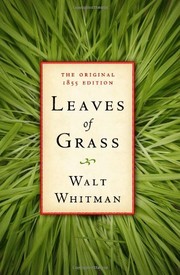
Leaves of Grass is a poetry collection by American poet Walt Whitman. After self-publishing it in 1855, he spent most of his professional life writing, revising, and expanding the collection until his death in 1892. Either six or nine separate editions of the book were produced, depending on how one defines a new edition. The continual modifications to Leaves of Grass resulted in vastly different copies of it circulating in Whitman's lifetime. The first edition was a slim tract of twelve poems, and the last was a compilation of over 400 poems.
Source: Wikipedia (CC BY-SA).
Historical Background
Walt Whitman self-published Leaves of Grass in 1855 in Brooklyn, setting some of the type himself and issuing it without his name on the title page, only an engraved frontispiece portrait. The slim first edition contained twelve untitled poems, prefaced by a prose manifesto proclaiming a new, distinctly American poetics free of European convention and rhyme. Whitman sent a copy to Ralph Waldo Emerson, who wrote back praising it as "the most extraordinary piece of wit and wisdom that America has yet contributed," a private letter Whitman controversially published without permission. Rather than treating the book as finished, Whitman spent nearly four decades revising, adding, and reorganizing it, issuing multiple editions that grew from twelve poems to several hundred, culminating in the so-called "deathbed edition" near his 1892 death. The book emerged from the ferment of antebellum America—Jacksonian democracy, westward expansion, urbanization, and the looming crisis over slavery—and drew on Whitman's work as a journalist, printer, and itinerant observer of Manhattan and Brooklyn street life, as well as his engagement with transcendentalism, opera, and the King James Bible's cadences.
The Story
Leaves of Grass has no narrative plot in the conventional sense; it is a continually expanding cycle of poems organized around a first-person poetic persona who identifies himself as "Walt Whitman, an American, one of the roughs, a kosmos." The collection's structural and thematic core is "Song of Myself," a long free-verse poem in which the speaker moves fluidly between intimate self-portraiture, catalogues of American people and occupations, meditations on the body and soul, and cosmic assertions of unity with all things living and dead. Later editions organize the poems into clusters with distinct concerns: "Children of Adam" and "Calamus" explore heterosexual and homoerotic love and the body; "Drum-Taps" responds to the Civil War, including elegies for Lincoln such as "When Lilacs Last in the Dooryard Bloom'd" and "O Captain! My Captain!"; and later additions turn toward old age, death, and cosmic reconciliation. Throughout, the poems argue, in loosely discursive and incantatory free verse, for the sacredness of ordinary experience, the equality and interconnection of all people and things, and the poet's role as prophetic witness and democratic representative who contains multitudes and addresses the reader directly and intimately.
Themes
- The self and its expansion into a democratic 'kosmos'
- The equality and dignity of ordinary people and labor
- The body and soul as inseparable and sacred
- American national identity and democracy
- Nature and organic cycles of growth, death, and renewal
- Sexuality and love, including homoerotic desire
- Death as transformation and continuity of life
- The poet as prophet and intimate companion to the reader
Literary Devices
- Free verse — abandons regular meter and rhyme in favor of long, rhythmic, breath-based lines
- Anaphora — repeated opening words or phrases build incantatory, sermon-like momentum
- Cataloguing (enumeration) — long lists of people, places, and occupations enact democratic inclusiveness
- Direct address — the speaker repeatedly addresses 'you,' the reader, collapsing distance between poet and audience
- Persona and self-mythologizing — the speaker merges autobiographical 'Walt Whitman' with an expansive, universalized voice
- Organic imagery — grass, leaves, and biological cycles serve as central controlling metaphors
Symbolism
- Grass — the democratic commonality and continuity of all life and death
- The open road — freedom, self-discovery, and the journey of democratic fellowship
- The body — the sacredness of physical existence as inseparable from the soul
- Lilacs (in the Lincoln elegy) — mourning, renewal, and the cyclical return of grief and spring
Critical Interpretation
Early reception was polarized: Emerson's private praise contrasted with public outrage over the book's sexual candor, and some reviewers and even Whitman's own employer condemned it as indecent, leading to the 1882 Boston obscenity controversy over a later edition. Twentieth-century critics such as F. O. Matthiessen situated Whitman within an "American Renaissance" alongside Emerson, Thoreau, Hawthorne, and Melville, reading Leaves of Grass as a foundational text of a distinctly national literature. Later scholarship, informed by queer studies, has emphasized the "Calamus" poems' homoerotic content and Whitman's significance for LGBTQ literary history. Whitman studies has also long grappled with the instability of the "text" itself, given the many differing editions, prompting debate over whether the 1855, 1860, or 1891–92 "deathbed" edition should be treated as authoritative. Critics have further examined Whitman's democratic poetics as both genuinely egalitarian and, at times, complicit in nineteenth-century racial and imperial ideologies, complicating earlier readings of him as an unqualified poet of universal inclusion.
Quotations
I celebrate myself, and sing myself, / And what I assume you shall assume, / For every atom belonging to me as good belongs to you.
The poem's famous opening asserting the interconnection of self and reader.
Do I contradict myself? / Very well then I contradict myself, / (I am large, I contain multitudes.)
Whitman's embrace of paradox and expansive identity.
A child said What is the grass? fetching it to me with full hands; / How could I answer the child? I do not know what it is any more than he.
Introduces the grass as a central, unresolved symbol of life and mortality.
O Captain! my Captain! our fearful trip is done
Opening line of the elegy mourning Abraham Lincoln.
Influence
Leaves of Grass is widely regarded as a founding text of modern American poetry, liberating verse from fixed meter and rhyme and legitimizing free verse as a major form. Its influence runs through Ezra Pound, William Carlos Williams, Hart Crane, and later the Beat poets, especially Allen Ginsberg, whose "Howl" directly echoes Whitman's cataloguing and prophetic voice. Internationally, Whitman shaped poets such as Pablo Neruda and Federico García Lorca, and his frank treatment of the body and sexuality opened space for later confessional and queer poetics. He is frequently paired with Emily Dickinson as one of the two poles of nineteenth-century American poetic innovation.
Related Works
- Emerson's "Nature" and "The Poet" (essays)
- Thoreau's Walden
- Allen Ginsberg's "Howl"
- Emily Dickinson's collected poems
- Hart Crane's The Bridge
Curator's Notes
- 1Whitman set some of the type for the 1855 first edition himself at a Brooklyn print shop.
- 2The 1855 edition did not print Whitman's name on the title page, identifying him only through an engraved portrait and a line within "Song of Myself."
- 3Whitman published Emerson's private letter of praise, without permission, to promote the book's second edition.
- 4Whitman continued revising and expanding the collection for nearly forty years, producing what is often called the "deathbed edition" shortly before he died in 1892.
- 5A Boston district attorney threatened obscenity prosecution over the 1881-82 edition, prompting its publisher to drop the book.
For the Exam
UGC NET English frequently tests Leaves of Grass on: its status as a founding work of American free verse and Whitman's break from traditional meter and rhyme; the significance of "Song of Myself" and its themes of the democratic self, body-soul unity, and cataloguing technique; the "Calamus" and "Children of Adam" clusters and their treatment of sexuality; the Civil War and Lincoln elegies in "Drum-Taps," especially "O Captain! My Captain!" and "When Lilacs Last in the Dooryard Bloom'd"; Whitman's place in the American Renaissance alongside Emerson, Thoreau, and Melville; and the concept of the poet as democratic prophet.