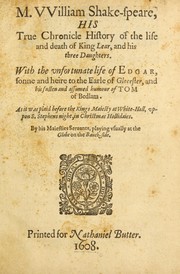
tragedy · 1608
King Lear
tragedy by William Shakespeare
- 1608
- tragedy
Summary
The Tragedy of King Lear, often shortened to King Lear, is a tragedy written by William Shakespeare in late 1605 or early 1606. Set in pre-Roman Britain, the play depicts the consequences of King Lear's love-test, in which he divides his power and land according to the praise of his daughters. The play is known for its dark tone, complex poetry, and prominent motifs concerning blindness, madness and human nature.
Source: Wikipedia (CC BY-SA).
Historical Background
King Lear was written by William Shakespeare around 1605-1606, during the reign of James I, drawing on the legendary pre-Roman British king Leir as recorded in Geoffrey of Monmouth's Historia Regum Britanniae and retold in Holinshed's Chronicles, Edmund Spenser's The Faerie Queene, and an earlier anonymous play, King Leir. Shakespeare departed sharply from these sources, most notably by rejecting their happy endings in favor of catastrophe. The play was first performed at court before King James on St Stephen's Night, 26 December 1606, and entered in the Stationers' Register in 1607; a quarto text appeared in 1608, followed by a revised version in the 1623 First Folio, the two texts differing enough that modern editions often print them separately or as a conflation. Composed in the same extraordinary period as Macbeth and Antony and Cleopatra, King Lear reflects Jacobean anxieties about succession, the division of kingdoms (echoing James I's own ambitions to unite England and Scotland), and a darkening philosophical outlook. Its unflinching bleakness led the eighteenth-century editor Nahum Tate to rewrite it with a happy ending, the version that dominated the stage for nearly 150 years.
The Story
King Lear, aging king of pre-Roman Britain, decides to divide his kingdom among his three daughters according to how well each professes her love for him. Goneril and Regan flatter him extravagantly and receive their shares; Cordelia, his youngest and most genuinely loving daughter, refuses to perform false flattery and is disowned and banished, while the loyal Earl of Kent is banished for protesting the decision. Stripped of his authority, Lear soon finds himself mistreated and humiliated by Goneril and Regan, who strip away his retinue and hospitality. Cast out into a violent storm, accompanied only by his Fool, the disguised Kent, and the feigning madman "Poor Tom" (actually the disguised Edgar), Lear descends into madness on the heath, gaining painful insight into his own folly and into the suffering of the powerless. A parallel plot unfolds around the Earl of Gloucester, whose illegitimate son Edmund schemes to displace his legitimate brother Edgar and betrays his father, leading to Gloucester's brutal blinding by Regan and her husband Cornwall. Cordelia returns from France with an army to rescue her father, and Lear and Cordelia are briefly reconciled, but their forces are defeated. Cordelia is hanged in prison on Edmund's orders, and Lear dies of grief cradling her body. Goneril, Regan, Edmund, and most of the principal antagonists also die amid the collapsing moral order, leaving the kingdom in the hands of the surviving, chastened Edgar (or Albany, depending on the text).
Themes
- The nature of authority and its loss
- Filial ingratitude and familial betrayal
- Appearance versus reality in love and loyalty
- Madness as a path to insight
- Blindness, literal and figurative
- The indifference or cruelty of the natural/cosmic order
- Old age and the fragility of power
- Suffering, redemption, and the limits of endurance
Literary Devices
- Dramatic irony — the audience perceives Lear's and Gloucester's misjudgments of their children long before the characters do
- Parallel plotting — the Gloucester-Edgar-Edmund subplot mirrors and intensifies the Lear-Goneril-Regan-Cordelia main plot
- Imagery of sight and blindness — recurring language and action (Gloucester's literal blinding) linking physical and moral vision
- The Fool as choric commentator — using riddle, song, and paradox to voice uncomfortable truths to power
- Storm as pathetic fallacy — the tempest on the heath externalizes Lear's mental disintegration and the play's cosmic disorder
- Feigned and real madness — Edgar's disguise as Poor Tom and Lear's genuine descent into madness comment on each other
- Blank verse and prose shifts — verse marking authority and reason, prose often marking madness or low status
- Animal imagery — recurring bestial language reflecting the characters' fall into a state below civilized humanity
Symbolism
- The storm — the chaos of nature mirroring the collapse of political, familial, and mental order
- Blindness and eyes — Gloucester's literal blinding symbolizing the failure of insight and judgment that afflicts both plots
- Clothing and nakedness — Lear's and Edgar's stripping away of garments symbolizing the loss of false status and the exposure of shared humanity
- The Fool — embodying wisdom disguised as folly, and the truth-telling license permitted to society's marginal figures
- The map/division of the kingdom — symbolizing the reduction of political authority and love to a transactional performance
Critical Interpretation
King Lear has attracted some of the most influential criticism in the Shakespearean canon. A. C. Bradley, in Shakespearean Tragedy (1904), treated it as a supreme but formally flawed tragedy, praising its poetic and psychological depth while questioning its stage-worthiness. Twentieth-century criticism shifted markedly: G. Wilson Knight explored its grotesque, near-absurdist elements, while Jan Kott's Shakespeare Our Contemporary (1964) famously linked the play to the Theatre of the Absurd and Samuel Beckett, reading it through the lens of modern nihilism and post-war despair, an interpretation that shaped Peter Brook's landmark production. Christian readings, notably by G. Wilson Knight and others, see a pattern of redemption through suffering, while more skeptical critics emphasize the play's refusal of consolation, particularly in Cordelia's death. New Historicist critics such as Stephen Greenblatt situate the play within Jacobean debates over kingship, inheritance, and enclosure, and have examined its relation to contemporary anxieties about beggary and dispossession. Feminist criticism has scrutinized the play's treatment of Goneril and Regan versus Cordelia and the absence of a mother figure. The play's textual history, with substantively different Quarto (1608) and Folio (1623) versions, has also generated significant editorial and bibliographic scholarship.
Quotations
Blow, winds, and crack your cheeks! rage! blow!
Lear, raging on the heath during the storm, addressing the elements in his growing madness
As flies to wanton boys, are we to the gods; / They kill us for their sport.
Gloucester's despairing reflection after being blinded, on the cruelty of fate
Ripeness is all.
Edgar, disguised, offering stoic counsel amid suffering
I am a very foolish fond old man.
Lear, having gained painful self-knowledge, addressing Cordelia with humility
Never, never, never, never, never!
Lear's anguished final lament, cradling the dead Cordelia
Influence
King Lear has profoundly shaped later literature and thought, becoming a touchstone for tragic writing about power, age, and suffering. Its influence extends through Romantic criticism (Coleridge, Hazlitt, Keats), into modern drama and fiction that echo its themes of familial betrayal and inheritance, such as Jane Smiley's novel A Thousand Acres and Edward Bond's play Lear. Its bleak, near-absurdist vision, as read by Jan Kott, directly influenced Samuel Beckett and the post-war Theatre of the Absurd, and Peter Brook's stark 1962 stage production and 1971 film became landmark interpretations. The play's exploration of madness, dispossession, and the limits of human endurance continues to resonate across psychology, philosophy, and political theory.
Adaptations
- Grigori Kozintsev's Russian film Korol Lir (1971), scored by Shostakovich, widely admired for its bleak visual power
- Peter Brook's stark, Beckett-influenced 1971 film starring Paul Scofield, following his celebrated 1962 RSC stage production
- Akira Kurosawa's Ran (1985), a loose Japanese feudal adaptation transposing the daughters into sons
- Laurence Olivier's 1983 television film performance as Lear
- Ian McKellen's acclaimed RSC/PBS filmed stage production (2008)
Related Works
- Macbeth by William Shakespeare
- Hamlet by William Shakespeare
- The True Chronicle History of King Leir (anonymous source play)
- Lear by Edward Bond
- A Thousand Acres by Jane Smiley
- Ran, directed by Akira Kurosawa
Curator's Notes
- 1The First Folio (1623) version of King Lear differs substantially from the 1608 Quarto, including cutting about 300 lines and altering the ending, leading many modern editors to treat them as two distinct plays.
- 2For nearly 150 years, from the Restoration until the early nineteenth century, audiences saw only Nahum Tate's 1681 adaptation, which gave the play a happy ending with Cordelia surviving and marrying Edgar.
- 3The play was first performed at the court of King James I on St Stephen's Night, 26 December 1606.
- 4Shakespeare's principal source, the anonymous earlier play King Leir, actually ends happily, making Shakespeare's tragic conclusion a deliberate departure.
- 5Akira Kurosawa's Ran, a celebrated free adaptation, transposes Lear's three daughters into three sons in feudal Japan.
For the Exam
UGC NET English frequently tests King Lear as a core Renaissance/Shakespearean tragedy text: candidates should know the play's date and sources, the double plot structure (Lear-daughters and Gloucester-sons), major themes (authority, filial ingratitude, nature, blindness/insight, nihilism versus redemption), the Fool's dramatic function, key critical approaches (Bradley, Jan Kott, New Historicism, feminist readings), the Quarto/Folio textual variance, and famous lines. Comparative questions may link it to other tragedies (Macbeth, Hamlet) or to Kurosawa's Ran and Edward Bond's Lear as adaptations/appropriations.