Summary
The curators are still preparing the notes for this exhibit.
Historical Background
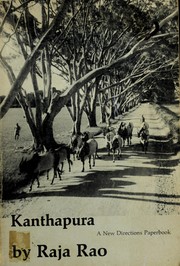
Kanthapura (1938) is Raja Rao's first novel, published when Indian writing in English was still finding its idiom. Rao (1908–2006), a Kannada-speaking Brahmin from Mysore state educated partly in France, wrote the novel while abroad, drawing on the Gandhian Non-Cooperation and Civil Disobedience movements of the 1920s–30s that he had witnessed in South India. The book is best known for its Foreword, a manifesto on the problem of writing in a colonizer's language: Rao argued that Indian English writers must "convey in a language that is not one's own the spirit that is one's own," infusing English with the "tempo" and oral rhythms of Indian speech. He modeled the novel's form on the sthala-purana, the traditional Indian genre of village legend that fuses local history with myth and religious lore, narrated by an elderly village woman in a single sustained, breathless oral flow. The setting, the fictional Kannada village of Kanthapura in the Western Ghats, stands for thousands of villages swept up in the freedom struggle, where Gandhi is received not as a distant political leader but as an avatar-like figure absorbed into Hindu devotional imagination. The novel thus sits at the founding moment of the Indian English novel's experiments with vernacular form and anti-colonial politics.
The Story
The novel is narrated retrospectively by Achakka, an old Brahmin woman of Kanthapura, recounting to an unnamed listener how her village was drawn into the Gandhian freedom movement. The story centers on Moorthy, a young, idealistic Brahmin youth who returns from the city inspired by Gandhi's ideals of non-violence, khadi (homespun cloth), temperance, and the abolition of untouchability. Moorthy begins organizing the village, forming a Congress committee, encouraging the weaving and wearing of khadi, and reaching out to the Pariah (untouchable) quarter, which scandalizes the orthodox Brahmins led by the priest Bhatta. Rangamma, a widowed, educated woman, becomes his chief ally and a source of political and spiritual guidance for the village women, while the headman Range Gowda lends his traditional authority to the movement. As the movement grows, it collides with the colonial administration and the local coffee estate's exploitative "Skeffington Coffee Estate," and Moorthy launches a campaign of picketing toll-gates and liquor shops. The British police and revenue authorities respond with escalating violence: beatings, arrests, and the burning and looting of the village. Moorthy is jailed after being implicated in an act of violence he did not condone, and the village women, led by Rangamma, take up the movement themselves, marching and courting arrest. In the end Kanthapura is destroyed and its inhabitants scattered into exile, yet the narrative closes on notes of continuing faith in the freedom struggle and Gandhi's eventual triumph, even as the village itself is lost.
Themes
- Gandhian nationalism and non-violent resistance
- The fusion of myth, religion, and politics
- Caste and untouchability
- Colonial exploitation and rural India
- Oral tradition and collective memory
- Awakening of women's political agency
- Sacrifice and martyrdom for the freedom struggle
- The clash between tradition and reform
Literary Devices
- Sthala-purana form — the novel is structured as a village legend/oral chronicle rather than a Western novel
- Skaz/oral narration — Achakka's single continuous, breathless first-person telling mimics spoken storytelling
- Mythic parallelism — Gandhi is figured through Hindu myth, likened to Krishna and other avatars
- Indianized English syntax — long run-on sentences and native idiom enacting Rao's Foreword manifesto
- Hymn and folk-song interpolation — devotional songs (harikathas) to goddess Kenchamma punctuate the narrative
- Allegory — the village itself allegorizes the Indian nation under colonial rule
Symbolism
- Kenchamma (the village goddess) — indigenous religious faith merging with nationalist fervor
- Kanthapura village — India itself, its destruction figuring colonial violence against the nation
- Khadi (homespun cloth) — self-reliance (swadeshi) and rejection of colonial economy
- The Skeffington Coffee Estate — colonial economic exploitation of land and labor
- Moorthy — the Gandhian ideal of the sacrificing, non-violent satyagrahi
Critical Interpretation
Kanthapura is a foundational text in postcolonial and Indian English literary criticism, most often discussed through its Foreword's theorization of "Indian English" — the deliberate infusion of English syntax with Kannada oral rhythms, proverbs, and the sthala-purana form. Critics have read the novel as an early experiment in the hybridization of the colonizer's language, anticipating debates taken up by later Indian writers and postcolonial theorists about linguistic decolonization. Scholars have examined its blending of Gandhian politics with Hindu myth, noting how the deification of Gandhi within the narrative reflects the actual devotional reception of Gandhi in rural India during the independence movement. The novel is also studied for its narrative technique — Meenakshi Mukherjee and other Indian English fiction historians have discussed its oral, feminized narrator (Achakka) as a distinctive formal innovation. Some critics have raised questions about the novel's treatment of caste, noting that despite its sympathy for the Pariah community, the narrative viewpoint remains firmly Brahminical. It is frequently paired with Mulk Raj Anand's and R. K. Narayan's contemporaneous fiction in surveys of the founders of the Indian English novel.
Quotations
There is no village in India, however mean, that has not a rich sthala-purana, or legendary history, of its own.
Opening line of Rao's Foreword, establishing the village-legend form of the novel.
One has to convey in a language that is not one's own the spirit that is one's own.
Rao's often-cited statement on the challenge of Indian English writing.
Influence
Kanthapura's Foreword became a touchstone for Indian writing in English, cited repeatedly in discussions of how English could be indigenized to carry Indian rhythms, idioms, and oral forms rather than remaining a purely borrowed medium. Its use of the sthala-purana and oral-narrator technique influenced later Indian novelists' experiments with vernacular-inflected English prose and non-Western narrative structures. Alongside Mulk Raj Anand's Untouchable and the early novels of R. K. Narayan, it helped establish the Indian English novel as a serious vehicle for nationalist and social themes, and it remains a standard reference point in postcolonial theory for debates on language, hybridity, and the politics of narrating anti-colonial resistance from the village level.
Related Works
- Untouchable by Mulk Raj Anand
- Waiting for the Mahatma by R. K. Narayan
- The Serpent and the Rope by Raja Rao
- Nectar in a Sieve by Kamala Markandaya
- Coolie by Mulk Raj Anand
Curator's Notes
- 1Kanthapura is a fictional village; it is not a real place on the map of Karnataka.
- 2The novel's Foreword is frequently anthologized and taught separately as a manifesto on Indian English.
- 3Raja Rao wrote much of the novel while living in France, reflecting on the Gandhian movement from a distance.
- 4The entire novel is presented as one long oral narration by a single elderly narrator, Achakka, without conventional chapter breaks in tone.
For the Exam
UGC NET frequently tests Kanthapura on: its status as one of the founding Indian English novels alongside Mulk Raj Anand and R. K. Narayan; the Foreword's theory of Indian English and the sthala-purana form; the Gandhian/nationalist theme and the fusion of myth with politics; the narrator Achakka and the oral/skaz narrative technique; and the novel's publication year (1938). Questions often ask candidates to match the novel with its narrative technique or Foreword quotations, or to identify it within the trio of pioneering Indian English novelists of the 1930s.