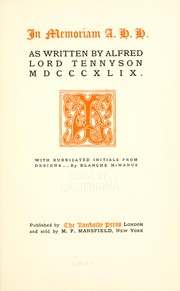
elegy · 1849
In Memoriam A.H.H.
poem by Alfred, Lord Tennyson on the death of Arthur Henry Hallam
- 1849
- elegy
Summary
In Memoriam A.H.H. (1850) by Alfred, Lord Tennyson, is an elegy for his Cambridge friend Arthur Henry Hallam, who died of cerebral haemorrhage in Vienna, at the age of twenty-two years, in 1833. As a sustained exercise in tetrametric lyrical verse, Tennyson's poetical reflections extend beyond the meaning of the death of Hallam, thus, In Memoriam also explores the random cruelty of Nature seen from the conflicting perspectives of materialist science and declining Christian faith in the Victorian era (1837–1901), the poem thus is an elegy, a requiem, and a dirge for a friend, a time, and a place.
Source: Wikipedia (CC BY-SA).
Historical Background
Alfred Tennyson began writing elegiac fragments after learning of the sudden death of Arthur Henry Hallam, his close Cambridge friend and his sister Emily's fiancé, who died of a cerebral haemorrhage in Vienna in 1833 at the age of twenty-two. Tennyson composed sections of the poem intermittently over roughly seventeen years, and the finished sequence of 131 numbered lyrics (with a Prologue and an Epilogue) was published anonymously in 1850. The poem is written predominantly in tetrameter quatrains rhymed abba, a form now often called the "In Memoriam stanza." It traces the poet's grief from raw despair through doubt to eventual consolation, moving across three symbolic Christmases that mark the stages of mourning. Composed during a period of growing scientific challenges to religious faith - including debates later sharpened by geology and, after 1859, Darwinian evolution - the poem grapples with contemporary anxieties about nature "red in tooth and claw" and the possibility of an afterlife. Its publication coincided with Tennyson's appointment as Poet Laureate and his marriage to Emily Sellwood. The Epilogue closes with an epithalamion for the marriage of Tennyson's sister Cecilia, affirming faith and continuity after loss.
The Story
In Memoriam A.H.H. is not a narrative poem but a sequence of 131 numbered elegiac lyrics framed by a Prologue and an Epilogue, tracing the psychological and spiritual journey of a mourner from the death of his friend toward eventual, hard-won consolation. The sequence opens with raw shock and despair at Hallam's death, the speaker questioning whether nature and the universe have any moral order or divine purpose. Early sections dwell on grief, the yew tree as an emblem of death's permanence, and the poet's struggle to find words adequate to loss. The poem is structured loosely around three Christmases, each marking a stage in the mourner's progress: the first is marked by muted, sorrowful bells; the second shows partial healing; the third arrives with more genuine hope. Interwoven are meditations on contemporary science, including geological time and the struggle of faith against a nature that seems indifferent to individual suffering, famously described as "red in tooth and claw." The speaker questions immortality, evolution, and whether love can survive death, alternating between doubt and tentative faith. Later sections revisit the anniversary of Hallam's death and the poet's visits to Hallam's former home, moving toward acceptance. The poem culminates in the Epilogue, a celebratory epithalamion for the wedding of Tennyson's sister, in which grief is transmuted into a qualified affirmation of faith, love, and cosmic progress toward "one far-off divine event."
Themes
- Grief and the process of mourning
- Faith versus scientific doubt
- Immortality and the afterlife
- Nature's indifference to human suffering
- Time, memory, and the passage of seasons
- Friendship and idealized love between men
- Evolution and geological deep time
- Consolation and spiritual progress
Literary Devices
- In Memoriam stanza - tetrameter quatrains rhymed abba, giving an enclosed, elegiac music
- Extended symbolism - recurring images such as the yew tree, the ship bearing Hallam's body, and ringing bells
- Apostrophe - direct address to the dead Hallam and to abstractions like Sorrow
- Seasonal and calendrical structure - the sequence organized around recurring Christmases and anniversaries
- Pathetic fallacy - natural landscapes reflecting the speaker's shifting emotional states
- Scientific allusion - imagery drawn from geology and natural history to dramatize doubt
Symbolism
- The yew tree - permanence of death and the graveyard's stony grief
- The ship - carrying Hallam's body home, symbolizing the passage between life and death
- Christmas bells - marking the cyclical return of time and gradual healing
- Nature 'red in tooth and claw' - the indifferent, violent processes of the natural world
Critical Interpretation
In Memoriam A.H.H. was received on publication as a profound meditation on Victorian religious doubt, and it quickly became one of the era's most influential long poems, admired by Queen Victoria as a source of comfort after Prince Albert's death. T. S. Eliot, in the twentieth century, praised the poem's intensity of doubt, writing that it is not religious for the quality of its faith but for the quality of its doubt, and that its faith is "a poor thing" beside its doubt, which he called "a very intense experience" - a judgment that reoriented much subsequent criticism toward the poem's engagement with scientific uncertainty rather than its consolatory framework. Later critics have examined the poem's homoerotic intensity of feeling toward Hallam, its formal achievement in sustaining the abba quatrain across a long sequence, and its historical importance as a document of Victorian responses to geology and evolutionary science predating Darwin's Origin of Species. The poem remains central to studies of Victorian elegy, mourning, and the crisis of faith.
Quotations
'Tis better to have loved and lost / Than never to have loved at all.
One of the poem's most quoted lines, affirming love's value despite the pain of loss.
Nature, red in tooth and claw
Famous phrase capturing the era's anxiety about a violent, purposeless natural world.
I hold it true, whate'er befall; / I feel it, when I sorrow most; / 'Tis better to have loved and lost / Than never to have loved at all.
Full stanza from which the famous couplet is drawn.
Ring out the old, ring in the new
Widely quoted New Year's lyric associated with renewal and progress.
Influence
In Memoriam A.H.H. cemented Tennyson's reputation and contributed to his appointment as Poet Laureate in 1850. It became one of the most widely read and quoted poems of the Victorian era, offering language of consolation that shaped public mourning, most famously providing comfort to Queen Victoria after the death of Prince Albert. The poem's engagement with scientific doubt anticipated and paralleled the broader crisis of faith that intensified after the 1859 publication of Darwin's On the Origin of Species, making it a key text for understanding Victorian intellectual history. Its distinctive stanza form influenced later poets, and the poem remains a touchstone for the elegiac tradition in English literature, frequently compared with earlier elegies such as Milton's "Lycidas" and Shelley's "Adonais."
Related Works
- Lycidas - John Milton
- Adonais - Percy Bysshe Shelley
- The Idylls of the King - Alfred, Lord Tennyson
- Maud - Alfred, Lord Tennyson
- Thyrsis - Matthew Arnold
Curator's Notes
- 1The poem was composed over approximately seventeen years, from soon after Hallam's death in 1833 until publication in 1850.
- 2It was originally published anonymously.
- 3Arthur Hallam had been engaged to Tennyson's sister Emily, deepening the personal loss for the Tennyson family.
- 4Queen Victoria reportedly found comfort in the poem after Prince Albert's death in 1861.
- 5The recurring quatrain form used throughout the poem is often called the 'In Memoriam stanza' in its honor.
- 6The poem's publication year of 1850 coincided with Tennyson's marriage to Emily Sellwood and his appointment as Poet Laureate.
For the Exam
UGC NET frequently tests In Memoriam A.H.H. as a landmark Victorian elegy, asking students to identify its occasion (death of Arthur Hallam), its stanza form (the abba tetrameter 'In Memoriam stanza'), and its central tension between religious faith and scientific doubt, especially the phrase 'Nature, red in tooth and claw.' Questions may probe the poem's structure around three Christmases, its relationship to Darwinian and geological anxieties predating 1859, T. S. Eliot's critical remark on its 'doubt,' and comparisons with other major elegies like Milton's "Lycidas" and Shelley's "Adonais." Familiarity with the famous couplet on having loved and lost is commonly expected.