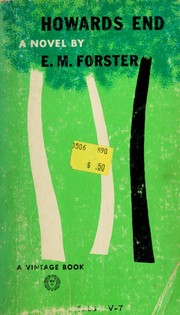
family drama · 1910
Howards End
novel by Edward Morgan Forster
- 1910
- family drama
Summary
Howards End is a novel by E. M. Forster, first published in 1910, about social conventions, codes of conduct and relationships in turn-of-the-century England. Howards End is considered by many to be Forster's masterpiece. The book was conceived in June 1908 and worked on throughout the following year; it was completed in July 1910.
Source: Wikipedia (CC BY-SA).
Historical Background
Howards End was conceived by E. M. Forster in June 1908 and completed in July 1910, published the same year. It came after his earlier novels Where Angels Fear to Tread (1905), The Longest Journey (1907), and A Room with a View (1908), and established Forster's reputation as a major novelist; many critics regard it as his masterpiece. The novel is set amid the rapid social and physical transformation of Edwardian England — the expansion of London, the rise of a commercial middle class, and shifting class boundaries. Forster, associated with the Bloomsbury Group and its emphasis on personal relations, art, and inner life, used the novel to stage a confrontation between three families representing different social and moral positions: the cultured, idealistic Schlegels; the wealthy, pragmatic business family the Wilcoxes; and the struggling clerk Leonard Bast and his family. The house named Howards End, modelled partly on Forster's own childhood home, Rooksnest, in Hertfordshire, stands at the novel's center as a symbol of continuity, rootedness, and Englishness threatened by modernity, motorcars, and urban sprawl. The famous epigraph "Only connect..." signals the book's central concern with bridging the divisions of class, gender, and temperament in modern life.
The Story
The novel follows the Schlegel sisters, Margaret and Helen, English-German intellectuals of independent means, and their entanglement with the wealthy Wilcox family. Helen's brief infatuation with the younger Wilcox son ends awkwardly, but Margaret later forms a close, genuine friendship with Ruth Wilcox, owner of the family's country house, Howards End, who values Margaret's sensitivity to it. On her deathbed, Ruth leaves Howards End to Margaret in a handwritten note, which the Wilcox family, startled and possessive, suppresses and burns, keeping the house within their own line. Time passes; the widowed Henry Wilcox, a self-made businessman of brisk practicality, courts and marries Margaret, drawing her into his world of commerce and convention even as she works to understand and humanize him. Meanwhile Helen, moved by idealism and guilt, befriends the poor insurance clerk Leonard Bast, whose economic ruin the Schlegels have inadvertently worsened by passing on Henry's dismissive advice about his employer. Helen's sympathy deepens into a brief liaison with Leonard, resulting in a pregnancy, while Henry's hypocrisy is exposed when his own past affair comes to light. The threads converge violently at Howards End itself, where Leonard confronts the Wilcoxes and is killed by Margaret's stepson Charles, who is subsequently imprisoned. In the aftermath, chastened, Henry yields; Margaret and Helen, with Helen's child, settle at Howards End, which passes to Margaret after all, embodying a fragile reconciliation of the novel's opposed worlds.
Themes
- Connection across class and temperament ("only connect")
- Inheritance, property, and Englishness
- The clash between inner life and outer, material life
- Gender and women's independence in Edwardian society
- Class inequality and economic precarity
- The transformation of England by modernity and commerce
- Personal relations versus institutional/business values
Literary Devices
- Symbolic setting — Howards End the house embodies continuity, memory, and rooted English identity
- Epigraph and motif — "Only connect..." frames the novel's moral and thematic argument
- Free indirect discourse — narration moves fluidly into characters' consciousness, especially Margaret's
- Authorial commentary — an intrusive, essayistic narrator generalizes about English society and character
- Foreshadowing and coincidence — chance encounters (the umbrella, the concert) drive the plot's convergences
- Juxtaposition of families — Schlegels, Wilcoxes, and Basts structurally embody opposed values and classes
Symbolism
- Howards End (the house) — continuity, rootedness, and the true, humane England
- The wych-elm tree at Howards End — organic permanence and pre-modern rural wisdom
- The motorcar — the encroachment of restless modernity and Wilcox materialism
- Ruth Wilcox's unsent/suppressed will — the suppression of feeling and legitimate inheritance by convention
Critical Interpretation
Howards End has long been read as Forster's fullest attempt to reconcile the divided halves of English society and of his own moral vision, summed up in the epigraph "only connect." Early twentieth-century critics praised its liberal humanism and its critique of commercial philistinism, while later Marxist and materialist critics, including Raymond Williams, scrutinized the novel's treatment of class, noting the difficulty of truly connecting across economic inequality and questioning how convincingly Leonard Bast's poverty is rendered from outside. Feminist critics have examined Margaret and Helen Schlegel as figures of female intellectual agency negotiating a patriarchal, business-dominated world embodied by Henry Wilcox. Postcolonial and historicist readings situate the novel within anxieties about empire, national identity, and the changing English landscape, reading Howards End as an allegory of who shall inherit England. E. M. Forster's own later reflections and biographical criticism (notably by scholars tracing the novel's roots in his family home) further illuminate its personal and symbolic investments.
Quotations
Only connect...
The novel's epigraph, printed alone on the dedication page before the story begins, signaling the book's central call to bridge divided lives.
Only connect the prose and the passion, and both will be exalted, and human love will be seen at its height.
From Chapter 22, Margaret's interior reflection on 'connection' as her personal creed, echoing and expanding the epigraph.
Influence
Howards End is widely regarded as Forster's masterpiece and a landmark of Edwardian fiction, admired for its ambitious attempt to diagnose the state of England through the novel form. It influenced the "condition of England" tradition of social novels and anticipated later fiction's concerns with class mobility, property, and inheritance as national allegory. Its blend of realist social observation with symbolic and essayistic narration shaped subsequent English fiction's approach to combining private relationships with broader social critique, and its exploration of connection across class lines resonated with later twentieth-century social-realist and campus-and-class novels alike.
Adaptations
- Howards End (1992 film, directed by James Ivory, screenplay by Ruth Prawer Jhabvala, starring Emma Thompson, Anthony Hopkins, and Helena Bonham Carter)
- Howards End (2017 BBC television mini-series, adapted by Kenneth Lonergan)
Related Works
- A Room with a View by E. M. Forster
- A Passage to India by E. M. Forster
- The Longest Journey by E. M. Forster
- Middlemarch by George Eliot
- The Forsyte Saga by John Galsworthy
Curator's Notes
- 1Forster began conceiving Howards End in June 1908 and completed it in July 1910.
- 2The fictional house Howards End was inspired by Rooksnest, the Hertfordshire home where Forster spent much of his childhood.
- 3Forster belonged to the Bloomsbury Group, the London circle of writers, artists, and intellectuals that also included Virginia Woolf.
- 4The 1992 Merchant Ivory film adaptation won multiple awards, including the Academy Award for Best Adapted Screenplay.
For the Exam
UGC NET English frequently tests Howards End on: the epigraph "Only connect" and its thematic significance; the symbolism of the house and the wych-elm; the class triad of Schlegels, Wilcoxes, and Basts as social allegory; Forster's narrative technique (authorial intrusion, free indirect discourse); its place within Forster's oeuvre and the Bloomsbury Group; and its status as a "condition of England" novel engaging liberal humanism, gender, and inheritance.