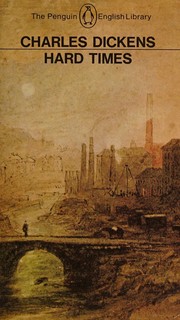
serialized fiction · 1854
Hard Times: For These Times
novel by Charles Dickens
- 1854
- serialized fiction
- social fiction
Summary
Hard Times: For These Times is the tenth novel by English author Charles Dickens, first published in 1854. The book surveys English society and satirises its social and economic conditions.
Source: Wikipedia (CC BY-SA).
Historical Background
Hard Times: For These Times, Dickens's tenth novel, was published in weekly installments in his periodical Household Words from April to August 1854, then issued as a single volume the same year. Circulation of Household Words was flagging, and Dickens conceived a shorter, more compressed serial to boost sales; the tight weekly format shaped the novel's unusually spare, concentrated style compared with his other works. Dickens set the story in the fictional industrial town of Coketown, drawing on his observations of Manchester and Preston, and wrote it against the backdrop of Victorian debates over utilitarianism, laissez-faire political economy, and the Manchester School. He was troubled by the Preston strike of 1853-54, a prolonged cotton-mill lockout which he visited in January 1854, shortly before writing the novel, and by the reduction of workers and children to statistics under a purely fact-based, utilitarian education associated with thinkers such as Jeremy Bentham. The novel is dedicated to Thomas Carlyle, whose critique of industrial society and mechanistic 'philosophy of fact' strongly influenced Dickens's satire. Unlike his loosely plotted multi-volume novels, Hard Times is tightly structured in three books titled 'Sowing,' 'Reaping,' and 'Garnering,' echoing a biblical and agricultural logic of cause and consequence.
The Story
The novel opens in the Coketown schoolroom of Thomas Gradgrind, a retired merchant devoted to 'Fact' and utilitarian philosophy, who raises his children Louisa and Tom on a strict diet of facts, statistics, and self-interest, suppressing imagination and feeling. Gradgrind's friend and business partner Josiah Bounderby, a wealthy factory owner and banker who boasts of a self-made rise from poverty, marries the much younger Louisa in a loveless match arranged largely to please her weak brother Tom, who works at Bounderby's bank and grows selfish and dissolute. Meanwhile Sissy Jupe, daughter of a circus performer abandoned by her father, is taken into the Gradgrind household after Gradgrind's fact-based system fails to reform her, and her natural warmth gradually softens the family. The novel follows Stephen Blackpool, an honest Coketown power-loom weaver trapped in an unhappy marriage and ostracized by both his fellow workers, for refusing to join a union led by the agitator Slackbridge, and by Bounderby, who dismisses him. Tom robs Bounderby's bank and frames Stephen, who is exonerated only after falling into a disused mineshaft and dying from his injuries. Louisa, tempted toward adultery by the languid seducer James Harthouse, flees to her father in emotional collapse, forcing Gradgrind to confront the failure of his fact-based philosophy. Tom escapes abroad with Sissy's help, and the novel closes surveying the diminished, chastened futures of its principal characters.
Themes
- Utilitarianism and the tyranny of 'Fact'
- Fancy, imagination, and wonder versus rationalism
- Industrialism and the dehumanization of workers
- Class conflict between masters and 'hands'
- Education and the stifling of the imagination
- Marriage, gender, and domestic unhappiness
- Self-interest versus compassion and community
Literary Devices
- Satire — mocks utilitarian philosophy and industrial capitalism through exaggeration
- Symbolic/allegorical naming — characters named for traits (Gradgrind, M'Choakumchild, Bounderby)
- Industrial imagery — recurring images of machinery, smoke, and the 'melancholy-mad elephant' pistons of Coketown
- Circus as counter-symbol — Sleary's circus embodies fancy, feeling, and community against Gradgrind's fact
- Tripartite structure — books titled 'Sowing,' 'Reaping,' 'Garnering' impose a moral, agricultural logic
- Irony — Bounderby's self-made-man myth is exposed as a fabrication
- Free indirect narration and authorial commentary — direct satirical intrusions on Coketown and its philosophy
Symbolism
- Coketown — the blackened industrial town symbolizes the ugliness and monotony of unchecked industrial capitalism
- The circus (Sleary's troupe) — symbolizes fancy, human warmth, and the value of play against sterile utilitarianism
- Smoke serpents and machinery — symbolize the mechanization and dehumanization of workers as mere 'hands'
- Stephen Blackpool's mineshaft fall — symbolizes the destructive neglect of the working class by an indifferent system
- Louisa's fire-gazing — symbolizes the suppressed imagination and passion beneath her fact-trained exterior
Critical Interpretation
Hard Times has long occupied a contested place in Dickens criticism. F. R. Leavis notably praised it in The Great Tradition (1948) as a 'moral fable' of high seriousness, elevating it above Dickens's other novels for its concentrated artistic and moral purpose, though this reading has been much debated. Other critics have found its satire of utilitarianism and trade unionism (in the figure of Slackbridge) crude or unfair, arguing Dickens caricatures political economy and organized labour rather than engaging them seriously. Marxist and social-historical critics have examined its critique of industrial capitalism and class relations, while noting the novel's ultimately individualist, sentimental resolution rather than structural social change. Feminist critics have attended to Louisa's constrained position within patriarchal marriage and utilitarian upbringing as a critique of Victorian gender ideology. The novel is frequently discussed alongside the 'Condition of England' novel tradition, in dialogue with works by Elizabeth Gaskell and Thomas Carlyle's social criticism.
Quotations
Now, what I want is, Facts... Facts alone are wanted in life.
Gradgrind's opening pronouncement to the schoolroom, establishing the novel's central philosophy of Fact
You are not to have, in any object of use or ornament, what would be a contradiction in fact.
Spoken by the visiting government inspector ('the gentleman') in Gradgrind's classroom, lecturing on utilitarian aesthetics and rejecting fancy and decoration
People mutht be amuthed.
Mr. Sleary's lisped closing wisdom, defending imagination and pleasure against Gradgrind's philosophy
Influence
Hard Times helped consolidate the Victorian 'Condition of England' novel tradition of social-problem fiction addressing industrialism, class conflict, and utilitarian philosophy, standing alongside works by Elizabeth Gaskell. Its critique of a purely fact-based education influenced later literary and educational debates about the value of imagination, and its satire of utilitarianism remains a touchstone reference in discussions of Victorian political economy in literature. The novel's compact, allegorical mode also anticipated later social satire and continues to be a key text in critical discussions of industrial-era literature and pedagogy.
Adaptations
- Hard Times (1977 Granada Television serial for ITV)
- Hard Times (1994 BBC television film)
Related Works
- North and South by Elizabeth Gaskell
- Mary Barton by Elizabeth Gaskell
- Bleak House by Charles Dickens
- Sybil by Benjamin Disraeli
- Past and Present by Thomas Carlyle
Curator's Notes
- 1Hard Times is Dickens's shortest novel and the only one of his major novels not set at least partly in London.
- 2It was written to boost flagging sales of Dickens's weekly periodical Household Words.
- 3The novel is dedicated to Thomas Carlyle, whose social criticism shaped its themes.
- 4Dickens divided the book into three parts titled 'Sowing,' 'Reaping,' and 'Garnering,' evoking a biblical harvest metaphor.
- 5F. R. Leavis's championing of the novel in The Great Tradition significantly boosted its critical reputation in the twentieth century.
For the Exam
UGC NET frequently tests Hard Times as the paradigmatic Victorian 'Condition of England'/industrial novel: its critique of utilitarianism and Gradgrind's philosophy of Fact, the fancy-versus-fact opposition embodied by Sleary's circus, its serialization in Household Words (1854), its dedication to Carlyle, its tripartite 'Sowing/Reaping/Garnering' structure, and Leavis's canonization of it in The Great Tradition. Character identification (Gradgrind, Bounderby, Stephen Blackpool, Louisa, Sissy Jupe) and thematic questions on class, education, and industrialism are common.