tragedy · 1600
Hamlet
tragedy by William Shakespeare
- 1600
- tragedy
Summary
The Tragedy of Hamlet, Prince of Denmark, often shortened to Hamlet, is a tragedy written by William Shakespeare sometime between 1599 and 1601. It is Shakespeare's longest play. Set in Denmark, the play depicts Prince Hamlet and his attempts to exact revenge against his uncle, Claudius, who has murdered Hamlet's father in order to seize his throne and marry Hamlet's mother.
Source: Wikipedia (CC BY-SA).
Historical Background
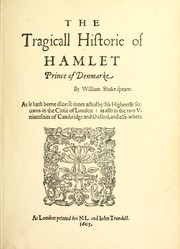
Hamlet was written by William Shakespeare around 1600-1601, during the height of his career at the Globe Theatre, when he was principal playwright for the Lord Chamberlain's Men (later the King's Men). Shakespeare drew on an old Scandinavian legend of Amleth, recorded by the medieval chronicler Saxo Grammaticus and retold in Francois de Belleforest's French Histoires tragiques, as well as on a lost earlier English play (referred to by scholars as the "Ur-Hamlet"), possibly by Thomas Kyd, whose revenge-tragedy conventions Shakespeare inherited and transformed. The play survives in three early printed texts with significant differences: the "bad" First Quarto (1603), the longer Second Quarto (1604/5), and the First Folio (1623), a textual instability that has shaped centuries of editorial debate. Composed at a moment of religious and philosophical uncertainty in England, amid Reformation-era anxieties about ghosts, purgatory, and the afterlife, the play channels contemporary unease about kingship, mortality, and the nature of conscience. It is Shakespeare's longest play and one of the most performed and studied works in the English language.
The Story
The ghost of the recently dead King of Denmark appears to his son, Prince Hamlet, revealing that he was murdered by his brother Claudius, who has since married Hamlet's mother, Gertrude, and seized the throne. Charged with revenge, Hamlet feigns madness while seeking proof of Claudius's guilt, staging a play, "The Mousetrap," that mirrors the murder to "catch the conscience of the king." Convinced of Claudius's guilt, Hamlet nonetheless hesitates, famously agonizing over action, mortality, and the afterlife in soliloquies such as "To be, or not to be." He mistakenly kills Polonius, the king's councillor and father of Ophelia, whom Hamlet has courted; grief and rejection drive Ophelia to madness and death, likely by drowning. Claudius, now fearing Hamlet, sends him to England with a secret order for his execution, but Hamlet escapes and returns to Denmark. Ophelia's brother Laertes, seeking revenge for his father and sister, conspires with Claudius to kill Hamlet in a fencing match using a poisoned blade and a poisoned drink. In the catastrophic final scene, Gertrude drinks the poisoned cup, Laertes and Hamlet wound each other with the poisoned sword, and Hamlet, dying, finally kills Claudius. Prince Fortinbras of Norway arrives to find the Danish royal family dead and claims the throne.
Themes
- Revenge and its moral cost
- Action versus inaction/procrastination
- Appearance versus reality
- Mortality and the fear of death
- Madness, real and feigned
- Corruption and decay in the state
- Betrayal and family duty
- Uncertainty and the limits of knowledge
Literary Devices
- Soliloquy — Hamlet's interior monologues expose his shifting thoughts on action, death, and duty
- Dramatic irony — the audience knows Claudius's guilt long before most characters do
- Play-within-a-play — 'The Mousetrap' mirrors the murder to test Claudius's conscience
- Foil characters — Laertes and Fortinbras contrast with Hamlet's hesitation through decisive action
- Ambiguity — the Ghost's nature and Hamlet's madness remain deliberately unresolved
- Imagery of disease and decay — recurring language of rot and corruption figures Denmark's moral state
- Blank verse and prose — shifts between verse and prose mark shifts in register and sanity
Symbolism
- The Ghost — the unresolved past and the demand for justice
- Yorick's skull — the inevitability and equalizing power of death
- Ophelia's flowers — lost innocence and fractured grief
- The poisoned sword and cup — hidden corruption beneath a courtly surface
- Denmark as a 'prison' — the decayed, morally compromised state
Critical Interpretation
Hamlet has generated more critical commentary than perhaps any other English text. Eighteenth- and nineteenth-century critics, including Samuel Johnson and Samuel Taylor Coleridge, focused on Hamlet's character, with Coleridge famously reading his delay as excessive intellectualizing at the expense of action. A. C. Bradley's Shakespearean Tragedy (1904) treated Hamlet within a broader theory of tragic character and flaw. In the twentieth century, Sigmund Freud and Ernest Jones offered psychoanalytic readings centered on an unconscious Oedipal conflict explaining Hamlet's hesitation. T. S. Eliot controversially argued the play was an artistic failure lacking an "objective correlative" for Hamlet's emotion. New Historicist and cultural-materialist critics have since situated the play within Reformation debates about purgatory and Elizabethan anxieties about succession and kingship, while textual scholars continue to debate the relationship between the Quarto and Folio versions and what it means for the "authentic" text.
Quotations
To be, or not to be: that is the question.
Hamlet's soliloquy weighing the merits of life, suicide, and the unknown of death.
Something is rotten in the state of Denmark.
Spoken by Marcellus, capturing the play's pervasive sense of political and moral corruption.
This above all: to thine own self be true.
Polonius's parting advice to his son Laertes.
The lady doth protest too much, methinks.
Gertrude's comment while watching the play-within-the-play.
Alas, poor Yorick! I knew him, Horatio.
Hamlet's meditation on death, addressed to the skull of the former court jester.
The rest is silence.
Hamlet's final words as he dies.
Influence
Hamlet reshaped the possibilities of tragic character, establishing the introspective, soliloquizing protagonist as a model for later literature. Its influence runs through Romantic writers who idolized Hamlet as a figure of thought overwhelming action, through Goethe's Wilhelm Meister and Coleridge's criticism, into the psychological novel and modernist stream-of-consciousness technique. Countless phrases have entered everyday English, and the play's structure of feigned madness, revenge, and moral paralysis recurs across drama and fiction, from Gothic and revenge fiction to T. S. Eliot's poetry and existentialist theatre. It remains a touchstone for exploring consciousness, doubt, and the ethics of action.
Adaptations
- Laurence Olivier's film Hamlet (1948)
- Kenneth Branagh's film Hamlet (1996)
- Franco Zeffirelli's film Hamlet (1990)
- Tom Stoppard's play Rosencrantz and Guildenstern Are Dead (1966), a spin-off centered on two minor characters
Related Works
- Macbeth by William Shakespeare
- King Lear by William Shakespeare
- The Spanish Tragedy by Thomas Kyd
- Rosencrantz and Guildenstern Are Dead by Tom Stoppard
- Wilhelm Meister's Apprenticeship by Johann Wolfgang von Goethe
Curator's Notes
- 1Hamlet is Shakespeare's longest play, and the title role is his longest.
- 2The play survives in three distinct early texts (Q1 1603, Q2 1604/5, F1 1623) with notable differences in length and wording.
- 3The phrase 'something is rotten in the state of Denmark' has become a common English idiom for pervasive corruption.
- 4Scholars believe Shakespeare drew on a now-lost earlier play about Hamlet, referred to as the 'Ur-Hamlet.'
For the Exam
UGC NET English frequently tests Hamlet on: the soliloquies (especially 'To be, or not to be') and their philosophical content; the revenge tragedy genre and its conventions; textual history (Q1, Q2, F1 differences); critical approaches (Bradley's character criticism, Freudian/Oedipal readings, T. S. Eliot's 'objective correlative' critique, New Historicist readings); themes of madness, delay, and corruption; and character analysis of Hamlet, Ophelia, Claudius, and Gertrude. Questions often ask candidates to identify quotations, speakers, and critical schools associated with the play.