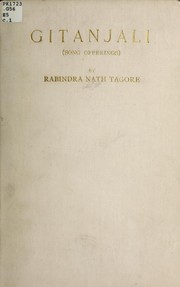
1910
Gitanjali
collection of poems by Rabindranath Tagore
- 1910
- ◆ Nobel-winning author
Summary
Gitanjali is a collection of poems by the Bengali poet Rabindranath Tagore. Tagore received the Nobel Prize for Literature in 1913, for its English translation, Song Offerings, making him the first non-European and the first Asian and the only Indian to receive this honour.
Source: Wikipedia (CC BY-SA).
Historical Background
Gitanjali (Bengali, 1910) was Rabindranath Tagore's own collection of devotional Bengali lyrics. In 1912, en route to England, Tagore began translating a selection of these poems into English prose-poetry, drawing not only from the original Gitanjali but also from other Bengali collections such as Gitimalya and Naivedya. Published in London by the India Society in 1912 as "Gitanjali (Song Offerings)," with an introduction by W. B. Yeats, the English volume brought Tagore to Western attention. Yeats had been introduced to the poems by the painter William Rothenstein and was deeply moved by their spiritual lyricism, helping revise the English and championing the work in literary circles including the India Society. The collection's devotional idiom draws on the Bengali Vaishnava bhakti tradition and Baul folk-mysticism, addressing a divine beloved in tones of longing, surrender, and union. For this English "Song Offerings," Tagore received the Nobel Prize in Literature in 1913, becoming the first non-European laureate. The book thus stands at the crossroads of Bengali devotional poetry and an emerging global modernist reception of "Eastern" spirituality.
The Story
Gitanjali has no narrative plot; it is a sequence of lyrical prose-poems structured as an extended offering of songs to a divine "Lord" or beloved. The collection moves through recurring devotional movements: invocation and self-surrender, in which the poet-singer offers his life and songs as tribute; expressions of longing and separation, imagining the divine as a lover, master, or traveler who must be awaited; meditations on the presence of God in ordinary life, work, nature, and among the poor rather than in ritual withdrawal or temple worship; reflections on freedom, joy, and the dissolution of the ego before the infinite; and, toward its close, a turn to meditations on death, imagined as a further stage of union and homecoming rather than an ending. Threaded throughout is the recurring image of the poet as a vessel, instrument, or boatman carrying his songs across a river toward the divine presence. The sequence builds an emotional and philosophical arc from initial humility and questioning toward serene acceptance, culminating in poems that welcome death as the final "letting go" of the boat's cord, completing the soul's voyage back to its source.
Themes
- Divine love and devotion (bhakti)
- Union of the finite self with the infinite
- Spiritual longing and separation
- God present in everyday life and labor rather than ritual
- Freedom through surrender of the ego
- Death as homecoming and fulfillment
- Nature as a manifestation of the divine
- Song and music as a path to the sacred
Literary Devices
- Free verse prose-poem form — abandons regular meter/rhyme for rhythmic, incantatory prose lines
- Extended metaphor of the boat/river journey — figures life's course toward union with the divine
- Apostrophe — direct address to an unnamed 'Lord' or divine beloved throughout
- Symbolic imagery of light, music, and flowers drawn from Bengali devotional (bhakti) tradition
- Anaphora and parallelism — repeated syntactic openings build a chant-like, prayerful rhythm
- Paradox — union sought through surrender, freedom found in service and humility
Symbolism
- The boat/boatman — the soul's journey through life toward the divine
- The river — the flow of time and life carrying the self toward union
- Light/lamp — divine presence and awakening of the soul
- Music and song — the offering of the self and the medium of communion with God
- Flowers/garlands — devotion, beauty, and the offering of the heart
Critical Interpretation
Gitanjali's Western reception was shaped decisively by W. B. Yeats's introduction, which framed the poems within a Romantic, mystical reading of "Eastern" spirituality, emphasizing their simplicity and devotional sincerity; this framing helped secure Tagore's Nobel Prize but has since been criticized by postcolonial scholars as an Orientalist projection that flattened the poems' Bengali literary and Vaishnava bhakti context into a generalized "mystic East." Later critics, including Bengali scholars, have noted that Tagore's English prose translations soften the metrical richness, musicality, and formal complexity of the original Bengali lyrics, producing a gentler, more devotional register in English than in Bengali. Within South Asian criticism, the collection is more often read as a sophisticated synthesis of bhakti devotionalism, Upanishadic philosophy, and Bengali folk (Baul) song traditions rather than simple mysticism.
Quotations
Thou hast made me endless, such is thy pleasure.
Opening line establishing the poet's stance of receiving life as a gift from the divine.
Where the mind is without fear and the head is held high...
Famous invocation of freedom, later widely read as a vision for independent India.
I have got my leave. Bid me farewell, my brothers!
From the closing sequence meditating on death as departure and homecoming.
Influence
Gitanjali's 1913 Nobel Prize made Tagore an international literary figure and opened Western audiences to modern Indian literature for the first time, influencing the reception of Indian and South Asian writing in English throughout the twentieth century. Its devotional free-verse idiom, mediated through Yeats's introduction, fed into early-twentieth-century European interest in Eastern spirituality and shaped Anglophone expectations of "Indian" poetry for decades. In India, poem 35 ("Where the mind is without fear") became a touchstone of the nationalist and independence-era imagination, later informing India's self-conception at independence. Tagore's example encouraged subsequent Bengali and Indian writers to seek international audiences while remaining rooted in regional literary and devotional traditions.
Related Works
- The Gardener by Rabindranath Tagore
- Gitimalya by Rabindranath Tagore
- The Home and the World by Rabindranath Tagore
- Poems of Kabir, translated by Rabindranath Tagore (bhakti devotional tradition)
Curator's Notes
- 1Tagore became the first non-European and first Asian Nobel laureate in Literature in 1913, awarded specifically for the English Song Offerings.
- 2The English Gitanjali is not a direct translation of the Bengali Gitanjali alone; Tagore drew and translated poems from several of his Bengali collections for the English volume.
- 3W. B. Yeats wrote the introduction to the 1912 English edition and helped edit the translations before publication.
- 4Tagore composed music for many of the original Bengali Gitanjali poems, which were meant to be sung, not merely read.
For the Exam
UGC NET English commonly tests Gitanjali as the work that won Tagore the 1913 Nobel Prize in Literature (first Asian/non-European laureate), the role of W. B. Yeats's introduction to the English Song Offerings, and Tagore's place within the Bengali Renaissance. Expect questions on dates (1910 Bengali publication, 1912 English translation, 1913 Nobel), the identification of famous lines (especially "Where the mind is without fear"), and the poem's themes of bhakti devotion, surrender, and the finite-infinite relationship.