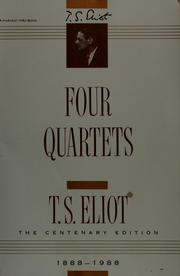
poetry · 1943
Four Quartets
by T. S. Eliot
1943 cycle of poems by T.S. Eliot
- 1943
- poetry
- ◆ Nobel-winning author
Summary
The Four Quartets is a set of four poems written by T. S. Eliot that were published over a six-year period. The first poem, Burnt Norton, was published with a collection of his early works.
Source: Wikipedia (CC BY-SA).
Historical Background
T. S. Eliot composed Four Quartets across the turbulent years 1935–1942, publishing each poem separately before assembling them as a single volume in 1943. "Burnt Norton" (1936) grew out of lines cut from Eliot's play Murder in the Cathedral and was named for a Gloucestershire manor house he visited. "East Coker" (1940) takes its title from the Somerset village from which Eliot's ancestor Andrew Eliot emigrated to America; "The Dry Salvages" (1941) refers to a rock formation off Cape Ann, Massachusetts, near Eliot's boyhood summer home, evoking both the Mississippi River of his St. Louis childhood and the New England coast. "Little Gidding" (1942) is named for the seventeenth-century Anglican religious community founded by Nicholas Ferrar. The sequence was written against the backdrop of the Second World War, including the London Blitz, during which Eliot served as an air-raid warden. It followed his 1927 conversion to Anglo-Catholic Christianity, and the poems represent his mature meditation on time, faith, and spiritual discipline, written in a more austere, musical style than The Waste Land, drawing structurally on the form of the late Beethoven string quartets.
The Story
Four Quartets has no narrative plot; it is a sustained meditative sequence in which each of the four poems shares a five-part structure, echoing musical form, and explores intersecting themes through a designated place, element, and season. "Burnt Norton" (air) opens with a meditation on time and the "still point of the turning world," using the image of a rose garden of unrealized possibility to suggest that past, present, and future converge in eternity. "East Coker" (earth) turns to origins and endings, cyclical human generation and decay ("In my beginning is my end"), and the poet's own uncertainty about language and vocation. "The Dry Salvages" (water) considers the river and the sea as figures for time, memory, and the unknowable, weighing scientific and religious ways of confronting mortality. "Little Gidding" (fire) returns to the pattern of pilgrimage and purgation, staging an encounter with a "familiar compound ghost," and closes the cycle with reflections on history, humility, and spiritual renewal, culminating in the famous vision that the end of exploration is to return to the beginning and know it truly for the first time.
Themes
- Time and eternity
- Spiritual quest and religious faith
- The limits of language
- Memory and history
- Death and renewal
- Detachment and the 'via negativa'
- Order versus flux
- The unity of past, present, and future
Literary Devices
- Musical structure — each quartet follows a five-movement form modeled on the string quartet
- Symbolic elements — air, earth, water, and fire organize the four poems
- Paradox — recurring oxymoronic phrasing ('the way up is the way down')
- Allusion — dense references to Dante, Heraclitus, the Bhagavad Gita, and Christian mystics
- Repetition and refrain — recurring phrases bind the sequence into a unified whole
- Terza rima — used in the Dantean encounter in Little Gidding
- Extended metaphor — the rose garden, the river, and the dance figure abstract ideas
Symbolism
- The rose garden — lost possibility and a timeless moment of vision
- The still point — stillness amid motion, symbolizing eternity within time
- The river and the sea (The Dry Salvages) — time as both personal memory and vast, impersonal force
- Fire — purgation, divine love, and destruction (as in the Blitz and Pentecostal imagery)
- The dance — pattern and order underlying apparent chaos
Critical Interpretation
Four Quartets is widely regarded as Eliot's culminating poetic achievement and the fullest expression of his Anglo-Catholic faith, in contrast to the fragmented despair of The Waste Land. Critics such as Helen Gardner examined its musical structure and devotional sources in detail, situating it within traditions of Christian mysticism and the via negativa associated with St. John of the Cross. F. R. Leavis, while admiring Eliot's earlier work, expressed reservations about the poem's discursive, meditative passages, questioning whether it sustained the same poetic intensity throughout. Some critics have debated the balance between the poem's abstract philosophical argument and its moments of concrete imagery, and whether its religious commitment narrows its appeal compared to Eliot's earlier, more open-ended modernism. The work is also frequently read alongside Eliot's essay "Tradition and the Individual Talent" for its treatment of history and continuity, and is considered a major instance of late modernist devotional poetry.
Quotations
In my beginning is my end.
Opening line, establishing the cyclical theme of the second quartet.
Time present and time past / Are both perhaps present in time future.
Opening lines introducing the poem's meditation on time.
We shall not cease from exploration / And the end of all our exploring / Will be to arrive where we started / And know the place for the first time.
Closing movement's vision of return and renewed understanding.
Humility is endless.
Part of the poem's meditation on spiritual discipline.
Influence
Four Quartets consolidated Eliot's reputation as the preeminent poet of religious and philosophical meditation in twentieth-century English poetry and remains central to the study of literary modernism's later, more contemplative phase. It influenced subsequent devotional and meditative poets and shaped critical discussions of how modernist form could accommodate explicit spiritual content. The poem is frequently cited in discussions of Eliot's Nobel Prize in Literature (1948) and is a staple text in the study of twentieth-century religious poetry, Christian modernism, and the reception of Dante in English verse.
Related Works
- The Waste Land — T. S. Eliot
- Ash-Wednesday — T. S. Eliot
- Murder in the Cathedral — T. S. Eliot
- The Divine Comedy — Dante Alighieri
- Journey of the Magi — T. S. Eliot
Curator's Notes
- 1The four poems were originally published separately between 1936 and 1942 before being collected as Four Quartets in 1943.
- 2Each poem is named after a real place with personal significance to Eliot: Burnt Norton (Gloucestershire), East Coker (Somerset, his ancestral village), The Dry Salvages (rocks off Cape Ann, Massachusetts), and Little Gidding (Huntingdonshire).
- 3Eliot served as an air-raid warden in London during the Blitz while writing the later quartets.
- 4The sequence's structure is often compared to the late string quartets of Beethoven, which Eliot admired.
For the Exam
UGC NET frequently tests Four Quartets on the titles and geographic/elemental associations of the four poems, the opening and closing lines of Burnt Norton and Little Gidding, Eliot's religious and philosophical themes (time, the via negativa, the still point), and its place in Eliot's career after The Waste Land. Questions may also probe its musical five-part structure, allusions to Dante and Heraclitus, and its significance to Eliot's Anglo-Catholicism and Nobel Prize recognition.