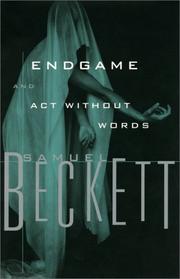
tragicomedy · 1957
Endgame
play by Samuel Beckett
- 1957
- tragicomedy
- ◆ Nobel-winning author
Summary
Endgame is an absurdist, tragicomic one-act play by the Irish playwright Samuel Beckett. First performed in London in 1957, it is about a blind, paralysed, domineering elderly man, his geriatric parents, and his servile companion in an abandoned house in a fictional post-apocalyptic wasteland, all of whom await an unspecified "end". Much of the play's content consists of terse, back and forth dialogue between the characters reminiscent of bantering, along with trivial stage actions. The plot is also supplanted by the development of a grotesque story-within-a-story that the character Hamm is relating. The play's title refers to chess and frames the characters as acting out a losing battle with each other or their fate.
Source: Wikipedia (CC BY-SA).
Historical Background
Samuel Beckett wrote Endgame (Fin de partie) in French in the mid-1950s, following the international success of Waiting for Godot (1953). He worked on it slowly and with difficulty, producing many drafts, and considered it a more austere, tightly controlled work than Godot. It premiered in French at the Royal Court Theatre in London on 3 April 1957; Beckett himself later translated it into English. Written in the shadow of World War II, the Holocaust, and Cold War anxieties, the play reflects a mid-century mood of exhaustion and apocalyptic dread, while also drawing on Beckett's engagement with philosophy (notably Descartes and the mind-body problem), chess, and the tradition of music-hall and vaudeville comedy. The title evokes the concluding phase of a chess game, when few pieces remain and defeat is all but certain, framing the drama as a ritualized, repetitive endgame the characters cannot escape. Beckett insisted on extreme precision in staging and language, treating the text almost as a musical score, and he became famously protective of productions that deviated from his exacting stage directions, at times pursuing legal action against unauthorized reinterpretations.
The Story
Endgame unfolds in a single bare room with two small high windows, lit by grey light, in an unspecified post-catastrophe world. Hamm, blind and unable to stand, sits centre-stage in an armchair on castors; his servant Clov, who cannot sit, tends to him but repeatedly threatens to leave, opening the play with the line "Finished, it's finished, nearly finished, it must be nearly finished." Hamm's legless parents, Nagg and Nell, live in two ashbins at the side of the stage, occasionally surfacing to beg for food or exchange fragments of memory before Nell falls silent, apparently dead. The action consists largely of repetitive rituals: Clov surveys the desolate, lifeless world outside through a telescope; Hamm demands to be wheeled around the room and returned to centre; the two bicker, reminisce, and rehearse a fragmentary story Hamm is composing about a man who once begged him for bread for his starving son. A boy is glimpsed outside near the play's end, hinting ambiguously at continuing life beyond the room, though nothing is resolved. Clov finally dresses for departure and stands motionless, unclear whether he will actually leave, while Hamm, alone, covers his face with a handkerchief and resumes his opening words in reverse, closing the play on the same note of suspended, unresolved ending with which it began.
Themes
- The impossibility of ending and the futility of endings
- Dependency, power, and mutual entrapment between master and servant
- The exhaustion of language and meaning
- Memory, storytelling, and the unreliability of the past
- Physical decay, disability, and the failing body
- Post-apocalyptic desolation and the possible end of the world
- Ritual, habit, and repetition as survival mechanisms
- Existential absurdity and the search for purpose in a godless universe
Literary Devices
- Absurdist theatre — logical incoherence and meaninglessness dramatized through everyday routine
- Circular, repetitive structure — the play begins and ends on nearly identical lines, denying resolution
- Minimalist, ritualized stage action — sparse setting and repeated physical business substitute for conventional plot
- Black comedy and vaudeville-style wordplay — music-hall gags juxtaposed with bleak subject matter
- Metatheatricality — characters comment on the artificiality of their own performance and situation
- Chess as controlling metaphor — the title and dialogue frame the action as a losing endgame
- Terse, elliptical dialogue — clipped exchanges that mimic exhausted, near-automatic speech
- Symbolic confinement of setting — the sealed room and ashbins stage entrapment and diminishment
Symbolism
- The bare room with two high windows — a skull-like enclosure suggesting the confines of consciousness or a shelter from a dead outer world
- Hamm's armchair on castors — his diminished, immobile authority, dependent entirely on others for movement
- Nagg and Nell's ashbins — the discarding and living burial of the aged and used-up
- The chess endgame — a contest nearing an inevitable, foreclosed conclusion
- The telescope and windows — the limits and unreliability of perception and knowledge of the world outside
- The boy glimpsed at the end — an ambiguous, possibly illusory sign of continuing life or renewal
Critical Interpretation
Endgame is a central text of the Theatre of the Absurd, a term coined by critic Martin Esslin, who grouped Beckett with Ionesco, Genet, and Adamov as dramatists staging the human condition's inherent meaninglessness after the collapse of shared metaphysical certainties. Critics have long debated the play's relationship to nuclear apocalypse and postwar ruin, reading the bare room and dead landscape outside as a bunker after global catastrophe. Theodor Adorno's influential essay on the play situated it as a response to the historical trauma of Auschwitz and the exhaustion of traditional humanist narrative and meaning. Other critics emphasize the play's roots in Beckett's fascination with Descartes and the mind-body split, seeing Hamm and Clov as a fractured single consciousness or as reason and body/will artificially divided. Psychoanalytic and biographical readings note echoes of Beckett's own family relationships, while formalist critics stress the play's musical, almost serial structuring of repeated phrases and gestures. The Beckett estate's insistence on literalist staging, resisting directorial reinterpretation, has itself become a recurring point of critical and legal discussion.
Quotations
Finished, it's finished, nearly finished, it must be nearly finished.
Clov's opening line, establishing the play's central theme of an ending that never quite arrives.
Nothing is funnier than unhappiness, I grant you that.
Spoken by Nell, encapsulating the play's fusion of bleak despair and dark comedy.
Use your head, can't you, use your head, you're on earth, there's no cure for that!
Hamm's outburst to Clov, a bald statement of existential entrapment.
The end is in the beginning and yet you go on.
Hamm reflecting on the inescapable, circular structure of existence within the play.
Influence
Endgame is regarded as one of the defining works of the Theatre of the Absurd and post-war avant-garde drama, extending the minimalist, existentially bleak territory Beckett opened with Waiting for Godot. Its stripped-down setting, circular structure, and fusion of despair with vaudeville comedy influenced later playwrights working in absurdist and postmodern modes, including Harold Pinter, Tom Stoppard, and Edward Albee, and it remains a touchstone for experimental theatre exploring stasis, decay, and the limits of language. The play's rigorous formal control also shaped later minimalist and conceptual theatre practice, and its imagery of confinement and diminished bodies has resonated in discussions of disability, old age, and post-catastrophe narrative in later drama and fiction.
Adaptations
- 2000 television film directed by Conor McPherson starring Michael Gambon as Hamm and David Thewlis as Clov, produced as part of the Beckett on Film project
Related Works
- Waiting for Godot — Samuel Beckett
- Krapp's Last Tape — Samuel Beckett
- Happy Days — Samuel Beckett
- The Chairs — Eugène Ionesco
- Rhinoceros — Eugène Ionesco
- The Birthday Party — Harold Pinter
Curator's Notes
- 1Beckett wrote Endgame originally in French, as Fin de partie, though English was his native language, a practice he adopted to strip his prose of habitual associations.
- 2The play premiered in French in London rather than Paris, at the Royal Court Theatre on 3 April 1957.
- 3Beckett was a devoted chess player, and the game's terminology and structure directly shaped the play's title and dramatic logic.
- 4Beckett was famously litigious about unauthorized reinterpretations of his stage directions, notably objecting to productions that altered the play's setting or casting.
For the Exam
UGC NET English commonly tests Endgame within the Theatre of the Absurd unit, expecting candidates to identify it as a Beckett play (often alongside Waiting for Godot), know its 1957 premiere, and recognize core absurdist features: circular structure, breakdown of language, master-servant dynamic between Hamm and Clov, and post-apocalyptic setting. Questions may probe the chess-endgame metaphor, existentialist and postmodern readings, comparisons with Ionesco or Pinter, and Martin Esslin's coinage of "Theatre of the Absurd." Familiarity with key characters (Hamm, Clov, Nagg, Nell) and the opening/closing lines is frequently expected.