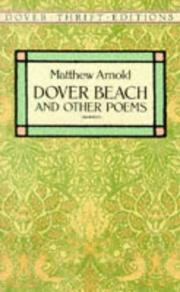
Summary
"Dover Beach" is a lyric poem by the English poet Matthew Arnold. It was first published in 1867 in the collection New Poems; however, surviving notes indicate its composition may have begun as early as 1849. The most likely date is 1851.
Source: Wikipedia (CC BY-SA).
Historical Background
Matthew Arnold — son of Thomas Arnold, the reforming headmaster of Rugby School, and himself an inspector of schools for thirty-five years — wrote "Dover Beach" in the shadow of the Victorian crisis of faith. Surviving drafts suggest the poem was begun around 1851, plausibly during or shortly after his honeymoon visit to Dover, though it was not published until 1867, when it appeared in the collection New Poems. The intervening years saw geology and biblical criticism steadily eroding the literal authority of scripture, and Arnold's poem registers that erosion not as argument but as a change in the sound of the world. Arnold was by then also the century's most influential critic, and the concerns of his prose — the search for a cultural centre once religion could no longer supply it, later argued in Culture and Anarchy — stand behind the poem's imagery. The setting is exact and observable: the Strait of Dover, the chalk cliffs, the light on the French coast twenty miles away. From that literal seascape Arnold builds a meditation in which the withdrawing tide becomes the withdrawal of belief itself.
The Story
The poem runs to thirty-seven lines in four verse paragraphs of irregular length, in loose iambic lines with an unpredictable rhyme scheme that never settles into a fixed stanza. It opens in calm description: the sea is quiet, the tide is full, the moon lies fair on the strait, and the light on the French coast gleams and is gone. The speaker calls a companion to the window to share the view. Then the sense shifts from sight to sound — the grating roar of pebbles which the waves draw back and fling up the shingle, a movement that brings, in Arnold's phrase, the eternal note of sadness in. The second paragraph reaches back across two and a half millennia: Sophocles long ago heard this same sound on the Aegean, and it brought into his mind the turbid ebb and flow of human misery. The third paragraph makes the poem's central metaphor explicit — the Sea of Faith was once at the full and lay like a bright girdle round the earth, but the speaker now hears only its melancholy, long, withdrawing roar as it retreats down the vast edges of the world. The final paragraph turns from meditation to appeal. Since the world that seems to lie before us like a land of dreams has in truth neither joy, nor love, nor light, nor certitude, nor peace, nor help for pain, the speaker asks his love that they be true to one another. The poem closes on a simile of a darkling plain swept with confused alarms of struggle and flight, where ignorant armies clash by night.
Themes
- The Victorian crisis of religious faith
- Love as the last refuge in a world without certainty
- The continuity of human suffering across history
- The deceptive calm of surfaces concealing turmoil
- Isolation and the failure of shared belief
- Nature as indifferent rather than consoling
- The gap between the world as it appears and as it is
- Confusion and moral disorientation in modern life
Literary Devices
- Extended metaphor — the "Sea of Faith" whose ebbing tide figures the retreat of belief
- Allusion — to Sophocles hearing the same sea-sound on the Aegean, and, in the closing image, to a confused night battle
- Auditory imagery — the "grating roar" of pebbles that shifts the poem from sight to sound
- Enjambment — run-on lines that imitate the unbroken advance and retreat of the waves
- Irregular verse form — variable line length and unpredictable rhyme, refusing the consolation of fixed pattern
- Simile — the closing comparison to a darkling plain of clashing armies
- Onomatopoeia — "grating" and "roar" enacting the sound they describe
- Dramatic address — an unnamed listener beside the speaker at the window
Symbolism
- The sea — religious faith, once full and encircling, now withdrawing
- The tide's ebb — the historical recession of belief in the speaker's own age
- Night and the darkling plain — moral and intellectual confusion
- The moonlit calm — the deceptive serenity of a world in crisis
- The pebbles drawn back and flung up — the repetitive, purposeless motion of human misery
- The French coast's vanishing light — certainty glimpsed and lost
Critical Interpretation
"Dover Beach" is routinely treated as the representative poem of Victorian doubt, the lyric in which the century's loss of religious certainty found its most concentrated image. Critics have long noted the poem's structural oddity: it moves not by argument but by association, sliding from seascape to Sophocles to faith to the closing battlefield, and its irregular form has been read by some as anticipating modernist practice. The final image has attracted particular attention, since the picture of armies fighting in darkness is generally traced to Thucydides' account of the disastrous night battle at Epipolae during the Athenian expedition to Sicily. Lionel Trilling's study of Arnold remains a standard point of reference for reading the poem alongside the prose, where the same anxieties are met with the programme of culture rather than the consolation of love. Debate has centred on whether the closing appeal is genuinely consoling or merely a diminished substitute for the faith that has gone — whether private fidelity can bear the weight the poem places on it. Anthony Hecht's "The Dover Bitch" (1968) is the best-known sceptical response, answering Arnold by giving the silent listener a voice.
Quotations
The sea is calm to-night.
The flat declarative opening whose calm the rest of the poem dismantles
The Sea of Faith / Was once, too, at the full
Introduces the poem's central metaphor for the recession of belief
Ah, love, let us be true / To one another!
The turn from meditation to personal appeal, offering fidelity in place of certainty
Where ignorant armies clash by night.
The poem's final image of confusion, generally traced to Thucydides' night battle at Epipolae
Influence
"Dover Beach" became the touchstone lyric for the Victorian loss of faith and one of the most anthologised poems in English. Its phrases entered the language: the "Sea of Faith" is standard shorthand for religious belief in cultural debate, and "ignorant armies clash by night" has been borrowed repeatedly to describe confused conflict. The poem is read aloud at a pivotal moment in Ray Bradbury's Fahrenheit 451, where its effect on the listeners dramatises the power of the literature the novel's society has banned, and it supplies the title and governing allusion of Ian McEwan's Saturday. Anthony Hecht's parody "The Dover Bitch" is itself now a standard anthology piece, and the poem's method — a literal landscape opening onto historical and spiritual meditation — became a durable model for the reflective lyric.
Related Works
- Culture and Anarchy by Matthew Arnold
- The Scholar-Gipsy by Matthew Arnold
- Stanzas from the Grande Chartreuse by Matthew Arnold
- In Memoriam A.H.H. by Alfred, Lord Tennyson
- The Darkling Thrush by Thomas Hardy
- The Dover Bitch by Anthony Hecht
Curator's Notes
- 1Though published in New Poems in 1867, drafts indicate the poem was largely composed around 1851, probably in connection with Arnold's visit to Dover after his marriage.
- 2The closing image of armies clashing in the dark is generally traced to Thucydides' account of the night battle at Epipolae in the Athenian campaign against Syracuse.
- 3Arnold spent most of his working life as a school inspector, writing his poetry and criticism alongside a demanding official career.
- 4The poem is recited in Ray Bradbury's Fahrenheit 451, where it reduces one of the listeners to tears.
- 5Anthony Hecht's "The Dover Bitch" retells the scene from the perspective of the woman addressed in the poem.
- 6The French coast the speaker describes is genuinely visible from Dover across roughly twenty miles of the Strait.
For the Exam
UGC NET examiners treat "Dover Beach" as the central document of Victorian religious doubt. Expect questions on the publication year (1867) and collection (New Poems) as against the probable composition date of around 1851; on the "Sea of Faith" metaphor and its "melancholy, long, withdrawing roar"; on the Sophocles allusion and the Aegean; and on the closing line "Where ignorant armies clash by night" together with its Thucydidean source. The poem is frequently paired in comparison questions with Tennyson's In Memoriam and Hardy's The Darkling Thrush, and linked to Arnold's critical positions in Culture and Anarchy. Know the irregular form, the shift from visual to auditory imagery, and Anthony Hecht's "The Dover Bitch" as the famous response.