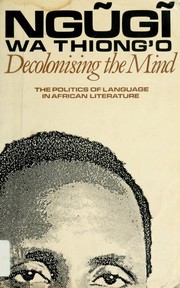
non-fiction · 1986
Decolonising the Mind
non-fiction work by Ngũgĩ wa Thiong'o
- 1986
- non-fiction
Summary
Decolonising the Mind: the Politics of Language in African Literature, by the Kenyan novelist and post-colonial theorist Ngũgĩ wa Thiong'o, is a collection of essays about language and its constructive role in national culture, history, and identity. The book, which advocates linguistic decolonization, is one of Ngũgĩ's best-known and most-cited non-fiction publications, helping to cement him as a preeminent voice theorizing the "language debate" in post-colonial studies.
Source: Wikipedia (CC BY-SA).
Historical Background
Ngũgĩ wa Thiong'o published Decolonising the Mind: The Politics of Language in African Literature in 1986, a landmark moment in his own career and in postcolonial theory. By the early 1980s Ngũgĩ, already established as a novelist writing in English (Weep Not, Child; The River Between; A Grain of Wheat; Petals of Blood), had been detained without trial by the Kenyan government in 1977-78 following the performance of his Gikuyu-language play Ngaahika Ndeenda (I Will Marry When I Want), co-written with Ngũgĩ wa Mirii. That experience hardened his conviction that African writers must write in African languages to genuinely decolonize African culture. The book gathers four essays originally delivered as lectures and announces Ngũgĩ's own "farewell to English" as a medium for his creative work, after which he committed to writing fiction primarily in Gikuyu. Composed against the backdrop of post-independence African states whose education systems remained culturally oriented toward former colonial powers, the book engages the long-running debate with figures such as Chinua Achebe over whether African literature written in English can be considered authentically African, establishing Ngũgĩ as a leading voice in postcolonial language politics.
The Story
Decolonising the Mind is a work of literary and cultural theory structured as four linked essays rather than a narrative. The central essay, "The Language of African Literature," argues that language is not simply a vehicle for culture but is culture itself, carrying the collective memory and worldview of a people; imposing a colonizer's language on colonized peoples severs them from their own history and instills a colonial mentality that equates civilization with Europe. Ngũgĩ distinguishes the language of "real life" (the mother tongue) from the language imposed by colonial schooling, describing how colonial education taught Africans to regard their own languages as inferior. Subsequent essays extend this argument to African theatre, examining how orature and communal performance were displaced by Western dramatic forms, and to the politics of literary criticism, questioning whose values and frameworks are used to judge African writing. Throughout, Ngũgĩ calls for African writers and intellectuals to reclaim indigenous languages as the primary medium of literature and thought, treating this as a necessary step toward full political and psychological liberation from colonialism, and he closes by explaining his own decision to write creative work in Gikuyu rather than English.
Themes
- Language as the carrier of culture and identity
- Colonialism and the colonization of the mind
- Linguistic imperialism in education
- African orature versus imposed Western forms
- Decolonization as an ongoing psychological process
- The politics of literary and cultural criticism
- National identity and cultural self-determination
Literary Devices
- Polemical essay form — argument built through direct, persuasive address rather than narrative
- Autobiographical anecdote — personal schooling and detention experiences ground abstract theory
- Binary framing — recurring oppositions like colonizer/colonized, English/Gikuyu, school-language/home-language
- Historical and comparative reference — draws on other colonized contexts to generalize the argument
- Direct engagement with named interlocutors — responds explicitly to critics like Chinua Achebe
Symbolism
- The mother tongue — symbol of authentic cultural memory and community
- The colonial classroom — symbol of the mechanism by which colonial values are instilled
- The English language (for Ngũgĩ) — symbol of cultural alienation and continued colonial dependency
- Gikuyu-language writing — symbol of cultural reclamation and psychological liberation
Critical Interpretation
Decolonising the Mind has become a foundational text in postcolonial studies and is widely taught alongside debates on language and African literature. Its central provocation—that writing African literature in English cannot fully decolonize African consciousness—placed Ngũgĩ in direct dialogue and disagreement with Chinua Achebe, who argued English could be domesticated and made to carry African experience. Scholars in postcolonial and African literary studies have both embraced Ngũgĩ's argument as a necessary corrective to Eurocentric assumptions about "world literature" and questioned its practicality, noting the challenges of publishing, readership, and multilingualism across Africa's many indigenous languages. The book is frequently discussed in relation to Frantz Fanon's ideas on colonial psychology and cultural resistance, and it remains a touchstone reference in debates over language policy, African-language publishing, and the politics of canon formation in world literature.
Quotations
Language carries culture, and culture carries, particularly through orature and literature, the entire body of values by which we come to perceive ourselves and our place in the world.
Ngũgĩ's core thesis linking language directly to cultural identity.
Influence
Decolonising the Mind has had a lasting influence on postcolonial theory, African literary studies, and language-policy debates across the formerly colonized world. It helped spur renewed interest in African-language publishing and inspired writers and scholars to reconsider the politics of the language they write in, extending debates initiated by earlier postcolonial thinkers such as Frantz Fanon into the specific domain of literature. The book is a standard text in postcolonial and African literature courses and continues to be cited in discussions of linguistic imperialism, translation, and the global politics of literary canon formation.
Related Works
- Things Fall Apart — Chinua Achebe
- Black Skin, White Masks — Frantz Fanon
- The Wretched of the Earth — Frantz Fanon
- Petals of Blood — Ngũgĩ wa Thiong'o
- Ngaahika Ndeenda (I Will Marry When I Want) — Ngũgĩ wa Thiong'o and Ngũgĩ wa Mirii
- Orientalism — Edward Said
Curator's Notes
- 1The book is often described as Ngũgĩ's 'farewell to English' as a language for his own creative writing.
- 2It followed his 1977-78 detention without trial by the Kenyan government after the Gikuyu-language play Ngaahika Ndeenda was staged.
- 3Ngũgĩ was born James Ngũgĩ and later renounced his English name as part of the same decolonizing project the book argues for.
- 4The essays were originally delivered as lectures before being collected into the 1986 book.
For the Exam
UGC NET English commonly tests Decolonising the Mind under postcolonial literary theory, asking students to identify its central argument (language as bearer of culture, not neutral tool), its author and publication context, its relation to the Ngũgĩ-Achebe language debate, and its connection to Frantz Fanon's theories of colonial psychology. Questions may also probe Ngũgĩ's shift from English to Gikuyu, the concept of the "colonization of the mind," and the book's place within broader postcolonial/decolonial theory alongside works by Said and Fanon.