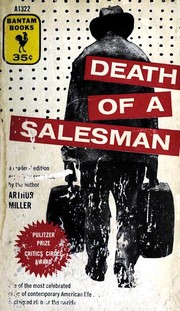
tragedy · 1949
Death of a Salesman
1949 play by Arthur Miller
- 1949
- tragedy
Summary
Death of a Salesman is a 1949 stage play written by the American playwright Arthur Miller. The play premiered on Broadway on February 10, 1949, running for 742 performances. It is a two-act tragedy—the subtitle of the play is "Certain Private Conversations in Two Acts and a Requiem"—set in late 1940s Brooklyn and told through a montage of memories, dreams, and arguments of the protagonist Willy Loman, a travelling salesman who is despondent with his life and appears to be slipping into senility. The play addresses a variety of themes, such as the American Dream, the anatomy of truth, and infidelity. It won the 1949 Pulitzer Prize for Drama and Tony Award for Best Play. Since its premiere, the play has been revived on Broadway five times, winning four Tony Awards for Best Revival, most recent in 2026. It has been adapted for the cinema ten times. In 1999, New Yorker drama critic John Lahr said that with 11 million copies sold, it was "probably the most successful modern play ever published."
Source: Wikipedia (CC BY-SA).
Historical Background
Arthur Miller wrote Death of a Salesman in the years following World War II, drawing on the anxieties of postwar American capitalism, the rise of consumer culture, and the myth of self-made success. Miller was influenced by his own family history, including an uncle who worked in sales, and by the ideological climate of the late 1940s, just before the McCarthy era in which Miller himself would later be targeted. The play premiered on Broadway on February 10, 1949, directed by Elia Kazan, with Lee J. Cobb as Willy Loman, and ran for 742 performances. Miller worked to fuse the intimate, psychological realism of domestic drama with expressionistic staging techniques—shifting time frames, permeable walls, and interior memory—to dramatize a mind under strain. He described his aim as creating a form in which the past and present could coexist onstage, reflecting how memory intrudes on the present for an aging man confronting failure. The play was written partly as a rebuttal to, and extension of, the tradition of American realist drama, engaging directly with ideas about capitalism, identity, and the American Dream that dominated postwar discourse. It won the Pulitzer Prize for Drama and the Tony Award for Best Play in 1949.
The Story
Death of a Salesman follows Willy Loman, an aging traveling salesman, over the last day and a half of his life, as he returns home to Brooklyn exhausted and mentally unraveling. Willy is fixated on the idea that being "well liked" guarantees success, a philosophy he has passed on to his elder son, Biff, once a promising high school athlete who has since drifted through failed jobs. Willy's younger son, Happy, is superficially successful but morally adrift, and his wife, Linda, is devoted but powerless to stop Willy's decline. Through a series of memory sequences that intrude on the present action, the audience learns that Biff's disillusionment stems from discovering his father's affair with another woman years earlier, an event that shattered his idealized image of Willy and derailed his ambitions. In the present, Willy is fired by his employer, Howard, while Biff fails to secure a business loan from a former boss, exposing the gap between the family's self-image and reality. A climactic confrontation at a restaurant, followed by a final showdown at home, forces a moment of raw honesty between father and son. Believing his life insurance payout will finally give Biff the capital to succeed and prove his worth, Willy takes his own life in a car crash. The play closes with a Requiem at Willy's sparsely attended funeral, where the surviving family members offer conflicting verdicts on his life and the value of the dream he pursued.
Themes
- The American Dream and its illusions
- The conflict between appearance and reality
- Father-son relationships and inherited failure
- The dehumanizing effects of capitalism
- Memory, time, and the unreliability of the past
- Identity and self-deception
- Betrayal and its lasting damage
- The tragedy of the common man
Literary Devices
- Expressionism — fluid staging blends past and present to dramatize Willy's disintegrating mind
- Flashback/memory sequences — scenes shift without warning into Willy's recollections and fantasies
- Symbolic setting — the encroaching apartment buildings represent the loss of pastoral American promise
- Dramatic irony — the audience perceives Willy's self-deceptions before the character does
- Motif and repetition — recurring lines like being 'well liked' underscore Willy's flawed philosophy
- Foreshadowing — references to rubber hoses and car accidents anticipate Willy's suicide
- Contrast/foil characters — Charley and Bernard's modest, honest success contrasts with Willy's delusions
Symbolism
- Seeds — Willy's futile late-night planting represents his desire to leave a legacy and undo failure
- The rubber hose — represents Willy's suicidal despair concealed within the household
- Stockings — symbolize Willy's guilt over his affair and its betrayal of Linda
- Diamonds — represent tangible, inheritable wealth as opposed to Willy's intangible dream of being liked
- The flute music — evokes Willy's father and a lost, simpler rural American past
Critical Interpretation
Death of a Salesman has been read as both a modern tragedy and a social critique, generating debate over whether Willy Loman qualifies as a tragic hero in the classical sense given his ordinary, non-noble status—a question Miller himself addressed in his essay "Tragedy and the Common Man," arguing that dignity and tragic stature are available to the common man. Marxist and sociological critics have emphasized the play as an indictment of American capitalism, reading Willy's collapse as the product of a system that discards workers once their usefulness ends. Psychological approaches focus on Willy's fractured consciousness and self-deception, treating the play's expressionistic form as an externalization of a troubled mind. Feminist critics have scrutinized Linda's role and the play's treatment of women, particularly the unnamed mistress, as reflective of mid-century gender ideology. Other scholars situate the play within the broader tradition of American realism and examine its critique of the American Dream as a national myth rather than a purely personal delusion.
Quotations
Attention must be paid.
Linda Loman insists that her husband's suffering and decline deserve recognition and respect.
A salesman is got to dream, boy. It comes with the territory.
Charley's eulogy for Willy at the Requiem, reflecting on the necessity and cost of the salesman's illusions.
I am not a dime a dozen! I am Willy Loman, and you are Biff Loman!
Willy's desperate assertion of significance during a confrontation with Biff.
The woods are burning, boys, the woods are burning.
Willy's cryptic warning to his sons, signaling his sense of impending ruin.
Influence
Death of a Salesman is widely regarded as a landmark of American drama, helping to establish the modern tragedy of the ordinary individual as a legitimate and influential form. Its blending of realism with expressionistic memory sequences influenced later American playwrights exploring psychological interiority and nonlinear time onstage, including work by Edward Albee and Sam Shepard. The play's critique of the American Dream became a touchstone reference point in American literature and popular culture, and Willy Loman entered the cultural lexicon as an archetype of the disillusioned, failed everyman. Miller's essay on tragedy and the common man, written alongside the play, reshaped critical discussions of what constitutes tragic drama in the modern age, extending the reach of tragic form beyond aristocratic protagonists.
Adaptations
- 1951 film adaptation directed by László Benedek, starring Fredric March
- 1985 television film starring Dustin Hoffman, adapted from the acclaimed Broadway revival
Related Works
- The Crucible by Arthur Miller
- All My Sons by Arthur Miller
- A Streetcar Named Desire by Tennessee Williams
- The Great Gatsby by F. Scott Fitzgerald
- Long Day's Journey into Night by Eugene O'Neill
Curator's Notes
- 1The play's subtitle is 'Certain Private Conversations in Two Acts and a Requiem.'
- 2It won both the Pulitzer Prize for Drama and the Tony Award for Best Play in 1949.
- 3The original Broadway production, directed by Elia Kazan, starred Lee J. Cobb as Willy Loman.
- 4Drama critic John Lahr called it 'probably the most successful modern play ever published,' citing 11 million copies sold.
- 5The play has been revived on Broadway multiple times, winning several Tony Awards for Best Revival.
For the Exam
UGC NET frequently tests Death of a Salesman on its status as a modern tragedy and the debate over the 'common man' as tragic hero, referencing Miller's essay "Tragedy and the Common Man." Expect questions on themes (American Dream, father-son conflict, capitalism's toll), dramatic technique (expressionism, flashback structure, the subtitle's significance), key symbols (seeds, rubber hose, flute), and character analysis of Willy, Biff, Linda, and Happy. Questions may also connect the play to Miller's biography and postwar American literary realism.