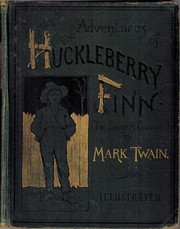
satire · 1884
Adventures of Huckleberry Finn
by Mark Twain
1884 novel by Mark Twain
- 1884
- satire
- humor
- picaresque novel
- adventure fiction
Summary
Adventures of Huckleberry Finn is a picaresque novel by American author Mark Twain that was first published in the United Kingdom in December 1884 and in the United States in February 1885. It is commonly named among the Great American Novels, and it is among the first in major American literature to be written throughout in vernacular English, characterized by local color regionalism. Being the direct sequel to The Adventures of Tom Sawyer, it is told in the first person by Huckleberry "Huck" Finn, the narrator of two other later Twain novels and a friend of Tom Sawyer.
Source: Wikipedia (CC BY-SA).
Historical Background
Mark Twain (Samuel Clemens) wrote Adventures of Huckleberry Finn as a sequel to The Adventures of Tom Sawyer (1876), publishing it in the United Kingdom in December 1884 and in the United States in February 1885. Twain drew on his own boyhood in Hannibal, Missouri, and his years as a Mississippi riverboat pilot to give the novel its intimate knowledge of river life, regional dialects, and antebellum Southern society. Composed over nearly a decade with long interruptions, the book marks a decisive shift from the comic sketches of Tom Sawyer toward a darker, morally probing narrative. Its most radical innovation is voice: the entire story is narrated in the first person by Huck, an uneducated boy, rendered in vernacular American English rather than formal literary prose. This choice, along with Twain's rendering of regional and African American dialects, made the novel a foundational text of American literary realism. Set before the Civil War but written after Reconstruction, the novel uses Huck's journey down the Mississippi with the runaway slave Jim to interrogate slavery, conscience, and the hypocrisies of "civilized" society, cementing its reputation as one of the Great American Novels despite persistent controversy over its language and racial content.
The Story
Huck Finn, having been taken in and "civilized" by the Widow Douglas after the events of Tom Sawyer, is reclaimed by his abusive, alcoholic father Pap, who imprisons him in an isolated cabin. Huck fakes his own death to escape and hides on Jackson's Island, where he meets Jim, Miss Watson's slave, who has fled after learning he is to be sold downriver. The two form a bond and set off together on a raft down the Mississippi, intending to reach the free states. Their journey is interrupted repeatedly: they board a wrecked steamboat, are separated in fog, and are eventually joined by two con men, the Duke and the King, who hijack the raft to run frauds on riverside towns, including a scheme to steal an inheritance from three orphaned sisters. Huck grows increasingly torn between the racist teachings of his society, which tell him helping Jim is a sin and theft, and his own growing affection and respect for Jim as a fellow human being; his famous decision to "go to hell" rather than betray Jim marks the novel's moral climax. Near the end, Huck discovers that Tom Sawyer's Aunt Sally has mistaken him for Tom, and Tom himself arrives and helps orchestrate an absurdly elaborate, storybook escape for Jim, who Tom already knows has been legally freed by Miss Watson's will. The novel closes with Huck resolving to "light out for the Territory" rather than be adopted and civilized once again.
Themes
- Slavery, race, and moral conscience versus a corrupt social code
- The conflict between civilization and freedom
- Coming of age and the loss of innocence
- Friendship and loyalty across racial lines
- Hypocrisy of religion and Southern respectability
- The Mississippi River as a space of freedom and danger
- Satire of romantic idealism and sentimentality
- Identity, disguise, and role-play
Literary Devices
- Vernacular narration - the entire novel is told in Huck's uneducated, regional first-person voice
- Dialect writing - Twain renders multiple distinct Southern and African American dialects phonetically
- Satire - mocks feuding aristocratic families, religious hypocrisy, and romantic literary conventions
- Irony - Huck's sincere but morally confused reasoning exposes the racism of his society to the reader
- Episodic picaresque structure - the raft journey strings together loosely connected riverbank adventures
- Symbolism - the river and raft repeatedly stand for freedom, contrasted with the shore's constraints
- Frame of an already-established character - the novel extends Tom Sawyer's world through a new narrator
- Foreshadowing and dramatic irony - readers often grasp dangers or truths before Huck does
Symbolism
- The Mississippi River - freedom, escape, and the natural world beyond societal law
- The raft - a fragile, self-made refuge of equality between Huck and Jim
- The fog - moral confusion and the difficulty of seeing truth clearly
- The shore - civilization, danger, feuds, and the corrupting rules of society
- Huck's faked death - rebirth and the shedding of an imposed identity
Critical Interpretation
Adventures of Huckleberry Finn is widely regarded as a founding work of modern American fiction; Ernest Hemingway's often-cited remark that all modern American literature descends from this one book reflects its canonical status for its vernacular prose style. T. S. Eliot praised the novel's use of the river as a structuring symbolic presence. At the same time, the book has drawn sustained criticism, notably from scholars such as Jane Smiley, who challenged its reputation by arguing the novel evades a fuller reckoning with slavery, particularly in its farcical ending. The frequent use of a racial slur and the minstrel-inflected characterization of Jim have made the novel one of the most challenged and banned books in American schools, provoking ongoing debate between those who read it as an anti-racist satire exposing the hypocrisy of its era and those who find its language and comic treatment of Jim's captivity harmful regardless of authorial intent. This tension between formal innovation and troubling content remains the central axis of scholarly discussion.
Quotations
All right, then, I'll go to hell.
Huck's climactic decision to tear up the letter betraying Jim, choosing loyalty and conscience over the 'moral' code he has been taught.
You don't know about me without you have read a book by the name of The Adventures of Tom Sawyer.
The novel's famous opening line, establishing Huck's vernacular first-person voice.
It was a close place. I took it up, and held it in my hand. I was a-trembling, because I'd got to decide, forever, betwixt two things.
Huck's internal crisis of conscience immediately before deciding to help Jim rather than turn him in.
Influence
Adventures of Huckleberry Finn is credited with legitimizing vernacular, colloquial speech as a vehicle for serious American literature, decisively shaping the realist and regionalist traditions that followed. Its influence is visible in the work of writers from Ernest Hemingway to William Faulkner and J. D. Salinger, particularly in the use of a distinctive first-person narrating voice tied to a specific American place and dialect. The novel helped establish the "Great American Novel" as a category and remains a fixture of American secondary and university curricula, even as its language and racial content continue to generate debate over how it should be taught, taught around, or contextualized in classrooms.
Adaptations
- Numerous film adaptations, including versions released in 1939 and 1993
- Big River, a Tony Award-winning Broadway musical adaptation (1985)
- Various television and animated adaptations produced across the 20th century
Related Works
- The Adventures of Tom Sawyer by Mark Twain
- Life on the Mississippi by Mark Twain
- Uncle Tom's Cabin by Harriet Beecher Stowe
- The Catcher in the Rye by J. D. Salinger
- Beloved by Toni Morrison
Curator's Notes
- 1The novel was banned by the Concord, Massachusetts public library shortly after its 1885 US publication, which Twain reportedly welcomed as good publicity.
- 2It was first published in Britain in December 1884, ahead of its US release in February 1885.
- 3Twain originally intended the book as a shorter follow-up to Tom Sawyer but the manuscript grew over roughly eight years with major interruptions.
- 4Twain used real Mississippi River geography and his own piloting experience to ground the raft journey's setting.
For the Exam
UGC NET English frequently tests Huckleberry Finn as a landmark of American literary realism and vernacular narration, its authorship and publication dates (1884 UK / 1885 US), its status as a sequel to Tom Sawyer, and its central themes of slavery, conscience, and the civilization-versus-freedom conflict. Expect questions on Twain's biography and river-pilot background, the significance of first-person vernacular narration, key symbols (river, raft), the "go to hell" moral turning point, and critical controversies around race and the novel's canonical status as a Great American Novel.