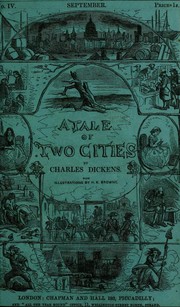
social fiction · 1859
A Tale of Two Cities
1859 novel by Charles Dickens
- 1859
- social fiction
- historical fiction
Summary
A Tale of Two Cities is a historical novel published in 1859 by English author Charles Dickens, set in London and Paris before and during the French Revolution. The novel tells the story of the French Doctor Manette, his 18-year-long imprisonment in the Bastille in Paris, and his release to live in London with his daughter Lucie whom he had never met. The story is set against the conditions that led up to the French Revolution and the Reign of Terror.
Source: Wikipedia (CC BY-SA).
Historical Background
Charles Dickens wrote A Tale of Two Cities in 1859, serializing it in his own weekly periodical All the Year Round, which he had just launched. It was his second historical novel after Barnaby Rudge and his most sustained engagement with a specific historical event: the French Revolution. Dickens drew heavily on Thomas Carlyle's The French Revolution: A History (1837), which he reread while composing the novel and which shaped his vision of revolutionary violence as both a response to and a mirror of aristocratic cruelty. He also credited Wilkie Collins's play The Frozen Deep, in which Dickens had acted the role of a man who sacrifices his life for a rival in love, as an inspiration for the Sydney Carton plot. Written during a period of personal turmoil—his marriage to Catherine Dickens was collapsing—the novel is notably tighter and more plot-driven than his usual sprawling social novels, with less comic digression and a more unified narrative structure built around doubling, resurrection, and sacrifice. It reflects mid-Victorian anxieties about class conflict and revolutionary upheaval, offering both sympathy for the oppressed poor of pre-revolutionary France and horror at the Terror's mob violence.
The Story
Dr. Alexandre Manette is released after eighteen years' unjust imprisonment in the Bastille and reunites in London with his daughter Lucie, who has never known him. Lucie later marries Charles Darnay, a French aristocrat who has renounced his family name and estates (he is secretly nephew to the cruel Marquis St. Evrémonde) to live honorably in England. Sydney Carton, a dissolute but brilliant English lawyer who resembles Darnay closely, loves Lucie hopelessly and vows he would do anything for her happiness. As revolution erupts in France, Darnay returns to Paris to help a former servant and is arrested as an emigrant aristocrat, condemned largely through the testimony of Ernest Defarge and his wife Madame Defarge, a leader of the revolutionary mob whose family was destroyed by the Evrémondes years earlier. Dr. Manette's own long-hidden account of his imprisonment, written in the Bastille, resurfaces and damns Darnay further. As Darnay awaits execution by guillotine, Carton, exploiting his resemblance to Darnay, secretly takes his place in prison and goes to the guillotine in his stead, enabling Darnay, Lucie, and their family to escape safely to England. The novel closes with Carton's famous imagined vision of a peaceful future purchased by his sacrifice.
Themes
- Resurrection and rebirth
- Sacrifice and redemption
- Doubling and duality (London/Paris, Carton/Darnay)
- Revolution and the cycle of violence
- Imprisonment, physical and psychological
- Fate and inevitability
- Social injustice and class oppression
- Love as transformative force
Literary Devices
- Doubling — Carton and Darnay's physical resemblance drives the plot and theme of substitution/redemption
- Foreshadowing — recurring images (footsteps, knitting, wine spilled like blood) anticipate coming violence
- Symbolism — recurrent objects and motifs (the Sea, the golden thread) carry thematic weight
- Motif of resurrection — 'Recalled to Life' frames Manette's release and recurs across the novel's structure
- Personification — abstractions like the Revolution and the guillotine are given human, monstrous qualities
- Parallelism and contrast — paired cities, paired trials, paired fates structure the narrative
- Serial suspense structure — cliffhanger chapter endings suited to weekly serialization
- Epigrammatic narration — Dickens's famous rhetorical opening antitheses set the novel's moral framework
Symbolism
- The knitting of Madame Defarge — records of the condemned, fate woven and fixed
- Wine spilled in the street — foreshadows the blood of revolution
- The golden thread — Lucie's love binding and redeeming her father and family
- The Sea/the crowd — the surging, uncontrollable force of revolutionary mobs
- The Bastille and its stones — tyranny and its eventual, violent overthrow
- The guillotine — revolutionary justice turned indiscriminate terror
Critical Interpretation
Critics have long debated whether A Tale of Two Cities is a genuine historical novel or a melodrama using the Revolution as backdrop for a domestic and psychological plot centered on sacrifice and doubling. Its heavy reliance on Carlyle's French Revolution has drawn charges that Dickens's history is impressionistic and ideologically conservative, more concerned with the horror of mob violence than with revolutionary causes, reflecting Victorian anxieties about class unrest at home. G. K. Chesterton praised the novel's imaginative intensity, while other critics have found it comparatively thin in the social-comic texture that marks Dickens's greatest work. The novel's psychological reading of Carton as a self-destructive double who achieves meaning only through sacrificial death has attracted psychoanalytic and Christian-allegorical interpretations, linking his fate to resurrection imagery threaded throughout the book. Feminist critics have scrutinized Madame Defarge as one of Dickens's most powerful and most demonized female figures, embodying both legitimate revolutionary grievance and monstrous vengeance, raising questions about the novel's gendering of political violence.
Quotations
It was the best of times, it was the worst of times...
The novel's famous opening, establishing its pattern of paradox and antithesis.
It is a far, far better thing that I do, than I have ever done; it is a far, far better rest that I go to, than I have ever known.
Sydney Carton's closing thought as he goes to the guillotine in Darnay's place.
Recalled to Life
The title of Book the First, applied to Dr. Manette's release from the Bastille and the novel's resurrection motif.
Influence
A Tale of Two Cities helped cement the historical novel as a vehicle for exploring contemporary social anxieties through a displaced past, influencing later fiction that pairs private melodrama with public upheaval. Its image of the self-sacrificing double has become a durable narrative archetype, echoed in countless later stories of substitution and redemptive death. The novel remains one of the best-selling novels in English and is a staple of introductions to the historical novel genre, frequently read alongside Carlyle for its dramatization of revolutionary violence and its ambivalent sympathy for both victims and perpetrators of the Terror.
Adaptations
- A Tale of Two Cities (1935 MGM film, starring Ronald Colman)
- A Tale of Two Cities (1958 British film, starring Dirk Bogarde)
- A Tale of Two Cities (1980 television film, starring Chris Sarandon)
- A Tale of Two Cities (2008 Broadway musical, music and lyrics by Jill Santoriello)
Related Works
- Thomas Carlyle — The French Revolution: A History
- Wilkie Collins — The Frozen Deep
- Charles Dickens — Barnaby Rudge
- Victor Hugo — Ninety-Three
- Baroness Orczy — The Scarlet Pimpernel
Curator's Notes
- 1Dickens serialized the novel in his own periodical, All the Year Round, which he founded partly to publish it.
- 2The novel's plot device of Carton and Darnay's close physical resemblance was inspired by Dickens's own stage performance in Wilkie Collins's The Frozen Deep.
- 3Unusually for Dickens, the novel contains relatively little of his characteristic comic subplot, focusing instead on a tighter, more suspense-driven plot.
- 4It is frequently cited among the best-selling novels of all time.
For the Exam
UGC NET frequently tests the novel's opening antithetical rhetoric ("It was the best of times..."), its relationship to Carlyle's history of the French Revolution, the doubling of Carton and Darnay, the resurrection motif structuring the three books, and Sydney Carton's closing sacrifice speech. Candidates should be able to place the novel within Dickens's career and Victorian historical fiction, identify its serialization context, and discuss its treatment of revolutionary violence and class conflict.