Southern Gothic · 1947
A Streetcar Named Desire
1947 US play by Tennessee Williams
- 1947
- Southern Gothic
Summary
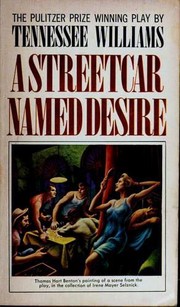
A Streetcar Named Desire is a play written by Tennessee Williams which was first performed on Broadway on December 3, 1947. The play dramatizes the experiences of Blanche DuBois, a former Southern belle who, after encountering a series of personal losses, leaves her once-prosperous situation to move into a shabby apartment in New Orleans rented by her younger sister Stella and brother-in-law Stanley.
Source: Wikipedia (CC BY-SA).
Historical Background
Tennessee Williams wrote A Streetcar Named Desire in the years following his 1944 breakthrough The Glass Menagerie, drawing on his own family history—his fragile sister Rose, his volatile parents—and his years in New Orleans, whose faded aristocratic gentility and raw immigrant vitality shape the play's setting. First performed on Broadway on December 3, 1947, directed by Elia Kazan and starring Marlon Brando as Stanley and Jessica Tandy as Blanche, it won the Pulitzer Prize for Drama and the New York Drama Critics' Circle Award. The play belongs to the Southern Gothic tradition, staging the collision between the Old South's decaying aristocratic myths, embodied by Blanche DuBois, and a brasher, working-class postwar America embodied by Stanley Kowalski. Williams was writing amid the emergence of American poetic realism in theatre, blending Chekhovian psychological nuance with expressionistic staging devices—lighting, music, sound—to externalize Blanche's disintegrating inner world. The postwar setting, with returning veterans like Stanley reshaping urban life, and the lingering trauma of the DuBois family's lost plantation, Belle Reve, root the play's social tensions in a specific moment of American transition from old agrarian order to new urban modernity.
The Story
Blanche DuBois, a former Southern belle whose family estate Belle Reve has been lost, arrives in New Orleans to stay with her younger sister Stella and Stella's husband Stanley Kowalski in their cramped French Quarter apartment. Blanche's genteel manners, fading beauty, and fragile pretensions clash with Stanley's blunt, physical world. Over a humid summer, Stanley grows suspicious of Blanche's account of losing Belle Reve and uncovers her hidden past in Laurel, Mississippi: dismissed from her teaching job for an affair with a student, and notorious at a local hotel. Meanwhile Blanche forms a tentative romance with Stanley's friend Mitch, hoping for a final chance at security, while also revealing to Stella the trauma behind her fragility—the suicide of her young husband after she discovered and condemned his homosexuality. Stanley exposes Blanche's past to Mitch, who abandons her. On the night Stella is in the hospital giving birth, Stanley rapes Blanche. When Stella returns, Blanche's account of the assault is disbelieved or suppressed, and the family, unwilling to accept that Stanley could have done this, has Blanche committed to a mental institution. The play ends with Blanche being led away by a doctor, uttering her famous line about depending on the kindness of strangers, while Stanley comforts Stella, and life in the Quarter continues.
Themes
- The decline of the Old South and its aristocratic illusions
- Desire and death as intertwined forces
- Fantasy versus reality/illusion versus truth
- Class conflict and social change in postwar America
- Fragility of female sexuality and vulnerability to male violence
- Madness and psychological disintegration
- Dependence on the kindness of others
- Light and concealment as strategies of self-protection
Literary Devices
- Symbolic naming — the streetcar lines 'Desire' and 'Cemeteries' map Blanche's trajectory from longing to destruction
- Expressionistic lighting and sound — polka music and revolver shots recur to signal Blanche's traumatic memory intruding on the present
- Poker night as social ritual — Stanley's card games stage raw masculine dominance against Blanche's refinement
- Symbolism of paper lanterns and dim light — Blanche's avoidance of direct light figures her flight from truth and aging
- Naturalistic dialect and stage directions — Williams's detailed setting descriptions function almost as authorial narration
- Foreshadowing through minor characters — the Mexican flower vendor and Blanche's fortune-telling scene presage her doom
- Contrast/juxtaposition of characters — Blanche and Stanley embody opposed value systems in near-allegorical tension
Symbolism
- The streetcar named Desire — the destructive, consuming force of sexual longing that brought Blanche to ruin
- Belle Reve ("beautiful dream") — the lost Old South, an idealized past that cannot survive modernity
- Paper lantern over the bare lightbulb — Blanche's attempt to soften and disguise harsh truth, especially her age and past
- Bathing — Blanche's repeated baths symbolize a futile attempt to cleanse herself of guilt and shame
- The Varsouviana polka — the tune playing at her husband's death, recurring in Blanche's mind as trauma resurfacing
Critical Interpretation
Early reviewers and later critics have read the play through multiple lenses. Psychoanalytic critics focus on Blanche's repression, hysteria, and the death drive underlying her desire. Feminist critics, including later scholars revisiting the play, have debated whether it exposes and critiques patriarchal violence against women or aestheticizes Blanche's victimization for dramatic effect, and have scrutinized the ambiguous, much-discussed staging of the rape and Stella's disbelief. Marxist and social-historical readings emphasize the play as a drama of class displacement, with Stanley representing an ascendant immigrant working class overturning the plantation aristocracy Blanche represents. Queer theory criticism, drawing on Williams's own biography, has examined the submerged presence of homosexuality in the backstory of Blanche's husband and its bearing on shame and concealment as structuring themes. Kazan's original direction and Brando's performance also generated a strand of criticism about how staging and star performance can shift audience sympathy toward Stanley despite the text's more critical framing of him.
Quotations
I don't want realism. I want magic!
Blanche to Mitch, articulating her preference for illusion over the truths of her past.
Whoever you are—I have always depended on the kindness of strangers.
Blanche's final line, spoken to the doctor as she is led away to the institution.
Influence
A Streetcar Named Desire helped establish American poetic realism as a major theatrical mode, influencing later playwrights such as Edward Albee and William Inge in their fusion of psychological intensity with heightened, symbolic staging. Its frank treatment of sexuality, mental illness, and domestic violence expanded what American drama could depict on stage, and Kazan's Method-inflected original production, with Brando's performance, reshaped American acting and directing practice for a generation. The play's central opposition of fading gentility against raw vitality became a durable template for Southern Gothic drama and fiction, and Blanche DuBois remains one of the most performed and reinterpreted female roles in the modern theatrical canon.
Adaptations
- A Streetcar Named Desire (1951 film), directed by Elia Kazan, starring Vivien Leigh and Marlon Brando
- A Streetcar Named Desire (opera by André Previn, libretto by Philip Littell), premiered at San Francisco Opera in 1998
- A Streetcar Named Desire (ballet by John Neumeier, also known as Endstation Sehnsucht), premiered with the Stuttgart Ballet in 1983
- Numerous major stage revivals, including Broadway and West End productions with actors such as Cate Blanchett, Gillian Anderson, and Jessica Lange as Blanche
Related Works
- The Glass Menagerie by Tennessee Williams
- Cat on a Hot Tin Roof by Tennessee Williams
- Death of a Salesman by Arthur Miller
- The Sound and the Fury by William Faulkner
- Long Day's Journey into Night by Eugene O'Neill
Curator's Notes
- 1Tennessee Williams won the Pulitzer Prize for Drama twice in his career: in 1948 for A Streetcar Named Desire and in 1955 for Cat on a Hot Tin Roof.
- 2Marlon Brando's performance as Stanley Kowalski in the original Broadway production and 1951 film is widely credited with popularizing Method acting in American cinema.
- 3Before settling on A Streetcar Named Desire, Williams considered other titles for the play, including The Poker Night, The Moth, and Blanche's Chair in the Moon; the eventual title drew on an actual New Orleans streetcar line named 'Desire.'
- 4Vivien Leigh, who played Blanche in the 1951 film, had also played Blanche onstage in London in 1949, directed by her husband Laurence Olivier.
For the Exam
UGC NET English frequently tests A Streetcar Named Desire on: its classification within Southern Gothic and American poetic realism; the Blanche–Stanley opposition as a symbol of Old South versus modern industrial America; the significance of the play's Pulitzer Prize and Kazan-Brando production; symbolism (streetcar names, Belle Reve, the paper lantern, the Varsouviana polka); the ambiguity of the final scene and Stella's complicity; and comparative questions pairing Williams with Arthur Miller or Eugene O'Neill on postwar American drama.