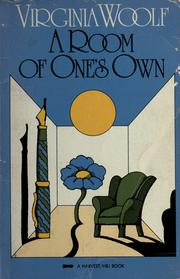
essay · 1929
A Room of One's Own
1929 essay by Virginia Woolf
- 1929
- essay
Summary
A Room of One's Own is an extended essay by Virginia Woolf, first published in 1929. Divided into six chapters, the work is based on two lectures Woolf delivered in October 1928 at two women's colleges, Newnham College and Girton College, of the University of Cambridge.
Source: Wikipedia (CC BY-SA).
Historical Background
Virginia Woolf composed A Room of One's Own (1929) from two lectures delivered in October 1928 to the Arts Society at Newnham College and to ODTAA at Girton College, Cambridge — the two women's colleges then admitting female students, who at the time could attend lectures but not receive full Cambridge degrees. Woolf revised and expanded the material into a single extended essay divided into six chapters, published by her own Hogarth Press. The book emerged during the interwar period, a decade after the Representation of the People Act (1918) had granted votes to some British women, and it reflects Woolf's Bloomsbury Group milieu of intellectual and artistic experimentation. Addressing the question "Women and Fiction," Woolf uses a fictional narrator, sometimes called "Mary Beton" or collectively "Mary," who wanders through Oxbridge and London libraries and streets, to dramatize the material and institutional obstacles facing women writers. The essay is a foundational text of feminist literary criticism, arguing that economic independence and private space are preconditions for women's creative achievement.
The Story
A Room of One's Own is not a narrative but a discursive essay structured as a quasi-fictional argument. A female narrator is invited to speak on "Women and Fiction" and instead traces her own thinking over two days. She visits an Oxbridge-like university, is turned away from a library because she is a woman, and contrasts the lavish lunch at a men's college with the meagre dinner at a women's college, using the disparity to illustrate unequal endowments and resources historically available to men versus women in intellectual life. She then moves to the British Museum in London to research why women have historically written so little, surveying male scholarship on women and finding it inadequate. Woolf invents the figure of Judith Shakespeare, an imagined sister of William Shakespeare with equal genius, to show how social constraint, lack of education, and domestic expectation would have destroyed such a woman's talent. She surveys the history of women's writing from Aphra Behn onward, discusses the Brontës, George Eliot, and Jane Austen, and considers the psychological and material conditions — privacy, leisure, and crucially money — necessary for artistic creation. The essay closes with the argument that a woman must have "a room of her own" and five hundred pounds a year to write fiction, and with an exhortation to women to take up the pen despite historical obstruction, envisioning the eventual emergence of a great woman poet.
Themes
- Economic independence as a precondition for creativity
- Gendered exclusion from education and institutions
- The material conditions of artistic production
- Recovering a lost female literary tradition
- Androgyny of the creative mind
- Silencing and erasure of women's voices in history
- The relationship between money, privacy, and freedom
Literary Devices
- Extended metaphor — the 'room of one's own' figures private space and autonomy as prerequisites for art
- Fictional persona/narrator — the invented 'Mary' figures allow Woolf to dramatize argument as personal experience
- Thought experiment — the imagined Judith Shakespeare illustrates structural barriers to female genius
- Stream-of-consciousness/associative digression — the essay moves fluidly between observation, memory, and reflection
- Irony and understatement — used to critique patriarchal institutions without direct polemic
- Rhetorical juxtaposition — contrasting scenes (rich men's college vs. poor women's college) to expose inequality
Symbolism
- The room — symbolizes privacy, autonomy, and creative space denied to women
- Judith Shakespeare — symbolizes the suppressed potential of women of genius throughout history
- The locked library — symbolizes institutional exclusion of women from knowledge and scholarship
- The unequal meals (lunch vs. dinner) — symbolize the material disparity in funding between men's and women's education
- The androgynous mind — symbolizes an ideal, non-gendered creative consciousness
Critical Interpretation
A Room of One's Own is regarded as a founding text of Anglo-American feminist literary criticism, influencing later critics such as Elaine Showalter, whose concept of "gynocriticism" builds on Woolf's project of recovering a female literary tradition, and Sandra Gilbert and Susan Gubar, whose Madwoman in the Attic engages Woolf's arguments about women's authorship. Feminist critics have praised the essay's materialist insistence that art depends on economic and social conditions, not merely talent. Some later critics, including voices within Black feminist and postcolonial criticism, have questioned the essay's narrow focus on a white, middle-class, university-educated woman's experience, noting its limited engagement with class and race. Woolf's concept of the "androgynous mind" has itself been debated, with some critics reading it as a liberating ideal and others as evasive of gendered specificity. The essay is also studied for its innovative blending of fiction, autobiography, and polemic, a hybrid form that anticipates later experimental feminist writing.
Quotations
A woman must have money and a room of her own if she is to write fiction.
The essay's central thesis, stated in Chapter One.
Lock up your libraries if you like; but there is no gate, no lock, no bolt that you can set upon the freedom of my mind.
The narrator's response to being barred from a university library.
Influence
A Room of One's Own became a cornerstone of twentieth-century feminist thought, shaping the development of feminist literary criticism from the 1970s onward, including the work of Elaine Showalter, Sandra Gilbert, and Susan Gubar. Its argument that material and economic conditions shape artistic production influenced subsequent feminist and materialist criticism more broadly. The essay's recovery of neglected women writers helped establish the project of reconstructing a female literary canon, and its central image of the "room of one's own" has become a widely invoked cultural shorthand for female autonomy and creative independence, referenced across later feminist writing, art, and popular discourse.
Related Works
- Three Guineas — Virginia Woolf
- Mrs Dalloway — Virginia Woolf
- To the Lighthouse — Virginia Woolf
- The Second Sex — Simone de Beauvoir
- The Madwoman in the Attic — Sandra Gilbert and Susan Gubar
- Jane Eyre — Charlotte Brontë
Curator's Notes
- 1The essay originated from two lectures Woolf gave in October 1928 at Newnham College and Girton College, Cambridge.
- 2It was first published by Woolf's own Hogarth Press, which she co-founded with her husband Leonard Woolf.
- 3The book is structured in six chapters and uses a fictional narrator, sometimes called 'Mary,' as a rhetorical device rather than presenting straightforward argument.
- 4The essay's invented figure 'Judith Shakespeare' has become a widely cited shorthand in feminist criticism for silenced female genius.
For the Exam
UGC NET frequently tests A Room of One's Own on its status as a founding feminist text: the thesis linking money and a room to female authorship, the Judith Shakespeare thought experiment, the concept of the 'androgynous mind,' and its historical context (the 1928 Cambridge lectures). Questions may ask about its genre (extended essay, not fiction), its six-chapter structure, its critique of patriarchal institutions like Oxbridge libraries, and its influence on later feminist critics such as Showalter and Gilbert and Gubar. Comparative questions may link it with Three Guineas or de Beauvoir's The Second Sex.