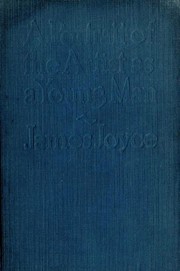
autobiographical novel · 1918
A Portrait of the Artist as a Young Man
by James Joyce
1918 autobiographical artist's novel and bildungsroman by James Joyce
- 1918
- autobiographical novel
- Künstlerroman
- Bildungsroman
Summary
A Portrait of the Artist as a Young Man is the second book and first novel of Irish writer James Joyce, published in 1916. A Künstlerroman written in a modernist style, it traces the religious and intellectual awakening of young Stephen Dedalus, Joyce's fictional alter ego, whose surname alludes to Daedalus, Greek mythology's consummate craftsman. Stephen questions and rebels against the Catholic and Irish conventions under which he has grown, culminating in his self-exile from Ireland to Europe. The work uses techniques that Joyce developed more fully in Ulysses (1922) and Finnegans Wake (1939).
Source: Wikipedia (CC BY-SA).
Historical Background
Joyce began the autobiographical novel Stephen Hero around 1904, then radically recast it as A Portrait of the Artist as a Young Man. It was serialized in Ezra Pound's magazine The Egoist from 1914 to 1915, and published in book form in 1916 (with a slightly later British edition in 1917/1918), making it Joyce's first published novel after the story collection Dubliners. The novel draws heavily on Joyce's own upbringing in Catholic, colonial Dublin: his Jesuit schooling at Clongowes Wood College and Belvedere College, his family's declining fortunes, and his eventual rejection of both Irish Catholicism and cultural nationalism in favor of art and self-imposed exile. Its five-chapter structure charts Stephen Dedalus's development from earliest childhood sensations through adolescent religious crisis to his final resolve to leave Ireland as a young artist. The book's free indirect style, which matures in complexity alongside its protagonist, marked a decisive step in Joyce's development of the techniques of psychological interiority he would push further in Ulysses. Pound championed the novel as a landmark of literary modernism.
The Story
The novel follows Stephen Dedalus from infancy to young adulthood in five chapters, each marking a stage of intellectual, religious, and artistic development. It opens with fragmented childhood memories and Stephen's early schooling at Clongowes Wood College, where he suffers an unjust punishment that becomes a formative memory of authority and injustice. As a teenager at Belvedere College, Stephen experiences the pull of sexual desire, visits prostitutes, and then undergoes an intense crisis of conscience after hearing a terrifying sermon on hell and judgment, which drives him into a period of extreme religious devotion. A priest later invites him to consider a vocation in the priesthood, but Stephen, walking along the strand, has an epiphany involving a girl wading in the water that convinces him his destiny lies in art rather than religion. In the final chapters, as a university student, Stephen develops his aesthetic theory, debating beauty, form, and the nature of art with friends, and gradually distances himself from family, church, and Irish nationalist politics. The novel closes with diary entries in which Stephen declares his intention to leave Ireland, seeking to "forge in the smithy of my soul the uncreated conscience of my race," embracing exile as the necessary condition for artistic creation.
Themes
- Coming of age and artistic self-discovery
- Conflict between religion and individual freedom
- Irish nationalism and the pressure of political loyalty
- Sin, guilt, and Catholic conscience
- Exile as creative and spiritual necessity
- Language, naming, and the artist's relation to his mother tongue
- Family and social constraint versus personal vocation
- Beauty and aesthetic theory
Literary Devices
- Free indirect discourse — narration adapts its vocabulary and syntax to Stephen's evolving age and consciousness
- Epiphany — Joycean moments of sudden spiritual or aesthetic revelation, most famously the bird-girl scene
- Bildungsroman/Künstlerroman structure — five-part chronological development of the artist's mind
- Stream of consciousness (incipient) — interior focus that anticipates Joyce's later technique in Ulysses
- Symbolic patterning of colors, birds, and water imagery tied to Stephen's psychological states
- Aesthetic theory as embedded discourse — Stephen's Thomist-inflected arguments on beauty function as authorial commentary
- Irony and detachment — the mature narrative voice subtly questions Stephen's self-mythologizing
Symbolism
- The bird-girl on the strand — art and beauty supplanting religious vocation
- Fire and hell imagery — the terror of sin and damnation instilled by the retreat sermon
- Birds and flight (Dedalus/Daedalus) — the artist's aspiration to escape confinement
- Green and maroon colors — competing loyalties to Irish nationalism (Parnell) versus church authority
- Water — purification, escape, and the threshold to artistic freedom
Critical Interpretation
Early readers, guided by Ezra Pound, praised the novel's formal innovation and its unsentimental rendering of consciousness, cementing Joyce's reputation as a modernist pioneer. Critics have long debated the reliability of the narrative voice: some read Stephen's final diary entries as a triumphant declaration of artistic vocation, while others, following a more ironic tradition of criticism, see Stephen's rhetoric as self-important and immature, arguing that Joyce distances himself from his youthful alter ego through subtle narrative irony. Psychoanalytic and biographical critics have examined the novel's close relation to Joyce's own adolescence and Jesuit education, while feminist critics have interrogated its treatment of women largely as symbolic objects (the bird-girl, the Virgin Mary, prostitutes) rather than fully realized subjects. Postcolonial critics read the novel's concern with language and Irish identity, especially Stephen's unease that English is "his language and yet not his," as central to its critique of colonial and religious authority. The novel is also studied as a technical bridge between the relatively conventional Dubliners and the radical experimentation of Ulysses.
Quotations
Welcome, O life! I go to encounter for the millionth time the reality of experience and to forge in the smithy of my soul the uncreated conscience of my race.
Stephen's diary entry near the novel's close, declaring his artistic vocation and impending exile
When the soul of a man is born in this country there are nets flung at it to hold it back from flight.
Stephen explains to Cranly his resolve to escape the nets of nationality, language, and religion
I will not serve that in which I no longer believe, whether it call itself my home, my fatherland, or my church.
Stephen's declaration of independence from family, nation, and church
Influence
A Portrait of the Artist as a Young Man established the modern Künstlerroman as a major form and demonstrated techniques of psychological narration that shaped subsequent modernist fiction. Its experiments with a narrative style that matures alongside its protagonist influenced writers exploring consciousness and interiority, and it directly prepared the ground for the more radical techniques of Ulysses. The novel's model of the artist-hero defined by alienation, exile, and aesthetic vocation became a touchstone for twentieth-century writers grappling with nationality, religion, and artistic identity, and it remains a foundational text in modernist studies and in postcolonial readings of Irish literature.
Adaptations
- A Portrait of the Artist as a Young Man (1977 film), directed by Joseph Strick, starring Bosco Hogan as Stephen Dedalus
Related Works
- Dubliners by James Joyce
- Ulysses by James Joyce
- Stephen Hero by James Joyce
- Sons and Lovers by D. H. Lawrence
- The Way of All Flesh by Samuel Butler
- Of Human Bondage by W. Somerset Maugham
Curator's Notes
- 1Stephen Dedalus's surname alludes to Daedalus, the mythical craftsman-artificer of Greek myth, foreshadowing Stephen's artistic destiny.
- 2The novel began as a much longer autobiographical manuscript, Stephen Hero, most of which Joyce discarded when reshaping it into Portrait.
- 3It was first serialized in the London literary magazine The Egoist, championed by Ezra Pound, before appearing as a book in 1916.
- 4Joyce reused and developed Stephen Dedalus as a central character in his later novel Ulysses.
- 5The novel's opening pages mimic a small child's fragmented perception and babyish language before gradually maturing in style.
For the Exam
UGC NET frequently tests this novel as a foundational modernist Künstlerroman/Bildungsroman: expect questions on its five-part structure, the technique of style matching Stephen's psychological age, the concept of "epiphany," the hell-sermon and religious crisis, Stephen's aesthetic theory (claritas, integritas, consonantia), the "nets" of nationality/language/religion, and the closing declaration about forging "the uncreated conscience of my race." Also expect comparison questions linking Portrait to Dubliners and Ulysses within Joyce's oeuvre.