comedy · 1600
A Midsummer Night's Dream
play by William Shakespeare
- 1600
- comedy
Summary
A Midsummer Night's Dream is a comedy play written by William Shakespeare between the years 1594 to 1596. The play is set in Athens, and consists of several subplots that revolve around the marriage of Theseus and Hippolyta. One subplot involves a conflict among four Athenian lovers. Another follows a group of six amateur actors rehearsing the play which they are to perform before the wedding. Both groups find themselves in a forest inhabited by fairies who manipulate the humans and are engaged in their own domestic intrigue. A Midsummer Night's Dream is one of Shakespeare's most popular and widely performed plays. Another subplot involves an argument between Titania, Queen of the Fairies and Oberon over an Indian changeling boy.
Source: Wikipedia (CC BY-SA).
Historical Background
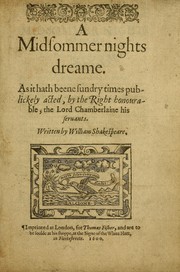
Shakespeare wrote A Midsummer Night's Dream in the mid-1590s (c. 1595-96), a fertile period that also produced Romeo and Juliet, with which it shares themes of love's irrationality. It may have been composed for an aristocratic wedding celebration, though it also entered the public repertoire at London playhouses. The play draws on classical sources — Ovid's Metamorphoses supplies the Pyramus and Thisbe story-within-the-story and Theseus's mythic background — while its fairy lore blends English folk tradition (Robin Goodfellow, i.e. Puck) with the literary fairy conventions being popularized in Elizabethan culture, notably by Edmund Spenser. Set nominally in ancient Athens, the play is thoroughly English in spirit, its enchanted wood evoking rural England's midsummer festivities, a season traditionally associated with supernatural mischief and folly. The play was first printed in quarto in 1600. It exemplifies Shakespeare's mature comic architecture, interlacing four distinct social worlds — the ducal court, the young lovers, the amateur actors ("mechanicals"), and the fairy kingdom — that converge through the forest's transformative magic. It also showcases his growing skill at modulating verse and prose registers, from courtly blank verse to the mechanicals' comic prose and the fairies' lyrical songs.
The Story
Duke Theseus of Athens prepares to marry Hippolyta, Queen of the Amazons. Egeus demands that his daughter Hermia marry Demetrius, though she loves Lysander; Theseus upholds Athenian law, giving Hermia until the wedding to comply or face death or lifelong chastity. Hermia and Lysander resolve to elope through the forest; Hermia confides in her friend Helena, who loves Demetrius and betrays the plan to him hoping to win his favor. All four lovers pursue one another into the woods. Meanwhile, a group of Athenian tradesmen ("mechanicals"), led by the weaver Bottom, rehearse a play, "Pyramus and Thisbe," to perform at the royal wedding. In the forest, fairy king Oberon and queen Titania are quarreling over a changeling boy in Titania's train. Oberon orders his sprite Puck to fetch a magic flower whose juice, applied to sleeping eyes, causes the sleeper to fall in love with the first creature seen upon waking. Oberon uses it on Titania and instructs Puck to help the Athenian lovers, but Puck mistakes Lysander for Demetrius, causing chaos as both men come to love Helena and abandon Hermia. Titania, enchanted, falls in love with Bottom, whose head Puck has transformed into that of an ass. Oberon eventually reverses the spells, reconciling Titania and restoring the lovers to their proper pairs — Lysander with Hermia, Demetrius (left under the flower's influence) with Helena. The couples marry alongside Theseus and Hippolyta, and the mechanicals perform their gloriously inept "Pyramus and Thisbe" as wedding entertainment. Puck closes the play with an epilogue suggesting the entire experience may have been a dream.
Themes
- The irrationality and instability of romantic love
- Illusion versus reality, dream versus waking
- Order versus disorder (court/law versus forest/magic)
- Transformation and metamorphosis
- Gender and power in courtship and marriage
- Art and theatrical illusion (the play-within-the-play)
- The disruptive power of imagination
- Reconciliation and the restoration of social harmony
Literary Devices
- Play-within-a-play — the mechanicals' "Pyramus and Thisbe" comically mirrors and parodies the main lovers' plot
- Dramatic irony — the audience knows of Puck's magic and mistakes while the lovers do not
- Symmetry and doubling — paired lovers, paired royal couples (Theseus/Hippolyta and Oberon/Titania), and mirrored plots structure the comedy
- Blank verse and prose register-shifting — courtly and fairy speech in verse, mechanicals' speech in prose, marking social and tonal distinctions
- Metatheatre — the play repeatedly draws attention to its own theatrical artifice, culminating in Puck's epilogue
- Pastoral/forest setting as a liminal space of transformation, contrasted with the ordered city of Athens
- Comic mismatched-pair device — the love-juice plot generates farcical reversals of affection
Symbolism
- The forest — a liminal, magical space of desire, disorder, and transformation outside civic law
- The love-juice flower — the irrational, involuntary nature of romantic attraction
- The ass's head (Bottom's transformation) — the absurdity and blindness of love, and the gap between appearance and worth
- The moon — recurring symbol of changeability, chastity, and the governing rhythm of the lovers' timeframe
- Dreams — the blurred boundary between illusion and truth, offered as a frame for reconciling the play's strangeness
Critical Interpretation
Criticism has long focused on the play's exploration of love as an irrational, almost involuntary force, with the love-juice plot read as a comic literalization of desire's arbitrariness. Feminist critics have examined the patriarchal structures framing the action — Egeus's authority over Hermia, Theseus's conquest of Hippolyta, and Oberon's domination of Titania — questioning how far the comic resolution truly restores harmony versus reasserting male control. Psychoanalytic and myth-critical readings, following the tradition associated with Northrop Frye's work on comic structure, treat the forest as a "green world" enabling psychological release and social renewal before the return to ordered society. Jan Kott's influential twentieth-century interpretation stressed the play's darker, more erotic and unsettling undercurrents, challenging earlier readings of the play as purely charming fantasy. Theatrical and metatheatrical criticism examines the mechanicals' play as a self-reflexive commentary on the nature of dramatic illusion and audience credulity, while the epilogue's framing of events as possibly a "dream" has generated extensive debate about how seriously the play's magic and transformations should be taken.
Quotations
The course of true love never did run smooth.
Lysander to Hermia, articulating the play's central theme of love's obstacles.
Lord, what fools these mortals be!
Puck, commenting with amusement on the lovers' confused, magic-induced quarrels.
The lunatic, the lover, and the poet / Are of imagination all compact.
Theseus, reflecting on the kinship between madness, love, and poetic creation.
If we shadows have offended, / Think but this, and all is mended, / That you have but slumbered here / While these visions did appear.
Puck's closing epilogue, framing the play's events as a possible dream.
Influence
A Midsummer Night's Dream established enduring conventions of fairy fantasy and comic forest-set romance that echo through later literature, from Romantic-era fairy poetry to Victorian illustrated fantasy and modern fantasy fiction's depiction of enchanted woods and mischievous sprites. Its play-within-a-play structure influenced subsequent metatheatrical drama, and its treatment of love's irrationality shaped later comic and romantic literature exploring desire's unpredictability. The character of Puck became an archetype for the trickster fairy figure in English literary and popular culture. The play has also been a touchstone for composers (notably inspiring orchestral and operatic settings) and remains one of the most frequently adapted and quoted of Shakespeare's comedies in English-language culture.
Adaptations
- Felix Mendelssohn's incidental music and overture, A Midsummer Night's Dream (1826/1843)
- Benjamin Britten's opera A Midsummer Night's Dream (1960)
- Max Reinhardt and William Dieterle's film A Midsummer Night's Dream (1935)
- Michael Hoffman's film William Shakespeare's A Midsummer Night's Dream (1999)
Related Works
- Romeo and Juliet by William Shakespeare
- As You Like It by William Shakespeare
- The Tempest by William Shakespeare
- Metamorphoses by Ovid
- The Faerie Queene by Edmund Spenser
Curator's Notes
- 1The play interweaves four distinct groups of characters — the Athenian court, the young lovers, the amateur actors, and the fairies — who converge in the forest.
- 2The mechanicals' play "Pyramus and Thisbe" is itself drawn from a story in Ovid's Metamorphoses, making it a play-within-a-play based on a real classical source.
- 3Puck's alternate name, Robin Goodfellow, derives from genuine English folklore predating Shakespeare's play.
- 4The play was first printed in quarto form in 1600.
- 5Bottom's transformation into a creature with an ass's head is one of English literature's most famous comic metamorphoses.
For the Exam
UGC NET frequently tests A Midsummer Night's Dream on its genre classification as a romantic comedy, its structural device of interlaced plots (court, lovers, mechanicals, fairies), and its use of the play-within-a-play. Expect questions on character identification (Puck/Robin Goodfellow, Oberon, Titania, Bottom), the significance of the forest as a space of transformation, and the meaning of the love-juice/flower device. Quotation-based questions often draw on "The course of true love never did run smooth" and "Lord, what fools these mortals be!" Candidates should also know the play's approximate composition date (mid-1590s) and its place among Shakespeare's comedies alongside As You Like It and Twelfth Night.