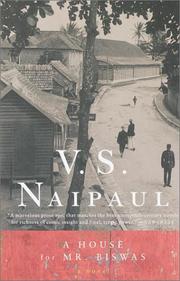
1961
A House for Mr Biswas
1961 novel by V. S. Naipaul
- 1961
- ◆ Nobel-winning author
Summary
A House for Mr Biswas is a 1961 novel by V. S. Naipaul, significant as Naipaul's first work to achieve acclaim worldwide. It is the story of Mohun Biswas, a Hindu Indo-Trinidadian who continually strives for success and mostly fails, who marries into the influential Tulsi family only to find himself dominated by it, and who finally sets the goal of owning his own house. It relies on some biographical elements from the experience of the author's father.
Source: Wikipedia (CC BY-SA).
Historical Background
V. S. Naipaul, born in Trinidad to a family of Indian indentured-labourer descent, drew for this novel on the frustrated ambitions of his own father, Seepersad Naipaul, a journalist and writer. It was Naipaul's fourth book and the one that established his international reputation. Naipaul had by then settled in England, writing from a position of exile about the Indo-Caribbean Hindu community of colonial Trinidad in the first half of the twentieth century — a world shaped by the legacy of indentured labour, extended joint-family structures, and colonial economic marginality. He drew on family letters and recollections of his father's life, though the novel remains a work of imaginative fiction rather than direct biography. Published in 1961, it appeared during a period of postwar decolonization reshaping the Caribbean, and as Naipaul was emerging as a major voice alongside contemporaries such as Samuel Selvon and George Lamming in the developing tradition of Anglophone Caribbean fiction. The novel is widely regarded as one of the finest novels in English of the twentieth century. Its central concern — an individual's struggle for autonomy, dignity, and self-possession against a stifling extended family and a precarious colonial economic order — reflects both personal material and broader postcolonial anxieties about identity, displacement, and belonging in a society still defined by the aftermath of empire and migration.
The Story
The novel follows Mohun Biswas from his unlucky birth in rural Trinidad, through poverty and drift, to his lifelong quest for independence and a home of his own. Orphaned early when his father drowns, Biswas is passed among relatives before training as a sign painter. A chance flirtation leads him into marriage with Shama, daughter of the large, domineering Tulsi family, and he is absorbed into their household at Hanuman House, where he becomes one of many sons-in-law subordinated to the matriarch Mrs Tulsi and her sons, losing his independence in the collective family enterprise. Chafing against this dependency, Biswas moves through a series of occupations and residences — running a shop at The Chase, overseeing a Tulsi sugar estate at Green Vale, working as a journalist in Port of Spain, and later as a minor civil servant — each attempt at self-sufficiency undermined by poverty, bad luck, his own volatility, and the Tulsis' pervasive control. Repeated attempts to build or acquire a house of his own end in failure, humiliation, or disaster, including a mental breakdown after a disastrous spell at Green Vale. Amid domestic strife, Biswas and Shama raise four children, and his relationship with his son Anand, whose education he prizes, becomes central to his hopes for a different, freer future. Late in life, in a moment of reckless triumph, Biswas buys a shoddily built, overpriced house in Port of Spain, saddling himself with debt. The novel closes after his early death, with the house — flawed but finally his own — standing as the imperfect fulfillment of a lifelong need for a place of self-possession.
Themes
- The search for identity and self-possession
- Colonialism and the Indo-Caribbean diaspora
- Family, dependency, and the extended household
- The house as symbol of autonomy and dignity
- Fate, superstition, and determinism
- Poverty and economic precarity
- Education as a path to freedom
- Exile and displacement
Literary Devices
- Tragicomic irony — Biswas's misfortunes are rendered with comic absurdity that deepens rather than undercuts their pathos
- Episodic structure — the narrative moves through a sequence of houses and occupations, each a fresh attempt and failure
- Free indirect discourse — the narration moves close to Biswas's consciousness while retaining ironic distance
- Symbolic naming and setting — houses (Hanuman House, The Chase, Green Vale) embody stages of Biswas's dependency and struggle
- Prologue-and-flashback frame — the novel opens near Biswas's death before tracing his life from birth
- Satire of family and social hierarchy — the Tulsi household exposes the comic tyranny of extended-family politics
Symbolism
- The house — autonomy, dignity, and self-possession against dependency and colonial dispossession
- Hanuman House — the oppressive weight of extended family and tradition
- Sign-painting and writing — Biswas's inarticulate creative and intellectual aspirations
- Green Vale and the unfinished house there — the fragility and danger of premature independence
Critical Interpretation
Critics have long read the novel as a foundational text of postcolonial literature, praised for its unsentimental yet deeply humane portrait of a colonized individual's struggle for selfhood within both family and empire. Many locate it in the tradition of the great nineteenth-century social novel while noting its distinctly Caribbean comic idiom, derived partly from oral and calypso traditions of Trinidad. Some critics, including later postcolonial scholars, have debated Naipaul's ambivalent, sometimes unflattering, treatment of the Indo-Caribbean and broader "Third World" communities he depicts, a tension that runs through readings of his later nonfiction and fiction alike. Others emphasize the novel's deep affection for its protagonist and its rootedness in Naipaul's own family history, arguing that its irony is ultimately sympathetic rather than contemptuous. The novel's tragicomic mode — finding both absurdity and dignity in Biswas's repeated failures — has been central to discussions of Naipaul's narrative voice. It is frequently discussed alongside the broader emergence of Caribbean and postcolonial literature in English in the mid-twentieth century, and its exploration of home, displacement, and inherited colonial structures has made it a touchstone text in postcolonial studies.
Quotations
How terrible it would have been, at this time, to be without it: to have died among the Tulsis, amid the squalor of that large, disintegrating and indifferent family; to have left Shama and the children among them, in one room; worse, to have lived without even attempting to lay claim to one's portion of the earth; to have lived and died as one had been born, unnecessary and unaccommodated.
From the novel's closing reflections, articulating the meaning of the house as Biswas's claim to dignity and existence.
Influence
A House for Mr Biswas established Naipaul as a major international literary figure and is regarded as a foundational work of postcolonial and Caribbean fiction in English. It helped open space for later generations of writers exploring diaspora, colonial legacy, and postcolonial identity, and is frequently cited as an influence on subsequent Indo-Caribbean and South Asian diaspora writers. Its blend of tragicomic realism and deep psychological interiority within a colonial setting has been seen as a model for postcolonial domestic fiction more broadly. The novel's reputation grew steadily after publication, and it is now widely taught as a central text in postcolonial literature courses and commonly cited among the essential English-language novels of the twentieth century, cementing Naipaul's subsequent career, including his 2001 Nobel Prize in Literature.
Related Works
- Miguel Street — V. S. Naipaul
- The Mystic Masseur — V. S. Naipaul
- A Bend in the River — V. S. Naipaul
- The Lonely Londoners — Samuel Selvon
- In the Castle of My Skin — George Lamming
Curator's Notes
- 1The novel draws substantially on the life of Naipaul's own father, Seepersad Naipaul, a journalist and writer in Trinidad.
- 2It was V. S. Naipaul's fourth published book and the one that brought him widespread international recognition.
- 3Naipaul went on to win the Nobel Prize in Literature in 2001.
- 4The novel is frequently ranked among the best English-language novels of the twentieth century by critics and literary publications.
For the Exam
UGC NET commonly tests A House for Mr Biswas as a landmark postcolonial and Caribbean novel: candidates should know its author V. S. Naipaul, its 1961 publication date, its autobiographical basis in Naipaul's father, and its status as his breakthrough work. Expect questions on the protagonist Mohun Biswas, the Tulsi family and Hanuman House, the symbolism of the house as autonomy and self-possession, and the novel's place within postcolonial literature alongside Naipaul's other works and Caribbean contemporaries like Selvon and Lamming. Naipaul's 2001 Nobel Prize is often linked in questions about his career.